Strategic Leadership in Indian Markets
Navigating Growth, Complexity, and Global Competitiveness
By Devanssh Mehta
Navigating Growth, Complexity, and Global Competitiveness
By Devanssh Mehta
1. Introduction: Strategic Leadership in the Era of India’s Economic Rise
India today stands at a pivotal moment in its economic and institutional evolution. Over the past three decades, the country has undergone a remarkable transformation—from a relatively closed, state-controlled economy to one of the most vibrant and dynamic market systems in the world. Liberalization reforms initiated in 1991 dismantled many structural barriers to growth, opened domestic industries to international competition, and catalyzed the emergence of a new generation of entrepreneurs and corporate leaders. In this environment of rapid transformation, strategic leadership has emerged as one of the most critical determinants of organizational success and national economic progress.
Strategic leadership differs fundamentally from traditional managerial leadership. While management often focuses on operational efficiency and routine decision-making, strategic leadership requires the capacity to anticipate future trends, manage uncertainty, and align organizational objectives with long-term economic and societal transformations. In the Indian context, this form of leadership assumes even greater significance because the country’s markets are characterized by demographic diversity, regulatory complexity, technological disruption, and geopolitical relevance.
Indian markets represent a paradoxical blend of opportunity and challenge. On one hand, the country possesses a massive consumer base, rapidly expanding digital infrastructure, and a young workforce eager to participate in economic growth. On the other hand, businesses must navigate a regulatory environment that is continuously evolving, infrastructure gaps that remain uneven across regions, and competitive pressures from global corporations with substantial financial resources.
Within this landscape, strategic leadership becomes the intellectual compass guiding organizations through complexity. Leaders must not only understand the internal capabilities of their firms but also interpret broader economic signals—policy changes, technological disruptions, consumer behavior shifts, and global market dynamics. Those who succeed in Indian markets are rarely those who merely react to change; instead, they are individuals capable of anticipating change and shaping it to their advantage.
This essay examines the nature, principles, and future trajectory of strategic leadership in Indian markets. It explores how leadership philosophies have evolved in response to economic reforms, technological revolutions, and global competition. Furthermore, it analyzes the competencies required for leaders to sustain competitive advantage in India’s rapidly changing economic landscape.
2. Historical Evolution of Leadership in Indian Markets
To understand the contemporary dynamics of strategic leadership in India, it is essential to examine the historical evolution of the country’s economic institutions and corporate culture.
2.1 The Pre-Liberalization Era: Leadership under the License Raj
Before the economic reforms of the early 1990s, India’s industrial structure was governed by a system widely known as the License Raj. Under this framework, businesses were required to obtain numerous government approvals to establish or expand industrial operations. Production quotas, import restrictions, and strict regulatory controls characterized the business environment.
Leadership during this era was largely defined by the ability to navigate bureaucratic systems rather than by innovation or competitive differentiation. Corporate success often depended on cultivating relationships with regulatory authorities, securing industrial licenses, and complying with government planning directives. As a result, many organizations focused more on survival within regulatory constraints than on strategic growth or technological advancement.
While this system limited entrepreneurial dynamism, it also shaped a generation of industrial leaders who developed extraordinary resilience and adaptability. Companies that survived within the License Raj learned to operate within complex institutional frameworks, skills that later proved valuable when India entered the global marketplace.
2.2 Economic Liberalization and the Birth of Strategic Leadership
The economic reforms introduced in 1991 fundamentally transformed India’s economic trajectory. Trade barriers were reduced, foreign direct investment was encouraged, and many industries were deregulated. Indian companies suddenly faced competition from multinational corporations possessing advanced technologies and global supply chains.
This shift demanded a new form of leadership. Organizations could no longer rely on regulatory protection; they needed to compete on the basis of innovation, efficiency, and global competitiveness. Strategic leadership thus became a necessity rather than an optional managerial capability.
Indian corporate leaders began adopting international management practices, investing in research and development, and expanding into global markets. The emergence of sectors such as information technology, pharmaceuticals, and telecommunications demonstrated the transformative power of strategic vision combined with entrepreneurial courage.
3. Structural Characteristics of Indian Markets
Indian markets possess unique structural characteristics that significantly influence leadership strategies. These characteristics create both opportunities and constraints for organizations operating within the country.
3.1 Demographic Diversity
India is home to more than 1.4 billion people, representing one of the most diverse consumer populations in the world. Cultural traditions, linguistic variations, and economic disparities shape consumer preferences across different regions. Strategic leaders must therefore design business models capable of addressing multiple market segments simultaneously.
Products and services that succeed in metropolitan cities may require entirely different pricing, marketing, and distribution strategies in rural areas. Leaders must develop multi-tiered market approaches that recognize the heterogeneity of Indian consumers.
3.2 Rapid Digital Transformation
Over the past decade, India has experienced an extraordinary digital revolution. Affordable smartphones and widespread internet connectivity have enabled millions of citizens to participate in digital commerce and financial transactions. Government initiatives promoting digital payments and online services have further accelerated this transformation.
Strategic leadership must therefore incorporate digital technologies into core business strategies. Companies that fail to adapt to digital ecosystems risk losing relevance in a market increasingly driven by data, automation, and platform-based business models.
3.3 Policy and Regulatory Dynamics
India’s regulatory environment continues to evolve as policymakers attempt to balance economic growth with social welfare objectives. Changes in taxation systems, environmental regulations, data governance frameworks, and foreign investment policies frequently reshape industry dynamics.
Strategic leaders must therefore develop institutional awareness, enabling them to anticipate policy shifts and align corporate strategies with national development priorities.
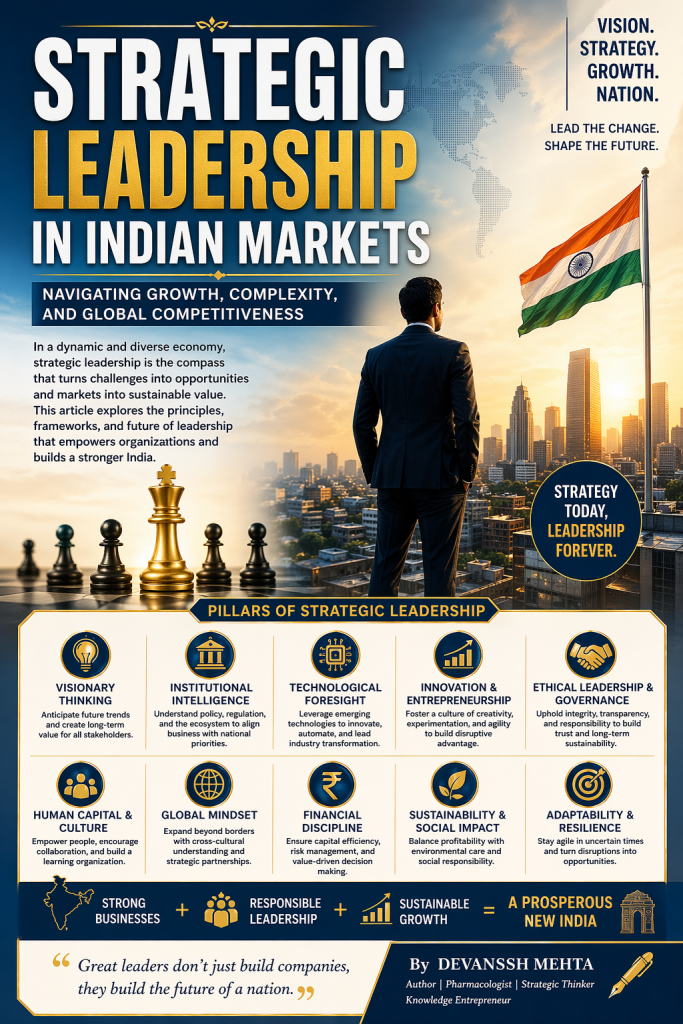
4. The Strategic Leadership Framework
Effective leadership in Indian markets requires a comprehensive framework integrating multiple competencies.
4.1 Visionary Thinking
Strategic leaders possess the ability to envision long-term opportunities beyond immediate operational concerns. Visionary thinking enables organizations to identify emerging industries, technological disruptions, and changing consumer needs before they become obvious to competitors.
In India, sectors such as renewable energy, biotechnology, digital healthcare, and artificial intelligence represent areas where visionary leadership can create transformative economic value.
4.2 Strategic Adaptability
Indian markets evolve rapidly. Consumer preferences change quickly, regulatory environments shift, and technological innovations continuously reshape competitive landscapes. Leaders must therefore cultivate strategic adaptability, the capacity to modify organizational strategies without compromising long-term objectives.
Adaptability often involves organizational restructuring, technological adoption, and continuous learning.
4.3 Institutional Intelligence
Successful leaders understand the broader institutional ecosystem within which their organizations operate. Institutional intelligence includes knowledge of regulatory frameworks, public policy objectives, and governmental priorities.
In India, businesses often interact closely with government initiatives related to infrastructure development, digital governance, and industrial policy. Leaders who align corporate strategies with these initiatives can create mutually beneficial partnerships between private enterprise and public institutions.
5. Entrepreneurship and Innovation in Indian Markets
Entrepreneurship has become a defining feature of India’s economic transformation. The rise of startup ecosystems across major cities has generated unprecedented levels of innovation and technological experimentation.
Entrepreneurial leaders typically demonstrate characteristics such as risk tolerance, creativity, and rapid decision-making. These qualities enable startups to challenge established industries and introduce disruptive technologies.
Indian startups have achieved global recognition in areas such as financial technology, e-commerce, education technology, and health technology. Many of these enterprises emerged from the vision of leaders who recognized opportunities within India’s unique socio-economic environment.
Large corporations have also begun adopting entrepreneurial strategies by establishing innovation laboratories, venture capital funds, and collaborative research programs. Strategic leadership therefore increasingly involves creating organizational cultures that encourage experimentation and innovation.
6. Corporate Governance and Ethical Responsibility
Strategic leadership cannot be sustained without strong ethical foundations. Corporate governance ensures that organizations operate transparently, responsibly, and in alignment with stakeholder interests.
In India, governance reforms have strengthened accountability mechanisms, requiring companies to adhere to strict financial reporting standards and regulatory compliance frameworks. Ethical leadership includes responsible financial management, environmental sustainability, and respect for employee welfare.
Organizations that demonstrate ethical integrity often gain the trust of investors, consumers, and policymakers. In contrast, companies that neglect governance principles may achieve short-term gains but risk long-term reputational damage.
7. Technology as a Strategic Catalyst
Technology has become the central driver of competitive advantage in modern markets. Artificial intelligence, data analytics, automation, and biotechnology are transforming industries ranging from healthcare to manufacturing.
Strategic leaders must evaluate how emerging technologies can enhance productivity, reduce operational costs, and create new market opportunities. Digital platforms enable organizations to reach customers more efficiently, while data analytics allows companies to understand consumer behavior with unprecedented precision.
Technology adoption also requires investment in workforce development. Employees must acquire new skills in areas such as digital analytics, cybersecurity, and technological innovation. Leaders must therefore prioritize continuous learning and skill development within their organizations.
8. Globalization and International Expansion
Indian companies are increasingly expanding beyond domestic markets. Globalization provides access to larger customer bases, advanced technologies, and international partnerships. However, international expansion also introduces new challenges related to cultural differences, regulatory compliance, and geopolitical uncertainties.
Strategic leadership in global markets requires cross-cultural understanding and the ability to manage multinational teams. Leaders must also navigate international trade policies and supply chain complexities.
Indian corporations that successfully expand globally enhance the country’s economic influence and contribute to the development of globally competitive industries.
9. Human Capital and Organizational Culture
Human capital remains one of the most valuable resources for organizations operating in knowledge-driven economies. India possesses a large pool of skilled professionals in fields such as engineering, information technology, and pharmaceutical sciences.
Strategic leaders must cultivate organizational cultures that encourage collaboration, innovation, and intellectual curiosity. Companies that prioritize employee development often achieve higher productivity and greater organizational resilience.
Leadership therefore involves not only directing organizational activities but also inspiring individuals to pursue excellence and contribute to collective success.
10. Strategic Leadership and National Development
The role of corporate leadership extends beyond individual firms. Business decisions influence employment generation, technological progress, and national economic growth.
Responsible leaders recognize that sustainable economic development requires balancing profitability with social responsibility. Investments in infrastructure, education, healthcare, and environmental sustainability contribute to broader societal well-being.
In emerging economies such as India, the relationship between business leadership and national development is particularly significant. Strategic leaders therefore function not merely as corporate executives but also as architects of economic transformation.
11. Challenges Facing Strategic Leaders in India
Despite significant opportunities, leaders in Indian markets confront numerous challenges.
Infrastructure gaps remain uneven across regions, affecting logistics and supply chains. Regulatory procedures can sometimes create bureaucratic delays. Additionally, intense competition from both domestic and international firms requires constant innovation.
Leaders must also address societal expectations regarding environmental sustainability and corporate responsibility. As public awareness of social issues increases, organizations are expected to demonstrate ethical commitment and community engagement.
12. The Future of Strategic Leadership in India
The coming decades will likely witness profound changes in India’s economic landscape. Technological innovations, demographic shifts, and geopolitical developments will redefine competitive dynamics across multiple industries.
Future leaders must cultivate systems thinking, recognizing that economic, technological, and societal factors are interconnected. They must also demonstrate resilience in the face of uncertainty, as global markets become increasingly volatile.
Education systems must therefore emphasize leadership development, interdisciplinary thinking, and entrepreneurial skills. The next generation of Indian leaders will need to integrate technological expertise with ethical judgment and strategic foresight.
Conclusion
Strategic leadership represents the intellectual foundation upon which successful organizations are built. In the context of Indian markets, leadership must operate within an environment characterized by demographic diversity, regulatory dynamism, technological disruption, and global competition.
Leaders who succeed in this environment are those capable of combining visionary thinking, institutional awareness, technological competence, and ethical responsibility. They must anticipate future trends while maintaining operational discipline and organizational resilience.
As India continues its transformation into a global economic powerhouse, strategic leadership will play an increasingly vital role in shaping industries, guiding innovation, and promoting sustainable development. Organizations led by visionary and responsible leaders will not only achieve commercial success but also contribute to the broader progress of Indian society.
In the final analysis, strategic leadership in Indian markets is not merely about corporate profitability; it is about building institutions capable of advancing economic prosperity, technological innovation, and societal well-being for generations to come.