
The Next Era of Cancer Care: From Treatment to Intelligent, Precision, and Preventive Oncology
Author Devanssh Mehta Mode
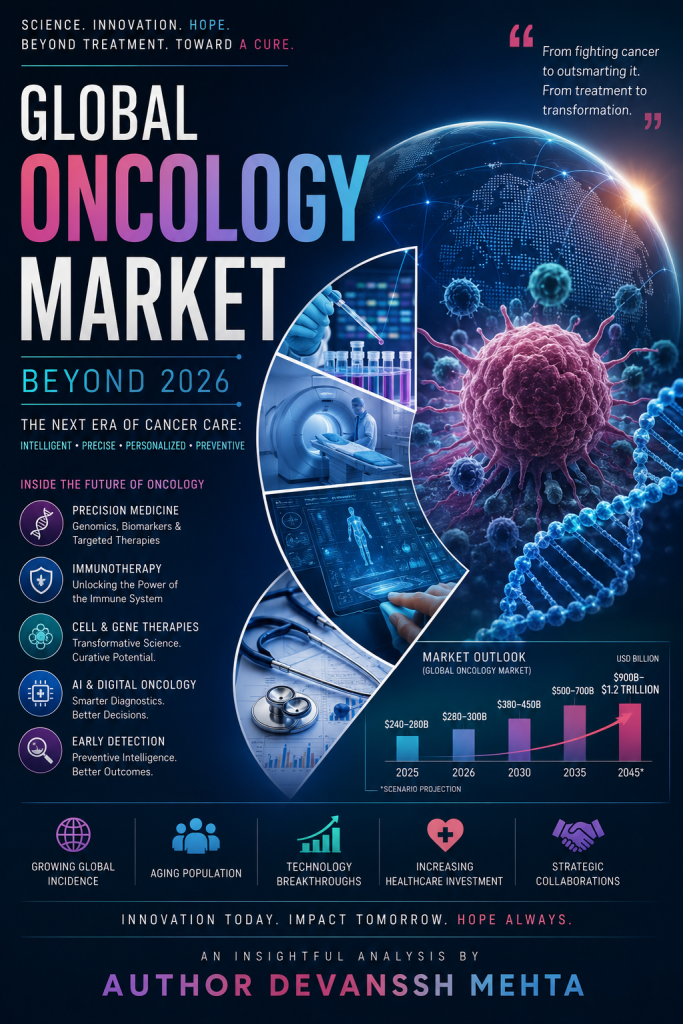


Cancer is no longer only a disease challenge.
It has become one of humanity’s largest scientific, economic, technological, and societal transformations.
For more than a century, oncology evolved through sequential revolutions—surgery, radiation, chemotherapy, targeted therapy, and immunotherapy. Yet the decades beyond 2026 may represent something fundamentally different: the movement from reactive cancer treatment toward predictive, personalized, continuously monitored cancer management.
The global oncology industry is entering an era where the value chain extends far beyond pharmaceuticals.
The future oncology economy will increasingly include:
- Precision therapeutics
- Molecular diagnostics
- AI-enabled clinical decision systems
- Cell and gene therapies
- Biomarker platforms
- Digital oncology ecosystems
- Early detection technologies
- Preventive cancer intelligence
Industry forecasts consistently indicate rapid expansion across oncology therapeutics, diagnostics, biomarkers, and precision medicine through the next decade. (Fortune Business Insights)
This article explores the growth potential, technological transformation, strategic outlook, and future architecture of the global oncology market beyond 2026.
1. The Scale of the Opportunity: Oncology as a Mega-Market
The oncology industry has entered a period of structural expansion.
Multiple forecasts estimate global oncology-related revenues reaching several hundred billion dollars over the next decade.
Recent market projections indicate:
- Global oncology market approximately US$250–290 billion in 2025–2026
- Potential expansion toward US$480–700 billion by 2034–2035
- Sustained CAGR commonly projected in the 7–12% range, depending on segment definitions. (Nova One Advisor)
This growth trajectory is being shaped by four forces:
- Rising cancer incidence
- Aging populations
- Technology-driven therapeutic expansion
- Greater healthcare investment globally
Figure 1 — Illustrative Global Oncology Market Outlook
| Year | Estimated Market Range |
|---|---|
| 2025 | US$240–280 Billion |
| 2026 | US$280–300 Billion |
| 2030 | US$380–450 Billion |
| 2035 | US$500–700 Billion |
| 2045 (Scenario Projection) | US$900 Billion–US$1.2 Trillion |
2035+ values represent scenario projections synthesized from current industry trajectories and not official forecasts.
Sources: (Fortune Business Insights)
2. The Epidemiological Engine Behind Market Growth
The oncology market grows because biology and demography are changing simultaneously.
Major contributors include:
Population aging
Cancer incidence rises substantially with age.
Urban lifestyles
Risk factors include:
- Sedentary behavior
- Obesity
- Tobacco
- Alcohol
- Environmental exposure
Longer survival
Cancer increasingly behaves as a chronic managed condition.
Improved detection
More cancers are diagnosed earlier.
This creates a paradox:
Better diagnosis initially increases case identification but ultimately improves outcomes.
3. The Evolution of Oncology: Five Eras of Cancer Treatment
Era 1 — Surgical Oncology
Removing visible disease.
Era 2 — Radiation Oncology
Precision destruction of localized tumors.
Era 3 — Chemotherapy
Systemic intervention.
Era 4 — Targeted Oncology
Molecular pathway interruption.
Era 5 — Intelligent Oncology (Beyond 2026)
Continuous prediction.
Integrated treatment.
Personalized intervention.
This transition may become the defining medical shift of the century.
4. Precision Oncology: The Core Growth Driver


Precision oncology is reshaping treatment selection.
Instead of asking:
“What cancer does the patient have?”
Modern oncology increasingly asks:
“What molecular profile does the tumor have?”
The precision oncology market alone was estimated at approximately US$115.8 billion in 2024 and projected to exceed US$200 billion by 2030. (Grand View Research)
Key technologies:
- Genomic sequencing
- Multi-omics
- Biomarker stratification
- Companion diagnostics
- AI-guided therapy selection
Clinical implications:
- Better efficacy
- Reduced toxicity
- Improved outcomes
5. Immunotherapy: Redefining Cancer Medicine
Immunotherapy changed oncology economics.
Instead of directly attacking tumors:
The immune system becomes the therapeutic platform.
Major growth areas:
- Immune checkpoint inhibitors
- Personalized vaccines
- Tumor microenvironment modulation
- Combination immunotherapy
Commercial momentum remains strong as large pharmaceutical companies continue prioritizing oncology pipelines and launches through 2030. (Reuters)
6. Cell and Gene Therapy: The New Biological Frontier
Perhaps the most transformative oncology segment beyond 2026.
Emerging modalities:
- CAR-T
- TCR therapies
- Gene-edited oncology platforms
- In vivo cellular engineering
Major biopharmaceutical investment activity increasingly reflects expectations that next-generation oncology platforms may reshape future revenue pools. (Barron’s)
Expected consequences:
Higher cure potential.
Higher development complexity.
New reimbursement models.
7. Diagnostics May Become Bigger Than Drugs
Historically:
Treatment captured attention.
Future oncology may elevate diagnosis.
Cancer diagnostics projections estimate market expansion toward approximately US$155 billion by 2030, supported by screening and molecular technologies. (Grand View Research)
Key areas:
Liquid biopsy
Single blood sample.
Multi-cancer detection.
Molecular pathology
Tumor fingerprinting.
Digital pathology
AI-enhanced interpretation.
Continuous monitoring
Cancer surveillance models.
Figure 2 — Illustrative Future Oncology Value Distribution
Therapeutics → 45%
Diagnostics → 20%
Precision Medicine → 15%
Digital Oncology → 10%
Cell & Gene Therapy → 10%
Illustrative strategic allocation—not market data.
8. Biomarkers: The Hidden Currency of Future Oncology
Biomarkers are becoming decision infrastructure.
Recent projections suggest oncology biomarkers continue expanding at double-digit growth rates through the decade. (GlobeNewswire)
Applications:
- Predict response
- Monitor resistance
- Select patients
- Reduce overtreatment
Future question:
Not “Which drug?”
But:
“Which patient benefits?”
9. Artificial Intelligence and Computational Oncology
AI may become the largest invisible force in oncology.
Applications include:
Drug discovery
Reducing development timelines.
Imaging interpretation
Earlier diagnosis.
Treatment prediction
Selecting optimal regimens.
Clinical trial optimization
Faster recruitment.
Clinical trial ecosystems continue expanding alongside personalized medicine development. (Grand View Research)
10. The Rise of Digital Oncology Ecosystems
The next oncology company may not resemble a traditional pharmaceutical company.
Future ecosystems may combine:
Diagnostics
AI
Therapeutics
Monitoring
Insurance
Tele-oncology
Digital oncology layers could become major economic multipliers.
11. Regional Outlook Beyond 2026
North America
Strengths:
- Innovation leadership
- Capital access
- Advanced reimbursement
Maintains largest market share in multiple oncology segments. (Yahoo Finance)
Europe
Strengths:
- Translational medicine
- Regulatory sophistication
Asia-Pacific
Fastest structural expansion.
Drivers:
- Population scale
- Infrastructure growth
- Healthcare investment
Diagnostics forecasts highlight particularly strong Asia-Pacific growth. (Grand View Research)
India
India’s oncology market is expected to expand rapidly with increasing awareness and infrastructure investment. Forecasts indicate strong double-digit growth through 2030. (Technavio)
12. The Business Models That Could Define Oncology 2035
Therapy-as-a-platform
Biomarker subscriptions
Companion diagnostics
Oncology cloud systems
Outcome-based reimbursement
Continuous cancer monitoring
These models may eventually shift revenue from episodic treatment toward longitudinal care.
13. The Economics of Oncology: Opportunity and Pressure
Growth brings tension.
Challenges include:
Affordability
Advanced therapies remain expensive.
Equity
Access gaps persist.
Regulatory speed
Innovation must remain safe.
Manufacturing complexity
Biologics and cellular products require advanced infrastructure.
Workforce shortages
Oncology talent demand is increasing.
Figure 3 — Oncology Technology Readiness (Illustrative)
Already Mainstream:
- Immunotherapy
- Targeted therapy
Scaling:
- Precision oncology
- Biomarkers
- Digital pathology
Emerging:
- AI-native oncology
- Cell engineering
Transformational:
- Preventive oncology ecosystems
14. Oncology Beyond Treatment: Preventive Medicine Emerges
One of the most disruptive future ideas:
Cancer prevention becoming economically dominant.
Future investment areas:
- Early detection
- Risk stratification
- Genomic screening
- Behavioral intervention
The future winner may not be the company that treats cancer best.
It may be the company that prevents treatment from becoming necessary.
15. Implications for Pharmaceutical Industry Leadership
From a pharmacology and strategic healthcare perspective, the oncology industry beyond 2026 may transition from:
Drug-centric → platform-centric
Hospital-centric → distributed care
Population medicine → individualized medicine
Intervention → prediction
The pharmaceutical leaders of the next generation may not be those with the largest sales portfolios.
They may be those capable of integrating:
Biology + Data + Algorithms + Clinical Execution.
16. Oncology 2050: A Human Perspective
The deepest transformation in oncology may not be commercial.
It may be philosophical.
Cancer care has historically asked:
“How do we fight disease?”
Future oncology may ask:
“How do we preserve life quality, predict risk, and personalize survival?”
By 2050, oncology may evolve into a continuously intelligent health system—one that detects disease before symptoms, predicts biological behavior, and selects therapy with extraordinary precision.
The future oncology market therefore represents more than a healthcare sector.
It represents one of humanity’s largest coordinated efforts to convert uncertainty into survival.
And perhaps that is the most powerful market of all.
Because unlike most industries—
oncology does not merely create economic value.
It creates time.