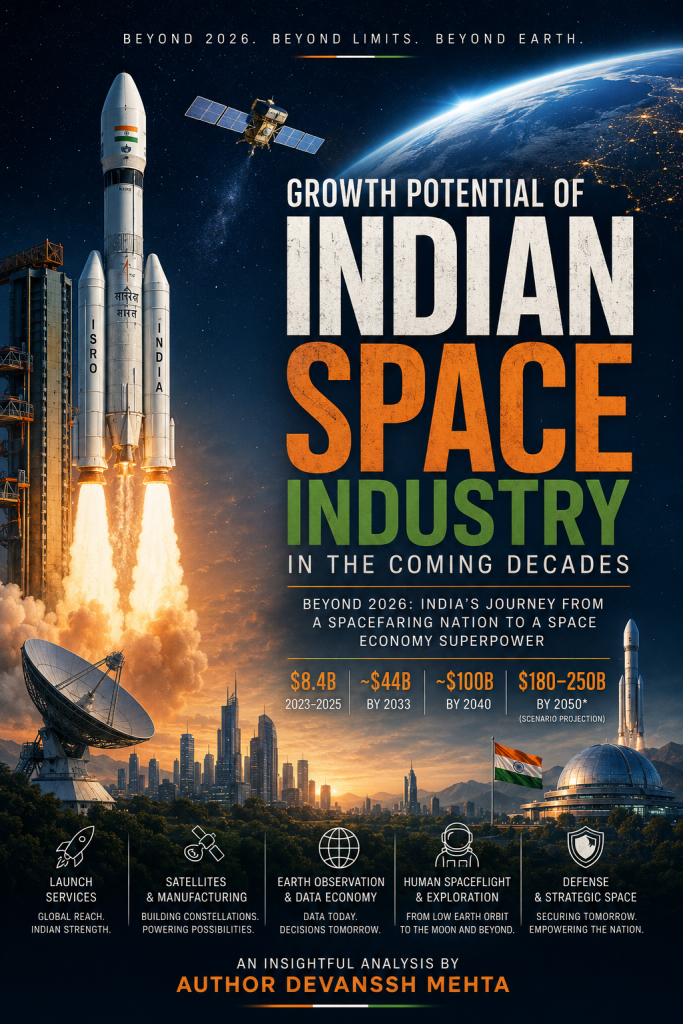
Beyond 2026: India’s Journey from a Spacefaring Nation to a Space Economy Superpower
By Author Devanssh Mehta Mode


Space is no longer a scientific frontier alone. It is becoming infrastructure.
For most of the twentieth century, access to space was a symbol of national prestige. In the twenty-first century—and particularly in the decades after 2026—it is transforming into an industrial, economic, technological, strategic, and civilizational asset.
India stands at a remarkable turning point.
For decades, the Indian space story was defined by frugality, scientific discipline, and national missions. From launching satellites on constrained budgets to demonstrating lunar and interplanetary capability, India built credibility through precision rather than extravagance.
But the coming decades may define India differently.
India is transitioning from a country that performs space missions to a country that builds a space economy.
Government projections place India’s space economy at approximately US$8.4 billion in 2023–2025, with ambitions to reach around US$44 billion by 2033 and nearly US$100 billion by 2040, increasing India’s share from roughly 2% to nearly 8–10% of the global market. (Press Information Bureau)
This article explores the long-term growth trajectory of the Indian space industry beyond 2026.
1. The Strategic Context: Why Space Has Become the New Industrial Revolution
Historically, industrial revolutions were driven by:
- Steam
- Electricity
- Petroleum
- Computing
- Internet
- Artificial Intelligence
The next integrated industrial layer may emerge through:
Space + AI + Communications + Manufacturing + Defense + Data.
The global space economy itself is expected to expand dramatically, with some industry projections placing it near US$1.8 trillion by 2035, creating enormous room for emerging space powers. (SIA India)
India’s opportunity is not merely to participate.
It is to capture value across the complete chain:
Launch → Satellites → Communications → Analytics → Services → Manufacturing → Exploration.
2. The Indian Space Ecosystem: From Monopoly to Multipolar Growth
Indian Space Research Organisation created the foundation.
Now a broader architecture is emerging:
- IN-SPACe
- NewSpace India Limited
- Private launch firms
- Satellite manufacturers
- Geospatial analytics companies
- Deep-tech startups
- Defense-space integration
India has already crossed nearly 399 active space startups, reflecting the transition from government-led execution toward market-led expansion. (Press Information Bureau)
Recent policy changes allowing greater private participation and technology transfer are accelerating industrialization of the sector. (The Times of India)
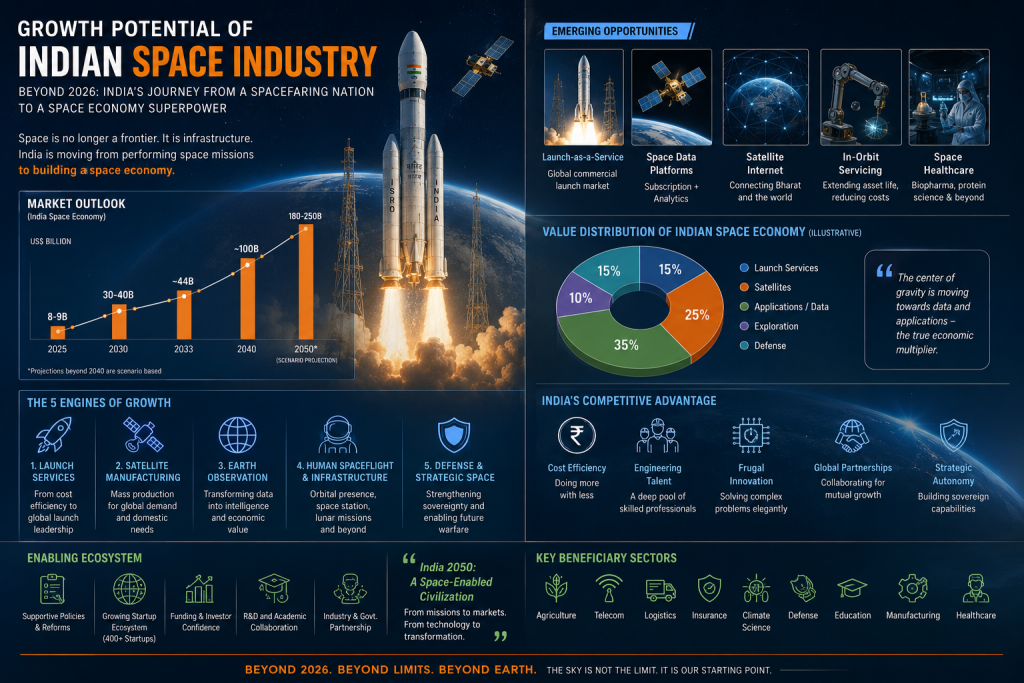
Figure 1 — Estimated Growth Path of India’s Space Economy
| Year | Estimated Space Economy |
|---|---|
| 2025 | US$8–9 Billion |
| 2030 | US$30–40 Billion |
| 2033 | ~US$44 Billion |
| 2040 | ~US$100 Billion |
| 2050 (Scenario Projection) | US$180–250 Billion |
2030–2050 values beyond official targets represent strategic scenario projections derived from growth trajectories and not government forecasts.
Sources for official targets: (Press Information Bureau)
3. The Five Engines That Could Drive Indian Space Growth
Engine 1: Launch Services Becoming an Export Industry
Launch capability creates leverage.
India’s traditional advantage has been cost-efficient launch architecture.
Future expansion may include:
- Reusable systems
- Small satellite launches
- Commercial orbital delivery
- International launch contracts
- Dedicated constellation deployment
Recent steps to transfer launch technologies such as PSLV capabilities to industry signal movement toward industrial-scale launch manufacturing. (The Times of India)
Projection:
2035:
- India becomes one of top launch exporters
2045:
- Multiple commercial launch corridors emerge.
Engine 2: Satellite Manufacturing Explosion
The satellite market may become India’s largest opportunity.
Demand drivers:
- Broadband
- Agriculture
- Climate
- Maritime logistics
- Disaster management
- Defense
- Autonomous systems
Satellite manufacturing has already been identified among the fastest-growing segments of India’s space economy. (Indian Space Association)
Projected Satellite Capacity:
| Year | Approximate Scenario |
|---|---|
| 2026 | Hundreds |
| 2035 | Thousands |
| 2050 | Tens of Thousands |
Engine 3: Earth Observation Becoming India’s Data Goldmine
Space is becoming a data industry.
Applications:
- Crop intelligence
- Precision agriculture
- Urban planning
- Water monitoring
- Insurance
- Supply chains
Industry commentary increasingly points toward downstream analytics and application layers becoming the largest creators of economic value. (The Times of India)
Future winners may not always launch rockets.
They may own data platforms.
Engine 4: Human Spaceflight and Orbital Infrastructure
Gaganyaan represents more than national pride.
Human spaceflight creates:
- Materials science
- Robotics
- Biomedical innovation
- Manufacturing capability
- International partnerships
India’s roadmap discussed publicly includes:
- Human missions
- Space station modules beginning later this decade
- Expanded lunar ambitions
- Long-term human lunar presence goals. (The Times of India)
Possible horizon:
2035:
- Operational Indian orbital presence
2040–2050:
- Sustained deep-space missions
Engine 5: Defense and Strategic Space
Space increasingly determines:
- Surveillance
- Communications
- Navigation
- Cyber resilience
- Battlefield intelligence
Future defense systems will depend on orbital architecture.
India’s geopolitical position gives space a dual role:
Economic growth + strategic sovereignty.
4. The Emerging Business Models That Could Create Billion-Dollar Indian Companies
Launch-as-a-Service
Revenue Model:
Recurring contracts.
Space Data Platforms
Revenue:
Subscription + analytics.
Satellite Internet
Revenue:
Consumer and enterprise connectivity.
In-Orbit Servicing
Revenue:
Maintenance and life-extension.
Space Manufacturing
Revenue:
High-value orbital production.
Space Healthcare
Revenue:
Biopharmaceutical research.
As a pharmacology-oriented observation: microgravity biology may eventually reshape protein science, drug formulation, and advanced therapeutic development.
Figure 2 — Future Value Distribution of Indian Space Economy (Illustrative)
Launch Services → 15%
Satellites → 25%
Applications/Data → 35%
Exploration → 10%
Defense → 15%
The center of gravity is likely to move toward data and applications.
5. Space Startups: India’s Hidden Economic Revolution
India’s next generation of growth may emerge from companies that:
- Build reusable rockets
- Operate constellations
- Create geospatial intelligence
- Design propulsion
- Manufacture electronics
Government-backed funding initiatives and venture support mechanisms have begun expanding technology adoption and commercialization pathways. (Reuters)
The long-term outcome:
India could develop a full-stack space industrial ecosystem.
6. India’s Global Competitive Position


India’s strategic comparison:
| Region | Strength |
|---|---|
| United States | Commercial scale |
| China | Infrastructure speed |
| Europe | Institutional coordination |
| India | Cost + engineering efficiency |
India’s advantage may emerge from:
Affordable innovation at industrial scale.
7. Long-Term Projections: 2030–2050
Scenario A — Conservative
- US$60–80B by 2040
- Moderate private growth
Probability:
High
Scenario B — Accelerated Growth
- US$100–150B
- Major export leadership
Probability:
Moderate–High
Scenario C — Space Power Transformation
- US$180–250B by 2050
- Human space infrastructure
- Orbital industry
Probability:
Dependent on execution.
8. Risks That Could Slow Growth
Every frontier industry carries friction.
Major risks:
Capital intensity
Space remains expensive.
Talent shortage
Advanced systems require deep capability.
Regulatory maturity
Speed and safety must coexist.
International competition
Global players move aggressively.
Technology dependence
Domestic supply chains remain critical.
9. The Sectors That Will Benefit Most
Space growth will not remain confined to aerospace.
Secondary beneficiaries:
- Agriculture
- Telecom
- Pharma
- Logistics
- Climate science
- Insurance
- Manufacturing
- Education
- Defense
- Semiconductor ecosystems
This multiplier effect may become larger than direct launch revenues.
10. India 2050: A Civilizational View of Space
The most interesting question is not:
“How many rockets will India launch?”
The deeper question is:
“How much economic life will eventually depend on Indian space systems?”
If India succeeds, the country may evolve through three phases:
1960–2025 → Scientific credibility
2026–2040 → Commercial expansion
2040–2050+ → Space-enabled civilization
India’s space future may not be written by a single agency.
It may be written collectively by scientists, startups, engineers, entrepreneurs, policy architects, investors, educators, and millions of citizens whose lives become connected to orbital infrastructure.
The coming decades may therefore represent something larger than industrial growth.
They may represent the emergence of India as a complete space economy.
And when future historians evaluate India’s rise, they may conclude that the decisive transformation did not begin on Earth.
It began when India stopped viewing space as a destination—
and started treating it as an economy.