Effective Strategic Marketing for the Indian Pharmaceutical Industry
A Comprehensive Strategic Perspective
1. Introduction: The Strategic Importance of Pharmaceutical Marketing in India
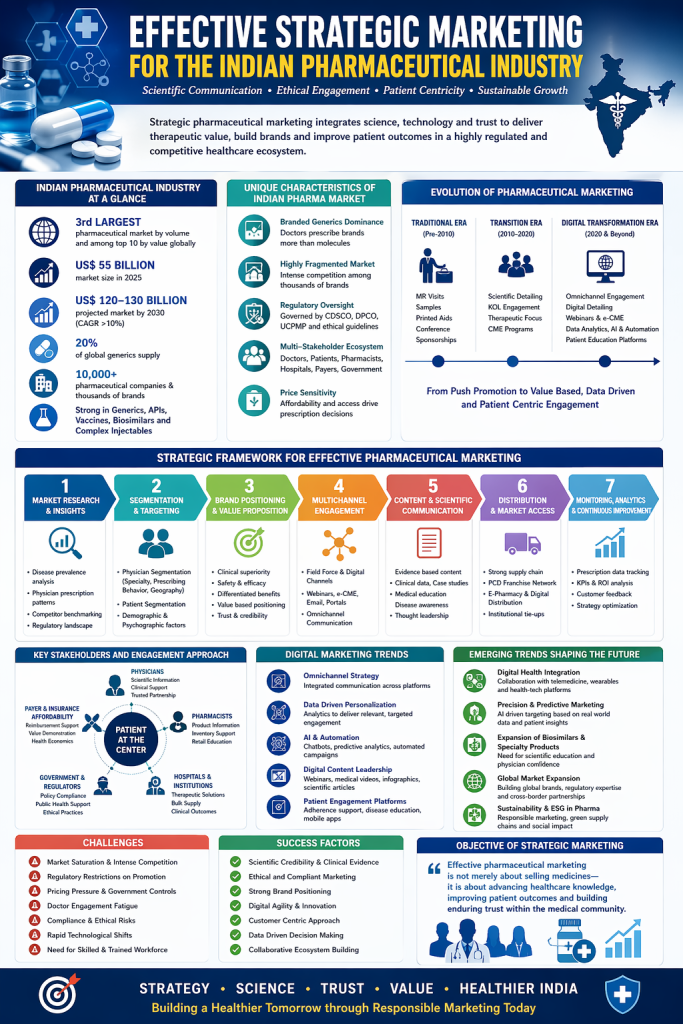
The Indian pharmaceutical industry stands today as one of the most significant pillars of the global healthcare economy. Often described as the “pharmacy of the world,” India has developed a powerful reputation for manufacturing affordable generic medicines, vaccines, and active pharmaceutical ingredients (APIs). The domestic pharmaceutical market alone was valued at about US$55 billion in 2025 and is projected to reach US$120–130 billion by 2030, growing at over 10% annually. (India Brand Equity Foundation)
However, manufacturing excellence alone is no longer sufficient for sustained success in the pharmaceutical marketplace. The modern pharmaceutical ecosystem has evolved into a complex strategic environment involving regulatory scrutiny, intense competition, technological disruption, and changing healthcare consumer behavior. In such a context, strategic marketing has emerged as the central determinant of commercial success.
Unlike conventional consumer product marketing, pharmaceutical marketing operates within a unique ecosystem characterized by:
- Strong regulatory oversight
- Scientific and clinical credibility requirements
- Multi-stakeholder decision making
- Ethical constraints on promotion
- High dependence on healthcare professionals
Consequently, pharmaceutical marketing is not merely promotional activity but a strategic orchestration of scientific communication, healthcare education, brand building, and patient engagement.
This article explores the concept of effective strategic marketing for the Indian pharmaceutical industry, examining its structural foundations, evolving trends, digital transformation, and future opportunities.
2. Understanding Pharmaceutical Marketing: Concept and Scope
Pharmaceutical marketing can be defined as:
“The strategic process through which pharmaceutical companies create value by communicating scientific information, building therapeutic awareness, and promoting pharmaceutical products to healthcare stakeholders.”
The stakeholders in pharmaceutical marketing typically include:
- Physicians and healthcare professionals (HCPs)
- Hospitals and healthcare institutions
- Pharmacists and retail pharmacies
- Government and regulatory bodies
- Patients and caregivers
- Medical insurance providers
Unlike traditional consumer marketing where the buyer and decision maker are usually the same, pharmaceutical markets involve multi-layered decision pathways. For example:
- A doctor prescribes a drug
- A pharmacist dispenses it
- A patient consumes it
- Insurance companies reimburse it
Therefore pharmaceutical marketing requires multi-stakeholder engagement strategies.
3. The Structure of the Indian Pharmaceutical Market
The Indian pharmaceutical industry possesses several structural characteristics that strongly influence marketing strategies.
3.1 Dominance of Generics
India is globally recognized for its generic drug manufacturing capabilities. Generic medicines dominate the domestic market because they are significantly cheaper than patented drugs.
Marketing strategies therefore often emphasize:
- Brand differentiation among generics
- Physician trust
- Therapeutic efficacy
- Competitive pricing
3.2 Branded Generic Market
India has developed a unique market structure called “branded generics.”
In this system:
- The same generic molecule is sold under different brand names by different companies.
- Physicians prescribe brands rather than molecules.
Consequently, pharmaceutical marketing plays a decisive role in brand recall among doctors.
3.3 Fragmented Market Structure
India has more than 10,000 pharmaceutical companies and tens of thousands of brands competing in the domestic market. (Iscon Life Sciences)
This intense fragmentation necessitates aggressive marketing differentiation.
3.4 Strong Regulatory Framework
Pharmaceutical marketing in India is regulated by:
- Drugs and Cosmetics Act
- Central Drugs Standard Control Organization (CDSCO)
- Uniform Code of Pharmaceutical Marketing Practices (UCPMP)
Direct-to-consumer advertising for prescription drugs is generally prohibited, which means companies must primarily market to healthcare professionals. (Suncare Formulations)
4. Evolution of Pharmaceutical Marketing in India
4.1 Traditional Era: Sales Representative Dominance
Historically, pharmaceutical marketing relied heavily on medical representatives (MRs) who visited doctors to promote products.
Typical promotional tools included:
- Product samples
- Printed visual aids
- Medical literature
- Conference sponsorships
- Continuing medical education (CME)
This approach is known as push marketing, where companies directly influence doctors to prescribe their brands. (Actiza Pharma)
4.2 Transition to Strategic Marketing
Over time, pharmaceutical companies realized that frequent visits alone were insufficient.
Strategic marketing began to incorporate:
- Market segmentation
- Brand positioning
- Clinical differentiation
- Key opinion leader engagement
4.3 The Digital Transformation Era
The COVID-19 pandemic accelerated digital transformation in pharmaceutical marketing.
Doctors increasingly rely on:
- Digital medical information
- Online CME platforms
- Webinars and virtual conferences
Pharmaceutical companies are now using digital channels such as:
- Email campaigns
- Doctor engagement portals
- WhatsApp communications
- Tele-detailing platforms
- Mobile applications for medical representatives (Suncare Formulations)
5. Key Principles of Strategic Pharmaceutical Marketing
Effective pharmaceutical marketing in India rests upon several strategic principles.
5.1 Scientific Credibility
In the pharmaceutical sector, marketing messages must be grounded in scientific evidence.
Companies must provide:
- Clinical trial data
- Pharmacological mechanisms
- Comparative efficacy studies
- Safety profiles
Scientific credibility is the foundation of physician trust.
5.2 Therapeutic Value Proposition
Doctors prescribe medicines based on therapeutic outcomes.
Strategic marketing therefore emphasizes:
- Better clinical outcomes
- Improved patient compliance
- Reduced side effects
- Faster recovery
5.3 Ethical Marketing Practices
Pharmaceutical marketing must adhere to ethical standards.
Unethical practices such as misleading advertising can result in regulatory penalties and reputational damage.
Recent regulatory warnings against surrogate drug promotion illustrate the increasing scrutiny of pharmaceutical marketing activities. (Reuters)
5.4 Patient-Centric Approach
Modern pharmaceutical marketing is shifting toward patient-centric healthcare communication.
Companies now focus on:
- Disease awareness campaigns
- Patient education programs
- Adherence support tools
- Digital health applications
6. Market Segmentation in Pharmaceutical Marketing
Strategic segmentation enables pharmaceutical companies to target specific healthcare stakeholders effectively.
6.1 Physician Segmentation
Doctors can be segmented based on:
- Specialty (cardiology, oncology, pediatrics)
- Prescription patterns
- Hospital affiliations
- Geographic location
This segmentation allows companies to customize marketing communication.
6.2 Geographic Segmentation
India’s healthcare landscape varies widely across regions.
Urban markets may emphasize:
- Specialty medicines
- Biologics
- High-end therapies
Rural markets require strategies focusing on:
- Affordable generics
- Distribution efficiency
- Physician accessibility
6.3 Patient Segmentation
Patients can be segmented based on:
- Disease categories
- Age groups
- socioeconomic status
- treatment adherence levels
Such segmentation helps design targeted patient education programs.
7. Brand Positioning Strategies in the Indian Pharmaceutical Market
Brand positioning is essential in a market dominated by generics.
7.1 Clinical Superiority Positioning
Companies may emphasize:
- Superior bioavailability
- Faster therapeutic action
- Better safety profile
7.2 Physician Trust Positioning
Brands often build trust through:
- scientific publications
- conference presentations
- expert endorsements
7.3 Value-Based Positioning
In price-sensitive markets like India, affordability plays a major role.
Companies highlight:
- cost-effectiveness
- patient affordability
- accessibility
8. Role of Medical Representatives in Strategic Marketing
Medical representatives remain a cornerstone of pharmaceutical marketing in India.
Their responsibilities include:
- Educating physicians about drug mechanisms
- Providing clinical evidence
- Delivering product samples
- Gathering market intelligence
However, the role of MRs is evolving.
Modern representatives must possess:
- scientific knowledge
- digital communication skills
- data-driven engagement capabilities
9. Digital Transformation in Pharmaceutical Marketing
Digital transformation has dramatically reshaped pharmaceutical marketing strategies.
9.1 Omnichannel Engagement
Modern pharmaceutical marketing integrates multiple channels including:
- email marketing
- digital detailing
- webinars
- social media platforms
- physician portals (LinkedIn)
This integrated communication model ensures consistent engagement with healthcare professionals.
9.2 Content Marketing
Educational content has become a powerful marketing tool.
Examples include:
- disease awareness articles
- clinical case studies
- medical explainer videos
- scientific infographics
Content marketing establishes companies as knowledge leaders rather than product promoters.
9.3 Data-Driven Personalization
Pharmaceutical companies increasingly use analytics to personalize communication.
Marketing campaigns can be tailored based on:
- doctor specialization
- prescription history
- regional disease prevalence (Suncare Formulations)
9.4 AI and Automation
Artificial intelligence enables:
- automated customer relationship management
- predictive analytics
- chatbots for medical information
AI enhances efficiency and improves physician engagement.
10. Distribution Strategy and Market Access
Distribution networks play a crucial role in pharmaceutical marketing success.
10.1 Supply Chain Optimization
Efficient supply chains ensure product availability in:
- hospitals
- pharmacies
- rural healthcare centers
10.2 PCD Pharma Franchise Model
The Propaganda-Cum-Distribution (PCD) franchise model is widely used in India.
This model allows companies to:
- expand geographically
- reduce marketing costs
- leverage local entrepreneurs
PCD franchises have significantly contributed to pharmaceutical market expansion. (Iscon Life Sciences)
10.3 E-Pharmacy and Digital Distribution
E-pharmacies are rapidly transforming pharmaceutical retail.
Online pharmacy platforms enable:
- home delivery of medicines
- digital prescription verification
- medication reminders
11. Role of Key Opinion Leaders (KOLs)
Key Opinion Leaders are influential physicians who shape medical practice.
Pharmaceutical companies collaborate with KOLs for:
- clinical research
- conference presentations
- scientific advisory roles
Such collaborations enhance brand credibility among physicians.
12. Regulatory and Ethical Constraints in Pharma Marketing
Pharmaceutical marketing operates under strict regulatory oversight.
Major constraints include:
- prohibition of direct advertising for prescription drugs
- strict labeling requirements
- clinical evidence validation
Companies must comply with the Uniform Code of Pharmaceutical Marketing Practices (UCPMP) to maintain ethical standards. (Suncare Formulations)
13. Challenges in Strategic Pharmaceutical Marketing
Despite enormous opportunities, pharmaceutical marketing in India faces several challenges.
13.1 Market Saturation
Thousands of brands compete within the same therapeutic categories.
Differentiation becomes difficult when drugs share the same active ingredients.
13.2 Regulatory Restrictions
Strict promotional regulations limit advertising flexibility.
Companies must carefully design compliant marketing strategies.
13.3 Pricing Pressure
Government policies such as the Drug Price Control Order (DPCO) restrict pricing for essential medicines.
13.4 Doctor Engagement Fatigue
Doctors are frequently approached by multiple pharmaceutical representatives, leading to reduced attention to promotional messages.
13.5 Compliance Risks
Weak compliance and unethical practices can damage brand reputation and attract regulatory penalties. (Emediwrite)
14. Emerging Trends in Pharmaceutical Marketing
14.1 Digital Health Integration
Pharmaceutical companies are integrating marketing with digital health ecosystems including:
- telemedicine platforms
- wearable health devices
- remote patient monitoring
14.2 Patient Empowerment
Patients today actively search for health information online.
This “Google-first healthcare behavior” is reshaping pharmaceutical marketing communication. (Suncare Formulations)
14.3 Precision Marketing
Advanced analytics allows companies to target specific patient populations based on disease prevalence and demographics.
14.4 AI-Driven Marketing
Artificial intelligence enables:
- predictive prescription modeling
- intelligent customer engagement
- automated marketing campaigns
15. Strategic Framework for Effective Pharmaceutical Marketing
An effective pharmaceutical marketing strategy typically involves the following framework.
Step 1: Market Research
- disease prevalence analysis
- physician prescribing patterns
- competitive landscape evaluation
Step 2: Target Segmentation
- identify high-value physician segments
- prioritize therapeutic markets
Step 3: Brand Positioning
- define clinical advantages
- develop unique value proposition
Step 4: Multichannel Engagement
- combine field marketing with digital platforms
Step 5: Continuous Monitoring
- track prescription data
- evaluate marketing ROI
16. Future Outlook for Pharmaceutical Marketing in India
The future of pharmaceutical marketing in India will be shaped by several transformational forces.
16.1 Digital Healthcare Ecosystems
Integration of pharmaceutical companies with telemedicine and health technology platforms will redefine marketing approaches.
16.2 Artificial Intelligence in Healthcare Marketing
AI-driven analytics will enable hyper-personalized physician engagement.
16.3 Expansion of Biosimilars and Biologics
The rapid growth of biosimilars will require specialized marketing strategies focused on scientific education.
16.4 Global Market Expansion
Indian pharmaceutical companies are increasingly targeting international markets.
Global marketing strategies will require:
- regulatory expertise
- international branding
- cross-border partnerships
17. Conclusion
Strategic marketing has become one of the most decisive factors shaping the competitive success of the Indian pharmaceutical industry. As the sector continues its rapid expansion toward a projected value exceeding US$120 billion by 2030, companies must adopt sophisticated marketing approaches that combine scientific credibility, ethical communication, digital innovation, and patient-centric healthcare engagement. (India Brand Equity Foundation)
The traditional model dominated by sales representatives and product promotion is gradually giving way to a multi-channel, data-driven, and knowledge-centric marketing paradigm. Pharmaceutical companies must now engage physicians, patients, and healthcare institutions through integrated communication strategies that deliver both clinical value and educational insight.
Furthermore, regulatory compliance and ethical marketing practices will remain fundamental to sustaining trust within the healthcare ecosystem. The rise of digital health technologies, artificial intelligence, and personalized medicine will further transform pharmaceutical marketing, requiring companies to continuously innovate their strategic frameworks.
Ultimately, the pharmaceutical companies that succeed in the coming decades will be those that recognize a profound truth: effective pharmaceutical marketing is not merely about selling medicines—it is about advancing healthcare knowledge, improving patient outcomes, and building enduring trust within the medical community.