American Revolution and Democracy
The Birth of a Modern Political Idea and the Making of Democratic Governance
By Devanssh Mehta
Introduction: A Revolution That Changed Political Civilization
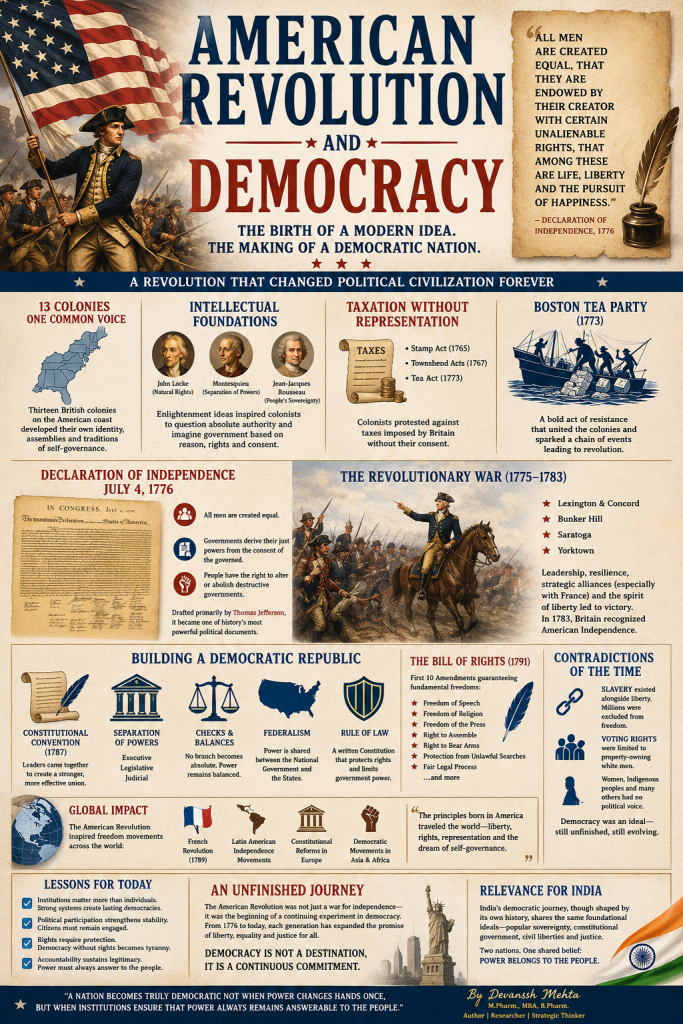
The American Revolution stands among the most influential political transformations in human history. More than a military struggle between colonies and imperial authority, it became a philosophical experiment that altered the relationship between citizens and government. Emerging during the eighteenth century, the revolution not only created the United States of America but also gave practical shape to principles that later became central to modern democratic governance: liberty, representation, constitutionalism, rule of law, separation of powers, and the idea that political authority derives from the consent of the governed.
Before the revolution, monarchy and hereditary rule dominated global politics. Kings governed through inherited authority, while ordinary citizens had limited participation in political decision-making. The American Revolution challenged this centuries-old assumption and proposed an alternative political imagination—one in which governments existed to serve people rather than people existing to serve governments.
Democracy today, although transformed and expanded beyond its eighteenth-century origins, continues to carry the intellectual imprint of the American Revolution. Across continents, constitutional democracies, civil rights movements, and struggles for representative governance have drawn inspiration from ideas first institutionalized during this historical moment.
This article explores the historical background, causes, events, intellectual foundations, democratic legacy, contradictions, criticisms, and continuing global relevance of the American Revolution.
Historical Background: Colonial America Before Revolution
To understand the American Revolution, one must first understand colonial America.
During the seventeenth and eighteenth centuries, thirteen British colonies developed along the eastern coast of North America. These colonies were economically productive and socially diverse. Colonists considered themselves loyal British subjects while simultaneously developing independent local identities.
The colonies included:
- Massachusetts
- New Hampshire
- Rhode Island
- Connecticut
- New York
- New Jersey
- Pennsylvania
- Delaware
- Maryland
- Virginia
- North Carolina
- South Carolina
- Georgia
Although controlled by Britain, these colonies enjoyed considerable local autonomy. Colonial assemblies governed local matters, and citizens gradually developed expectations regarding self-governance.
This period of relative independence shaped political consciousness.
Colonists became accustomed to:
- Local elections
- Community participation
- Property rights
- Religious freedoms
- Representative assemblies
Over time, these expectations created tension with British imperial control.
Intellectual Origins of the Revolution
The American Revolution was not merely a military uprising.
It was deeply influenced by Enlightenment philosophy.
European thinkers questioned traditional authority and proposed rational systems of governance.
Among the major intellectual influences were:
- John Locke
- Montesquieu
- Jean-Jacques Rousseau
John Locke and Natural Rights
Locke argued that all human beings possess natural rights:
- Life
- Liberty
- Property
Governments exist to protect these rights.
When governments violate these rights, citizens possess the moral authority to replace them.
This concept became revolutionary.
Economic and Political Causes of the American Revolution
Following the Seven Years’ War, Britain accumulated substantial debt.
To recover financially, Parliament imposed taxes on the colonies.
Major taxation measures included:
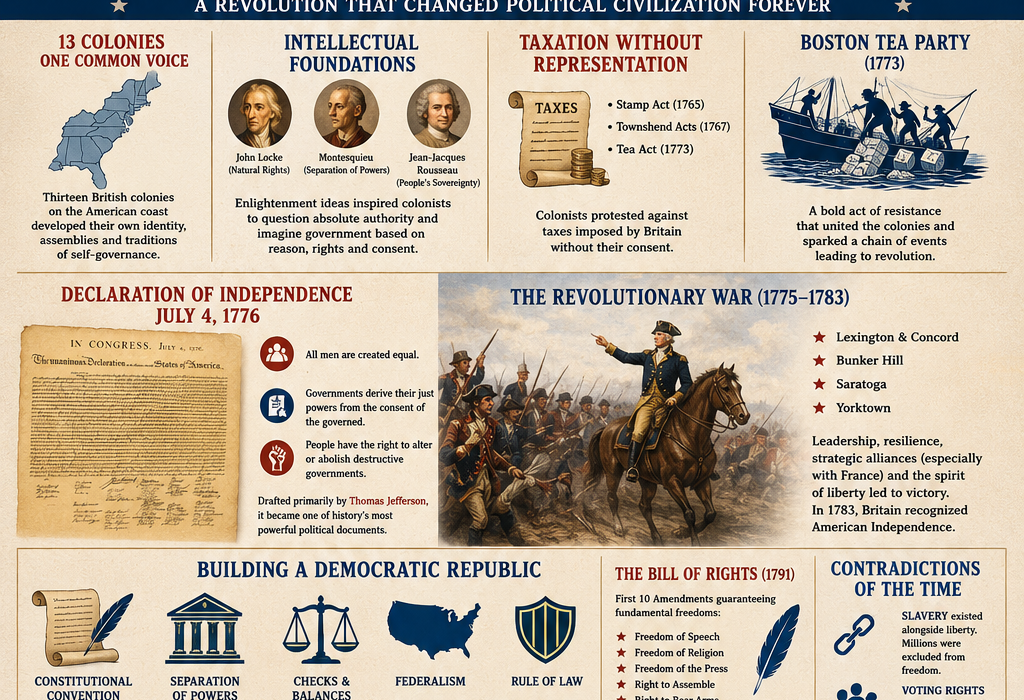
- Stamp Act (1765)
- Townshend Acts (1767)
- Tea Act (1773)
Colonists objected.
Their central complaint was:
“No taxation without representation.”
They argued that taxation required political participation.
Britain viewed Parliament as sovereign.
Colonists viewed representation as essential to legitimate governance.
This disagreement became the foundation of revolutionary conflict.
The Boston Tea Party: Symbol of Political Resistance
One of the most famous revolutionary events occurred in December 1773.
Colonists protested taxation policies by boarding British ships and throwing tea into Boston Harbor.
This became known as the:
Boston Tea Party
The event represented more than destruction of goods.
It symbolized rejection of political domination.
Britain responded with harsh punitive measures.
Rather than restoring order, these actions intensified colonial unity.
Declaration of Independence: Democracy in Written Form
On July 4, 1776, representatives formally declared independence.
The resulting document became one of history’s most influential political texts:
United States Declaration of Independence
Principal drafting leadership came from:
- Thomas Jefferson
- Benjamin Franklin
- John Adams
The declaration asserted revolutionary principles:
All individuals are created equal.
Governments derive authority from consent.
Citizens may alter destructive governments.
These ideas transformed political philosophy.
The Revolutionary War (1775–1783)
The revolution required military victory.
Important leaders included:
- George Washington
- Alexander Hamilton
- Marquis de Lafayette
Major battles included:
- Lexington and Concord
- Bunker Hill
- Saratoga
- Yorktown
Military success depended upon:
- Colonial resistance
- French assistance
- Strategic endurance
- British logistical challenges
In 1783, Britain recognized American independence.
Creating a Democratic Republic
Winning independence was only the beginning.
The founders faced a difficult question:
How should free people govern themselves?
Initial arrangements under the Articles of Confederation proved weak.
A constitutional convention eventually produced:
United States Constitutional Convention
The resulting constitution introduced:
Separation of Powers
Government divided into:
- Executive
- Legislative
- Judicial
Checks and Balances
No institution became absolute.
Federalism
Authority shared between national and state governments.
Constitutional Rule
Written law became superior to individual rulers.
This structure became a model for modern democratic systems.
Democracy: Revolutionary Innovation and Historical Continuity
Although democracy existed in ancient forms, particularly in:
Athens
the American model transformed democracy into a large-scale constitutional republic.
Key democratic principles included:
Popular Sovereignty
People become the source of legitimacy.
Representative Government
Citizens elect leaders.
Rule of Law
Laws govern rulers.
Protection of Rights
Government power remains limited.
Contradictions Within the American Democratic Experiment
Despite its revolutionary ideals, early American democracy contained serious contradictions.
Slavery
Many revolutionary leaders defended liberty while maintaining enslaved populations.
Millions remained excluded.
The contradiction became one of history’s deepest political paradoxes.
Eventually later movements—including abolition and civil rights—challenged this inconsistency.
Limited Voting Rights
Initially, voting was largely restricted to property-owning men.
Women lacked political rights.
Indigenous communities remained marginalized.
Democracy evolved gradually.
The Bill of Rights and Expansion of Liberty
The first ten constitutional amendments became known as:
United States Bill of Rights
They guaranteed:
- Freedom of speech
- Freedom of religion
- Freedom of assembly
- Legal protections
- Limits on state authority
This institutionalized civil liberty.
The Global Influence of the American Revolution
The revolution’s effects extended far beyond North America.
Major historical movements influenced by its ideas included:
- French Revolution
- Latin American independence movements
- Constitutional reforms across Europe
- Democratic movements in Asia and Africa
Ideas crossed borders:
- Constitutional government
- National sovereignty
- Civil rights
- Political participation
American Revolution and Democracy: Economic Dimensions
Political freedom alone does not sustain democracy.
Economic institutions matter.
The revolution encouraged:
- Private enterprise
- Property protection
- Commercial expansion
- Market development
Democratic institutions and economic growth increasingly became interconnected.
Yet tensions remained.
Questions emerged:
- How much equality is necessary?
- What role should government play?
- How should opportunity be distributed?
These questions continue today.
Democracy in Modern America
Modern American democracy differs substantially from its revolutionary origins.
Expansion occurred through:
- Universal voting rights
- Civil rights reforms
- Judicial protections
- Institutional development
Major democratic institutions now include:
- Elections
- Courts
- Media
- Civil society
- Constitutional review
Democracy remains an ongoing process rather than a finished achievement.
Lessons for Emerging Democracies
Countries seeking democratic development can draw several lessons.
Institutions Matter More Than Individuals
Durable systems require constitutional continuity.
Political Participation Strengthens Stability
Citizens must remain engaged.
Rights Require Protection
Democracy without rights becomes majoritarian dominance.
Accountability Sustains Legitimacy
Public trust depends upon responsible governance.
American Revolution and India: Comparative Democratic Reflection
For India, the American Revolution offers useful historical comparisons.
India’s democratic development emerged through constitutional struggle rather than armed colonial revolution.
Yet both traditions emphasize:
- Popular sovereignty
- Representative institutions
- Constitutional government
- Civil liberty
India adapted democratic principles to a vastly larger and more diverse society.
The democratic journeys remain distinct but intellectually connected.
Critiques of Democratic Idealism
Scholars continue debating the American democratic project.
Common criticisms include:
- Elite influence in politics
- Economic inequality
- Electoral limitations
- Unequal representation
Supporters argue democracy remains self-correcting.
Critics argue institutions require constant reform.
This debate itself demonstrates democratic vitality.
The Philosophical Legacy of the Revolution
The deepest contribution of the American Revolution may not be military victory.
Its lasting achievement was philosophical.
It transformed political legitimacy.
The central question changed from:
“Who has the right to rule?”
to
“How do citizens authorize government?”
That intellectual transition continues shaping global politics.
Conclusion: Revolution as an Unfinished Democratic Conversation
The American Revolution was one of history’s defining turning points.
It overthrew imperial authority, established a constitutional republic, and translated Enlightenment ideas into political institutions. Yet it also revealed the complexities and contradictions of democratic transformation.
Democracy did not emerge complete in 1776.
It expanded gradually through social movements, constitutional evolution, public participation, and continuous reinterpretation of liberty and equality.
Today, the revolution survives not merely as an American historical event but as an enduring conversation about governance, citizenship, freedom, accountability, and human dignity.
Its greatest lesson remains profoundly relevant:
A nation becomes truly democratic not when power changes hands once, but when institutions ensure that power always remains answerable to the people.
Written by Devanssh Mehta
M.Pharm., MBA, B.Pharm.
Author | Researcher | Strategic Thinker