
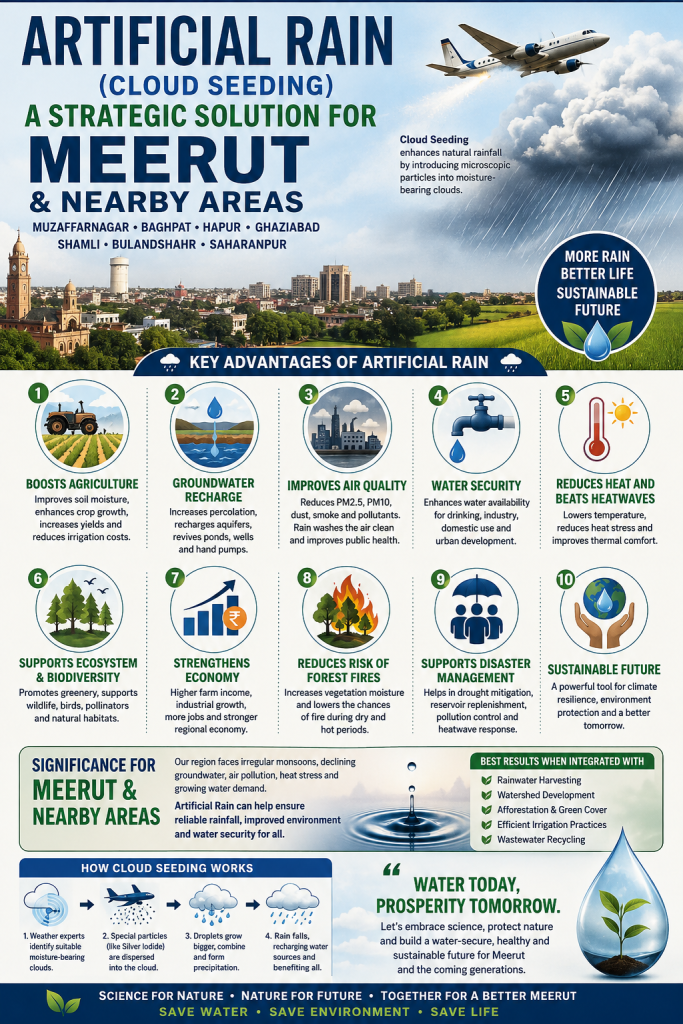
Artificial Rain (Cloud Seeding): A Strategic Solution for Water Security, Environmental Sustainability, and Climate Resilience in Meerut and the Surrounding Region
Introduction
Water has always been regarded as the foundation of civilization, economic prosperity, and ecological sustainability. Throughout history, the availability of adequate rainfall has determined agricultural productivity, industrial development, biodiversity conservation, and the quality of human life. However, the twenty-first century has witnessed unprecedented climatic uncertainties resulting from global warming, urbanization, deforestation, and environmental degradation. These factors have significantly altered rainfall patterns across many parts of India, including western Uttar Pradesh.
Meerut, one of the fastest-growing urban centers of Uttar Pradesh, together with neighboring districts such as Muzaffarnagar, Baghpat, Hapur, Ghaziabad, Shamli, Bulandshahr, and Saharanpur, increasingly faces irregular monsoons, declining groundwater reserves, rising temperatures, and seasonal air pollution. These environmental challenges threaten agricultural productivity, public health, industrial growth, and long-term regional sustainability.
Artificial rain, scientifically known as cloud seeding, has emerged as an innovative atmospheric intervention capable of enhancing precipitation under suitable meteorological conditions. Although cloud seeding cannot create clouds where none exist, it can increase rainfall efficiency in moisture-bearing clouds. Around the world, this technology has been employed to combat droughts, replenish reservoirs, suppress forest fires, reduce air pollution, and improve water security.
For Meerut and its surrounding region, artificial rain represents not merely a technological experiment but a strategic investment in climate adaptation, sustainable development, and environmental resilience.
Understanding Artificial Rain
Artificial rain refers to the process of stimulating precipitation by dispersing specific microscopic particles into suitable clouds. These particles act as condensation or ice nuclei, encouraging water droplets to combine and grow until they become sufficiently heavy to fall as rain.
Common cloud-seeding materials include:
- Silver iodide
- Potassium iodide
- Sodium chloride (common salt)
- Liquid propane
- Dry ice (solid carbon dioxide)
These materials are dispersed through aircraft, drones, rockets, or ground-based generators depending upon atmospheric conditions and operational requirements.
Cloud seeding is most effective when clouds already possess adequate moisture but require additional nuclei to enhance rainfall formation.
Scientific Principles Behind Cloud Seeding
The success of artificial rain depends upon atmospheric physics.
Clouds contain billions of microscopic water droplets suspended in the atmosphere. Under natural conditions, these droplets continuously collide and merge. However, in many cases they remain too small to overcome air resistance and fall as precipitation.
Cloud seeding accelerates this natural process by introducing artificial nuclei that facilitate droplet aggregation or ice crystal formation. As droplets grow larger, gravity eventually causes them to fall as rain.
Thus, artificial rain enhances existing meteorological processes rather than replacing them.
Advantages of Artificial Rain
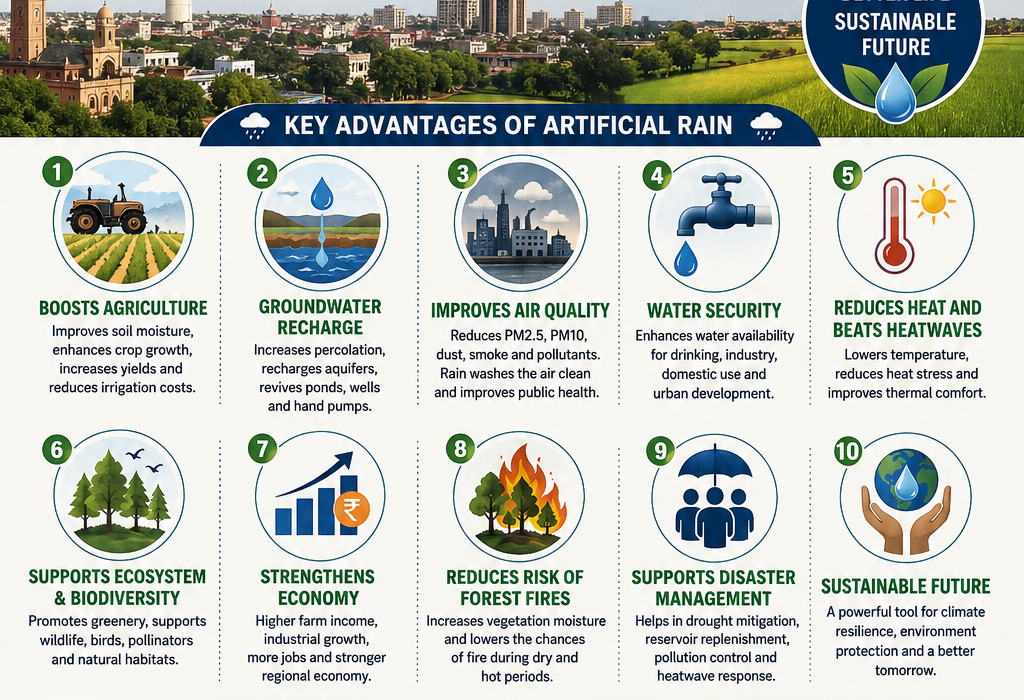
1. Strengthening Agricultural Productivity
Agriculture remains the economic backbone of western Uttar Pradesh.
Meerut and neighboring districts cultivate:
- Sugarcane
- Wheat
- Rice
- Mustard
- Vegetables
- Pulses
- Fodder crops
Delayed or deficient monsoons often reduce crop yields and increase irrigation costs. Artificial rain during critical crop growth stages can improve soil moisture, enhance germination, reduce crop stress, and stabilize agricultural production.
Improved rainfall also minimizes dependence on costly groundwater extraction, thereby lowering energy consumption associated with irrigation pumps.
2. Groundwater Recharge
Groundwater depletion represents one of the most pressing environmental challenges in Meerut.
Rapid urbanization, population growth, industrial expansion, and excessive tube-well irrigation have significantly lowered groundwater tables over recent decades.
Artificial rainfall contributes to:
- Aquifer recharge
- Increased percolation
- Restoration of village ponds
- Improved recharge of hand pumps
- Sustainable groundwater management
Enhanced groundwater availability directly supports agriculture, domestic water supply, industries, and ecosystem health.
3. Improving Air Quality
Every winter, western Uttar Pradesh experiences severe air pollution.
Major contributors include:
- Vehicular emissions
- Construction dust
- Industrial emissions
- Crop residue burning
- Road dust
Rain naturally removes airborne particulate matter by washing pollutants from the atmosphere.
Artificial rain can significantly reduce:
- PM2.5
- PM10
- Dust particles
- Smoke concentration
- Atmospheric aerosols
Improved air quality reduces respiratory illnesses, cardiovascular diseases, asthma attacks, and other pollution-related health complications.
4. Water Security for Urban Development
Meerut is expanding rapidly as an educational, industrial, commercial, and residential hub.
Growing cities require reliable water supplies for:
- Drinking
- Hospitals
- Schools
- Hotels
- Manufacturing
- Construction
- Public sanitation
Artificial rain can supplement reservoir inflows and groundwater recharge, reducing the likelihood of future water shortages.
5. Climate Change Adaptation
Climate change has increased rainfall variability across northern India.
Unexpected droughts, prolonged heatwaves, and irregular monsoons have become increasingly common.
Cloud seeding offers an adaptive strategy by:
- Enhancing rainfall during moisture-deficient periods
- Reducing drought intensity
- Supporting agricultural resilience
- Improving ecosystem stability
Although it is not a substitute for climate mitigation, it can strengthen regional climate resilience.
6. Reduction in Heatwave Intensity
Summer temperatures in Meerut frequently exceed 42–45°C.
Artificial rainfall contributes to:
- Lower surface temperatures
- Reduced urban heat island effect
- Increased humidity
- Improved thermal comfort
- Lower electricity demand for cooling
Even moderate rainfall following extreme heat can significantly improve living conditions.
7. Supporting Biodiversity
Natural ecosystems surrounding Meerut include wetlands, agricultural landscapes, and forest patches.
Improved rainfall benefits:
- Native vegetation
- Birds
- Pollinators
- Aquatic organisms
- Wildlife habitats
Healthy ecosystems also contribute to improved soil conservation and carbon sequestration.
8. Economic Benefits
Reliable rainfall directly influences regional economic growth.
Potential benefits include:
- Higher agricultural income
- Reduced drought losses
- Improved industrial productivity
- Increased employment
- Enhanced food security
- Greater investment confidence
Water availability remains one of the strongest determinants of sustainable economic development.
9. Reducing Forest Fire Risk
Although western Uttar Pradesh is not highly forested, nearby regions occasionally experience dry vegetation fires.
Artificial rainfall during prolonged dry periods may reduce wildfire risks in vulnerable landscapes by increasing vegetation moisture.
10. Strengthening Disaster Management
Artificial rain can become part of integrated disaster management strategies.
Potential applications include:
- Drought mitigation
- Pollution control
- Reservoir replenishment
- Emergency agricultural support
- Heatwave response
Such interventions can complement traditional water management practices.
Significance for Meerut and Nearby Areas
Meerut occupies a strategically important position within the National Capital Region (NCR) influence zone while retaining strong agricultural characteristics.
The region faces several interconnected environmental challenges:
- Declining groundwater
- Seasonal air pollution
- Urban expansion
- Increasing population
- Agricultural water demand
- Heat stress
- Climate variability
Neighboring districts—including Muzaffarnagar, Baghpat, Hapur, Ghaziabad, Shamli, Bulandshahr, and Saharanpur—share similar climatic and hydrological conditions.
Artificial rain, when implemented scientifically and under favorable meteorological conditions, could provide multiple regional benefits:
- Improved irrigation reliability
- Better groundwater recharge
- Cleaner air during pollution episodes
- Reduced heat stress
- Enhanced water availability for industries and municipalities
- Greater resilience against drought years
Its greatest value would lie in being integrated with watershed development, rainwater harvesting, wastewater recycling, afforestation, and efficient irrigation systems.
Challenges and Limitations
Despite its promise, artificial rain is not without limitations.
Cloud seeding requires suitable moisture-bearing clouds and cannot generate rainfall in cloudless conditions. Operational costs, aircraft deployment, meteorological monitoring, and scientific evaluation require significant investment. Environmental concerns regarding repeated use of seeding agents also necessitate continuous assessment, although studies generally indicate limited impacts when used within recommended guidelines.
Furthermore, cloud seeding should not be viewed as a replacement for sustainable water management practices but as one component of a broader climate adaptation strategy.
Future Prospects
Rapid advances in meteorology, satellite observation, artificial intelligence, drone technology, weather radar systems, and numerical weather prediction models are making cloud-seeding operations increasingly precise.
Future developments may include:
- AI-assisted cloud selection
- Autonomous drone-based seeding
- High-resolution weather forecasting
- Integrated hydrological monitoring
- Region-specific precipitation optimization
For Meerut, collaboration among scientific institutions, meteorological agencies, state governments, and academic researchers could enable scientifically designed pilot projects to evaluate the feasibility and effectiveness of artificial rain under local conditions.
Conclusion
Artificial rain represents one of the most promising technological interventions for enhancing climate resilience in water-stressed and environmentally vulnerable regions. While it cannot replace natural monsoon systems or solve every aspect of water scarcity, cloud seeding offers significant potential to improve rainfall efficiency, strengthen agricultural productivity, recharge groundwater, mitigate air pollution, moderate heatwaves, and support sustainable urban and rural development.
For Meerut and the surrounding districts, where agriculture, urban growth, and environmental sustainability are deeply interconnected, artificial rain could become an important component of integrated water resource management. Its successful implementation would require rigorous scientific planning, favorable atmospheric conditions, transparent environmental monitoring, and coordination among meteorologists, hydrologists, policymakers, and local communities.
As climate variability continues to challenge conventional water management practices, embracing scientifically validated technologies such as cloud seeding—alongside rainwater harvesting, watershed conservation, afforestation, efficient irrigation, and groundwater recharge—can help build a more resilient, water-secure, and environmentally sustainable future for Meerut and the wider western Uttar Pradesh region.