Russian Revolution: The Complete Story of the Fall of Imperial Russia and the Rise of Soviet Power
By Devanssh Mehta & TRM WRITERS LLP
SEO Keywords: Russian Revolution, Russian Revolution 1917, causes of Russian Revolution, effects of Russian Revolution, Bolshevik Revolution, Lenin, Tsar Nicholas II, October Revolution, February Revolution, Soviet Union history, history of Russia
Meta Description:
Explore the complete history of the Russian Revolution in this detailed SEO-optimized article covering causes, events, leaders, consequences, global impact, and historical lessons from the transformation of Imperial Russia into Soviet power.
Introduction: The Revolution That Redefined the Twentieth Century
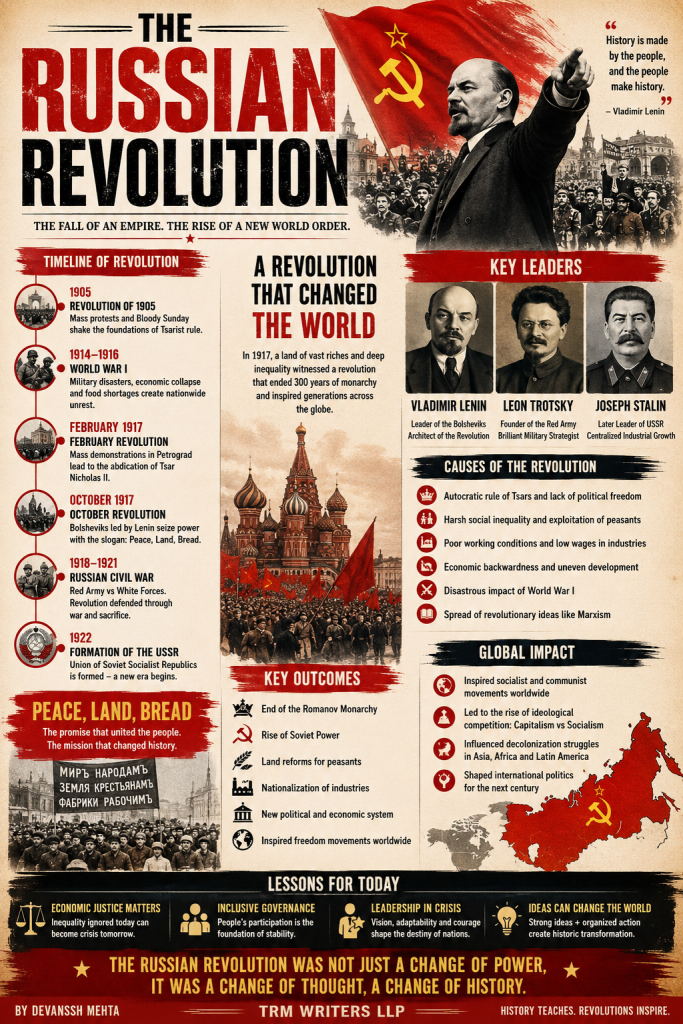
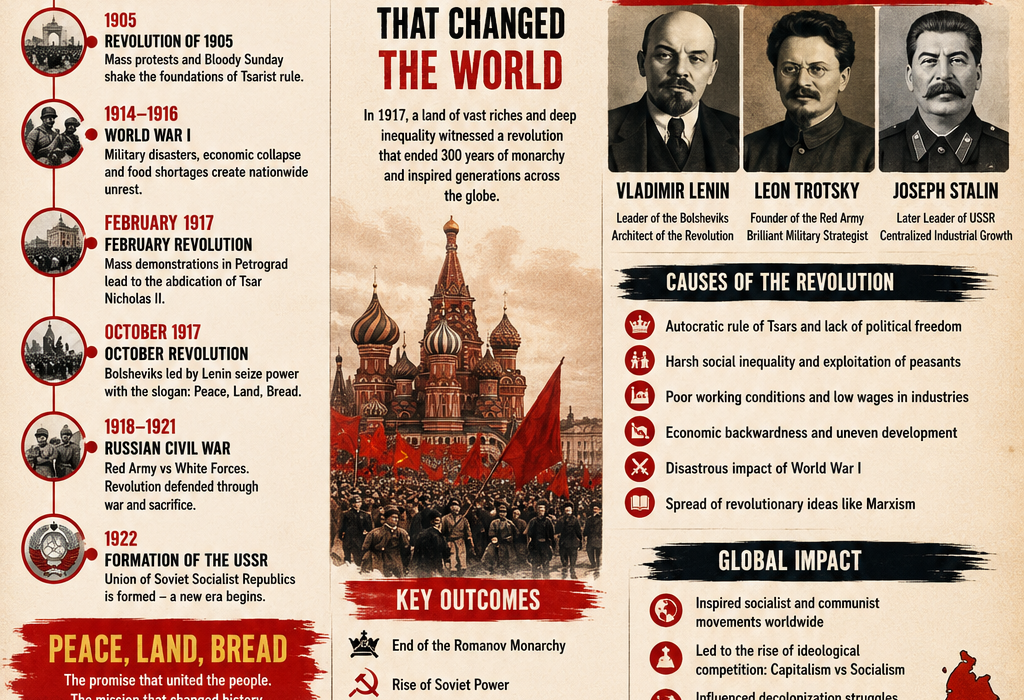
Few historical events altered the direction of global civilization as profoundly as the Russian Revolution. More than a political transition, it represented the collapse of monarchy, the rise of revolutionary ideology, the restructuring of economic systems, and the emergence of a new geopolitical order.
The Russian Revolution of 1917 changed not only Russia but also influenced the future of Europe, Asia, Latin America, and Africa. It transformed political language across the world. Terms such as socialism, workers’ rights, class struggle, state planning, revolutionary governance, and ideological competition gained unprecedented international relevance.
The revolution did not emerge overnight.
It was the outcome of decades of economic inequality, political dissatisfaction, military failures, social unrest, and ideological transformation.
This article presents a complete and detailed exploration of the Russian Revolution in an analytical yet accessible manner.
Table of Contents
- Understanding Russia Before the Revolution
- The Romanov Empire and Imperial Governance
- Social and Economic Conditions
- Industrialization and Worker Discontent
- Intellectual Roots of Revolution
- Leadership Crisis Under Nicholas II
- Revolution of 1905
- World War I and National Breakdown
- February Revolution of 1917
- Rise of Lenin and the Bolsheviks
- October Revolution
- Russian Civil War
- Economic Transformation Under Lenin
- Formation of the Soviet Union
- Rise of Stalin
- Global Impact of the Revolution
- Impact on India and Developing Nations
- Criticism and Historical Debates
- Long-Term Consequences
- Lessons for Modern Democracies
- Conclusion
Russia Before the Revolution: A Vast Empire with Deep Contradictions
At the beginning of the twentieth century, Russia was among the world’s largest empires.
Yet beneath territorial strength existed major structural weaknesses.
The Russian Empire experienced:
- Widespread poverty
- Agricultural dependence
- Political centralization
- Limited industrial development
- Social inequality
- Weak democratic institutions
The majority of the population lived in rural areas.
Economic growth remained uneven.
Political participation remained restricted.
These conditions gradually created revolutionary pressure.
The Romanov Empire: Power Concentrated in One Institution
For over three centuries Russia was ruled by the Romanov dynasty.
Several rulers expanded territorial reach and centralized administration.
Among the most influential figures were:
- Peter the Great
- Catherine the Great
Despite modernization efforts, reforms remained incomplete.
Industrial growth expanded selectively.
Political institutions remained highly centralized.
By the early twentieth century, demands for participation and reform intensified.
Social Structure and Economic Inequality
Russian society functioned through strong class divisions.
Aristocracy
Land ownership and political authority remained concentrated among elites.
Middle Classes
Urban professionals and merchants grew in influence but had limited political power.
Industrial Workers
Workers faced:
- Long working hours
- Low wages
- Minimal protections
- Poor living conditions
Peasantry
Most citizens depended on agriculture.
Although serfdom had ended in the nineteenth century, economic hardship continued.
Land remained unevenly distributed.
Industrialization and the Birth of Worker Consciousness
Industrial expansion accelerated during the late nineteenth century.
Factories appeared in major cities.
Railways expanded.
Urban migration increased.
However, rapid industrialization generated new tensions.
Workers began organizing.
Economic inequality became more visible.
Industrial growth created prosperity for some—but instability for many.
The Intellectual Foundation: Marxism and Revolutionary Thought
Modern revolutions rarely emerge without intellectual movements.
Russian political thinking became increasingly influenced by:
Karl Marx
Marx argued:
- Economic systems shape society
- History progresses through class struggle
- Workers ultimately challenge elite control
Russian revolutionaries adapted these ideas.
Among them emerged the most influential revolutionary figure:
Vladimir Lenin
Lenin believed disciplined revolutionary leadership could accelerate political transformation.
Tsar Nicholas II and the Crisis of Governance
Nicholas II ruled during a period of growing instability.
His government confronted:
- Economic dissatisfaction
- Labor protests
- Administrative inefficiency
- Military setbacks
Nicholas remained committed to centralized authority.
Many historians consider this inability to adapt one of the major contributors to revolutionary escalation.
Bloody Sunday and the Revolution of 1905
A major turning point occurred in January 1905.
Thousands marched peacefully toward the Winter Palace seeking reforms.
Government forces opened fire.
This event became known as:
Bloody Sunday
Consequences included:
- National outrage
- Worker strikes
- Political mobilization
- Reduced trust in monarchy
The government introduced limited reforms.
But dissatisfaction continued.
World War I: The Immediate Catalyst
The outbreak of:
World War I
placed enormous pressure on Russia.
The war produced:
Military Losses
Millions suffered casualties.
Economic Breakdown
Inflation increased.
Food Shortages
Cities struggled to maintain supply.
Political Instability
Confidence in government weakened dramatically.
Russia entered a cycle of crisis.
February Revolution of 1917: The End of Imperial Rule
In early 1917 demonstrations intensified.
Workers protested.
Citizens demanded food.
Soldiers increasingly refused orders.
Eventually:
Nicholas II abdicated.
The Romanov Empire collapsed.
A provisional government took control.
However, major problems remained unresolved.
Rise of Lenin and the Bolsheviks
Following political instability, Lenin returned to Russia.
His message gained support.
Key promises included:
- Peace
- Land
- Bread
Lenin’s political organization—the Bolsheviks—positioned itself as the force capable of delivering radical change.
Unlike moderate reformers, they advocated direct transfer of authority.
October Revolution: The Bolsheviks Seize Power
In October 1917 the Bolsheviks launched a coordinated takeover.
Strategic sites were occupied.
Government authority collapsed.
The event became known as:
October Revolution
The Bolsheviks established revolutionary control.
This marked the beginning of Soviet political history.
Russian Civil War: Revolution Defended Through Conflict
Political victory did not create immediate stability.
Civil war followed.
Two broad forces emerged:
Red Army
Supported revolutionary government.
Associated strongly with:
Leon Trotsky
White Forces
Opposed Bolshevik rule.
Civil war caused:
- Massive casualties
- Economic disruption
- Human suffering
Eventually the Red Army prevailed.
Economic Transformation Under Lenin
After revolution, major economic reforms emerged.
Policies included:
- Nationalization
- State planning
- Centralized production
Economic difficulties later led to:
New Economic Policy (NEP)
This introduced limited market flexibility while maintaining state direction.
The policy stabilized portions of the economy.
Formation of the Soviet Union
In 1922 a new state emerged:
Union of Soviet Socialist Republics
The Soviet Union became one of the twentieth century’s most influential powers.
Its goals included:
- Industrial modernization
- Socialist administration
- Strategic expansion
- Centralized governance
Rise of Stalin and Consolidation of Power
After Lenin’s death, leadership competition intensified.
Eventually:
Joseph Stalin
consolidated authority.
His governance emphasized:
- Industrial acceleration
- Central planning
- Agricultural collectivization
- Political control
Supporters highlighted industrial progress.
Critics emphasized political repression and human costs.
Global Impact of the Russian Revolution
The Russian Revolution influenced global politics in multiple ways.
1. Expansion of Socialist Movements
Political movements emerged worldwide.
2. Rise of Ideological Competition
Capitalism and socialism increasingly competed.
3. Influence on Decolonization
Anti-colonial leaders studied revolutionary models.
4. Strategic Realignment
International alliances evolved.
Impact of the Russian Revolution on India
India’s political thinkers observed events carefully.
The revolution influenced:
- Labor movements
- Political debates
- Economic planning ideas
- Discussions around equality and industrial development
Indian intellectual and political circles analyzed the balance between social justice and democratic governance.
Historical Debates: Liberation or Centralization?
Historians continue debating the revolution.
Supporters argue:
- It challenged inequality.
- It accelerated modernization.
- It expanded worker identity.
Critics argue:
- Centralization increased.
- Political freedoms narrowed.
- State authority expanded.
Both perspectives remain important to historical understanding.
Long-Term Consequences of the Russian Revolution
The revolution contributed to:
- Formation of the USSR
- Transformation of global diplomacy
- Emergence of ideological blocs
- Influence on twentieth-century conflicts
- Changes in labor and economic policy worldwide
Its effects extended far beyond Russian borders.
Lessons for Modern Democracies
The Russian Revolution offers enduring lessons.
Economic Growth Alone Is Not Enough
Development without inclusion creates instability.
Institutions Matter
Adaptive governance reduces systemic pressure.
Public Trust Is Strategic Capital
Political legitimacy influences national resilience.
Leadership During Crisis Shapes History
Responses to hardship determine historical outcomes.
Frequently Asked Questions (FAQ)
What caused the Russian Revolution?
Economic inequality, political dissatisfaction, industrial tensions, and World War I contributed significantly.
Who led the Russian Revolution?
The Bolshevik movement under Vladimir Lenin became the dominant revolutionary force.
What was the result of the Russian Revolution?
The Russian monarchy ended and Soviet political authority emerged.
Why is the Russian Revolution important?
It reshaped global politics, economics, and international relations throughout the twentieth century.
Conclusion: A Revolution That Still Shapes Modern Thought
The Russian Revolution was not simply a transfer of power.
It was a transformational event that altered the architecture of modern political imagination.
Its history continues to generate debate because it contains contradictions:
freedom and authority, equality and control, industrial progress and social cost, revolution and state power.
Whether interpreted as a triumph of social transformation or a cautionary lesson in concentrated governance, the Russian Revolution remains one of the defining events of human history.
Understanding it is not merely an exercise in historical memory—it is a study of how societies respond when institutions, economics, ideology, and public expectations collide.
Written by Devanssh Mehta
TRM WRITERS LLP