
How to Become a Successful Author in India: A Strategic Guide Based on Current Publishing Trends ✍️📚
Introduction: The Emerging Era of Indian Authors
India today is witnessing a remarkable transformation in its literary ecosystem. The growth of digital platforms, self-publishing technologies, social media influence, and online marketplaces has dramatically reshaped the journey of becoming a successful author. Unlike previous decades—when publication depended heavily on traditional publishing houses—today’s writers have multiple pathways to reach readers and build influence.
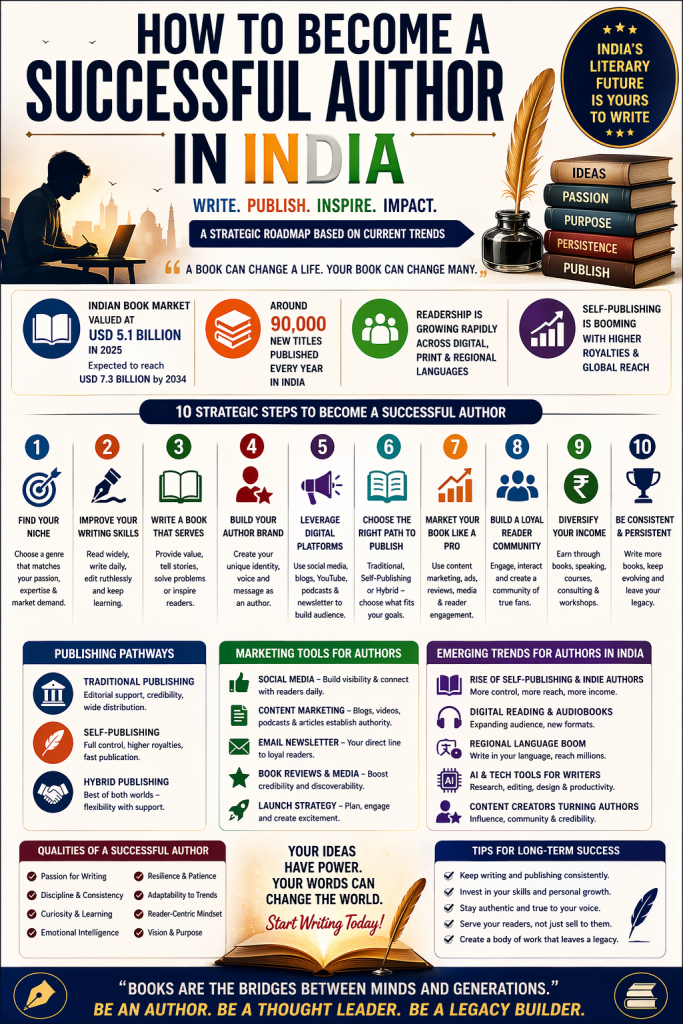
The Indian book market itself is expanding steadily. Industry reports estimate that the market was valued at over USD 5.1 billion in 2025 and is expected to reach about USD 7.3 billion by 2034, demonstrating sustained growth in publishing and readership. (IMARC Group)
Additionally, India publishes around 90,000 new titles annually, placing the country among the world’s major publishing nations. (The Times of India)
This expanding ecosystem offers tremendous opportunities for writers—but success requires strategic thinking. In the modern era, an author must not only write well but also understand branding, marketing, digital publishing, reader psychology, and content trends.
This article provides a comprehensive strategic roadmap for becoming a successful author in India, combining industry trends, publishing strategies, and practical steps for aspiring writers.
1. Understanding the Indian Publishing Landscape
1.1 Growth of the Indian Book Industry
The Indian publishing industry has grown rapidly in the last decade. Estimates indicate that the sector expanded from roughly ₹50,000 crore in 2019 to around ₹80,000 crore by 2024, reflecting increasing demand for books and knowledge products. (India Brand Equity Foundation)
Several factors have contributed to this growth:
- expansion of higher education
- digital reading platforms
- increasing literacy rates
- growth of regional language publishing
- rising middle-class readership
India’s publishing ecosystem includes:
- Traditional publishers
- Independent publishers
- Self-publishing platforms
- digital publishing platforms
This hybrid model has created multiple entry points for aspiring authors.
1.2 Rise of Self-Publishing
One of the most transformative trends in India is the rise of self-publishing.
With digital platforms, authors can publish books without traditional publishers. Platforms such as Kindle Direct Publishing allow writers to distribute their work globally and earn royalties from sales. (IN About Amazon)
Self-publishing has grown rapidly because of:
- internet penetration
- online bookstores
- smartphone usage
- increasing reader diversity
These factors have contributed to a steady increase in self-published titles in India. (Adhipati Creations –)
Self-publishing offers authors:
- creative freedom
- ownership of rights
- higher royalty rates
Some platforms offer up to 70% royalty per book sale, making it financially attractive. (ZorbaBooks)
2. Defining Success for an Author
Before beginning the journey, one must define what “successful author” means.
Success may include:
- Bestseller status
- literary recognition
- financial income
- intellectual influence
- social impact
In the modern literary economy, many authors achieve success through personal branding, speaking engagements, online influence, and consulting, in addition to book sales.
3. Choosing the Right Writing Niche
One of the most important decisions for an author is selecting the right genre or niche.
Popular genres in India include:
- self-help and personal development
- entrepreneurship and business
- mythology and historical fiction
- romance and contemporary fiction
- spirituality and philosophy
- exam preparation and educational books
Authors should choose a niche that combines:
- personal expertise
- audience demand
- storytelling capability
For example:
- professionals often write expertise-based books
- storytellers succeed in fiction genres
- researchers write academic books
The ideal niche lies at the intersection of knowledge, passion, and market demand.
4. Developing Exceptional Writing Skills
Success begins with the craft of writing.
Even in the era of digital marketing, a poorly written book cannot sustain readership.
Authors must focus on:
- narrative structure
- clarity of expression
- storytelling techniques
- editing and proofreading
Experienced writers recommend immersing oneself deeply in literature and studying narrative techniques used by successful authors. (LinkedIn)
Regular reading improves:
- vocabulary
- narrative understanding
- storytelling ability
Writing excellence is the foundation of long-term success.
5. Building a Personal Author Brand
Modern authors must think like entrepreneurs and brands.
Readers today follow authors not just for books but for ideas, personality, and expertise.
A strong author brand includes:
- unique voice
- clear intellectual identity
- recognizable themes
- consistent messaging
Examples of author brand positioning:
- motivational author
- historical storyteller
- geopolitical analyst
- entrepreneurship mentor
Your brand should answer a simple question:
What ideas do you represent?
6. Leveraging Digital Platforms
Digital platforms have revolutionized author success.
Today authors can reach millions of readers through:
- social media
- podcasts
- blogs
- newsletters
- video content
Platforms commonly used by authors include:
- YouTube
- Substack
- Medium
These platforms help authors:
- build readership
- promote books
- share ideas
- create intellectual influence
An author who builds a digital community often sells far more books than one who relies solely on traditional publishing.
7. Strategic Publishing Pathways
There are three main publishing paths available to Indian authors.
7.1 Traditional Publishing
Advantages:
- editorial support
- established distribution
- literary credibility
Limitations:
- low royalties
- long approval process
- limited creative control
7.2 Self-Publishing
Advantages:
- full control over book content
- faster publication
- higher royalties
Popular platforms include:
- Kindle Direct Publishing
- Notion Press
- Pothi
These platforms allow authors to publish both ebooks and print books with global distribution. (Authors Gully)
7.3 Hybrid Publishing
Hybrid publishing combines elements of both models.
Authors often:
- self-publish initial books
- later sign with traditional publishers after building audience
This strategy is increasingly common among modern authors.
8. Marketing Strategies for Authors
Writing a book is only half the journey.
The other half is marketing and promotion.
Successful authors use multiple marketing channels.
8.1 Social Media Marketing
Social media enables authors to build direct relationships with readers.
Key strategies include:
- storytelling posts
- writing tips
- behind-the-scenes content
- book discussions
8.2 Content Marketing
Content marketing helps authors establish authority.
Examples:
- blog articles
- podcasts
- educational videos
These platforms create thought leadership, which increases book credibility.
8.3 Email Newsletters
Email newsletters are powerful tools for maintaining reader relationships.
Benefits include:
- loyal reader community
- direct book promotion
- launch announcements
8.4 Book Reviews and Media Coverage
Positive reviews significantly influence book sales.
Authors should seek:
- blogger reviews
- YouTube book reviewers
- newspaper coverage
- podcast interviews
9. Building a Loyal Reader Community
The most successful authors cultivate reader communities rather than one-time buyers.
Community-building strategies include:
- reader clubs
- online discussion groups
- live Q&A sessions
- book signings
These communities create:
- word-of-mouth marketing
- repeat readership
- long-term influence.
10. Financial Realities of Being an Author
Authors must understand the economics of publishing.
For example:
A self-published ebook priced around ₹299 may earn around ₹200 per copy after royalties, depending on platform fees. (Write Right ®)
Income sources for authors often include:
- book sales
- speaking engagements
- consulting
- workshops
- courses
Thus, successful authors typically develop multiple revenue streams.
11. Importance of Consistency and Discipline
Most successful authors write multiple books.
Consistency builds:
- readership
- brand recognition
- intellectual influence
Writing one book rarely creates a career. Writing many meaningful books builds authority.
12. Emerging Trends Shaping the Future of Authors
Several trends will shape the future of authorship.
Digital reading growth
The global ebook market is expected to continue growing steadily as readers adopt digital formats. (SkyQuest Technology Consulting)
Regional language publishing
Nearly half of books sold in India are in regional languages, reflecting the country’s linguistic diversity. (The Times of India)
Content creators becoming authors
Many influencers and educators are transitioning into book writing.
AI-assisted writing
Artificial intelligence tools are beginning to assist authors with editing, research, and drafting.
13. Ethical Challenges and Risks
The digital publishing ecosystem also has risks.
For example:
- predatory publishing services
- fake marketing agencies
- publishing scams targeting authors
These scams often promise bestseller status or film deals to extract money from writers. (The Guardian)
Authors must remain cautious and verify publishers carefully.
14. Strategic Blueprint for Becoming a Successful Author
The modern author must combine creativity with strategic thinking.
A successful roadmap includes:
- develop deep expertise or storytelling ability
- write consistently
- choose the right niche
- build a personal brand
- leverage digital platforms
- publish strategically
- market actively
- build reader communities
- diversify income sources
- remain intellectually curious
Conclusion: The Future of Indian Authors
India is entering a new intellectual and literary renaissance.
The democratization of publishing, expansion of digital platforms, and growth of readership have created unprecedented opportunities for writers.
However, the modern author must evolve beyond the traditional role of a writer. Today’s successful author is simultaneously:
- a thinker
- a storyteller
- a communicator
- a brand
- a knowledge entrepreneur
Those who combine literary creativity with strategic thinking will not only achieve personal success but also contribute meaningfully to the intellectual development of India.
In the decades ahead, the authors who shape society will be those who transform their ideas into books, movements, and lasting intellectual legacies.