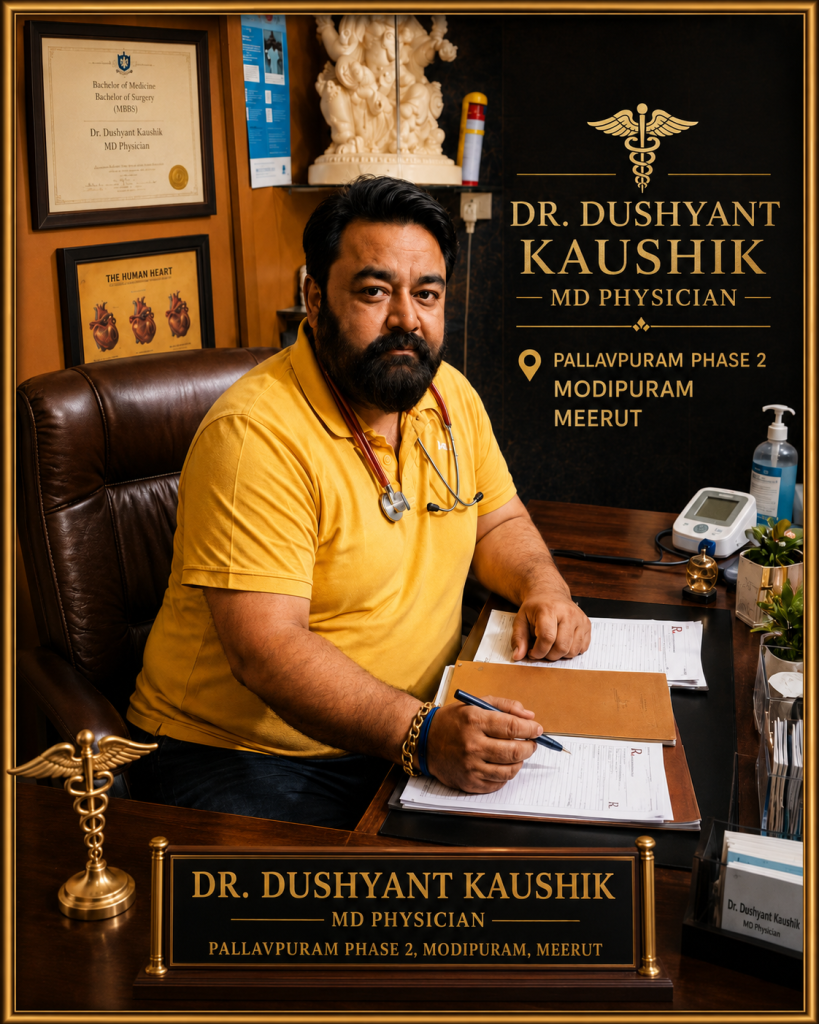
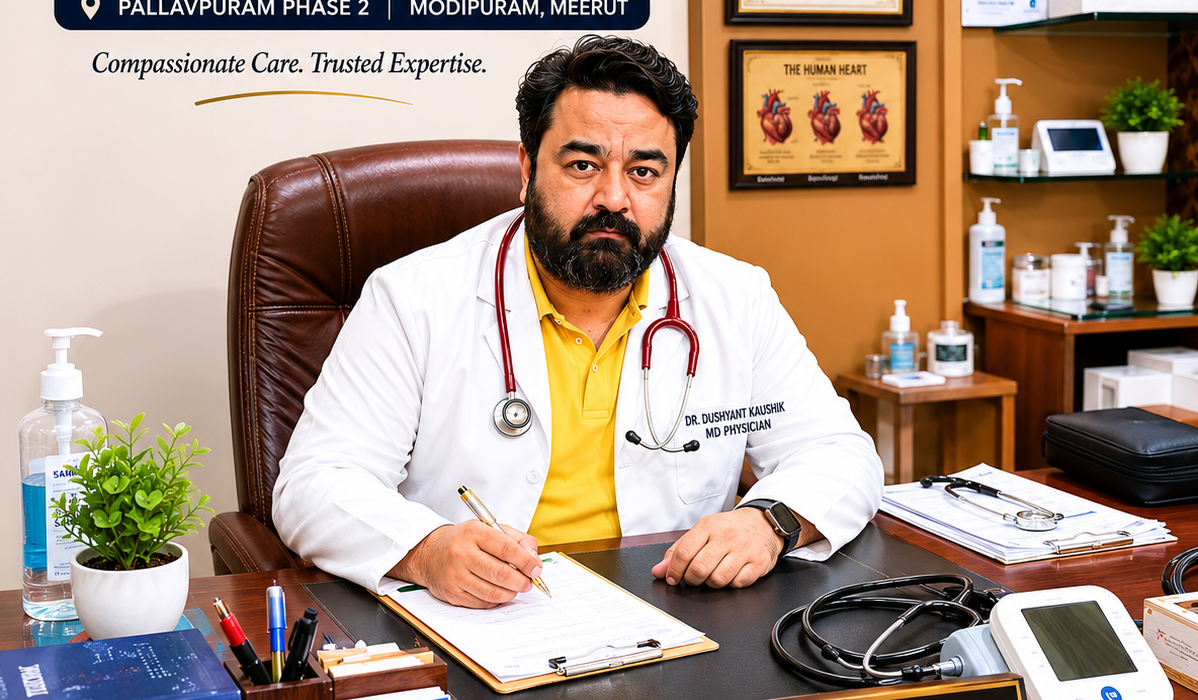
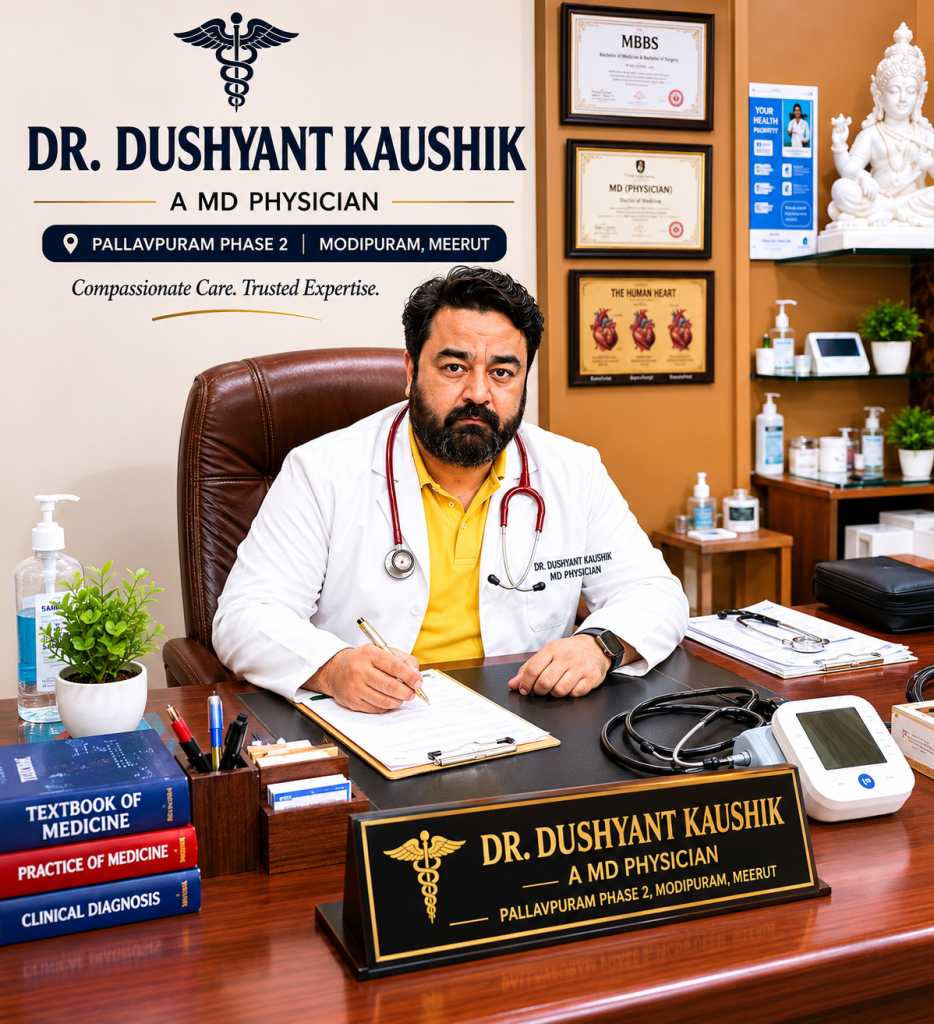
Dr. Dushyant Kaushik a MD PHYSCIAN at, Pallavpuram Phase 2, Modipuram, Meerut
A Portrait of Medical Commitment, Human Trust, and the Continuing Mission of Healing
There are professions that build institutions.
There are professions that create wealth.
And then there are professions that quietly sustain human life.
Medicine belongs to the latter.
Long before advanced technologies, super-specialized hospitals, and artificial intelligence transformed healthcare systems, healing began with a simple human relationship—the relationship between a physician and a patient. Across generations, societies have relied upon physicians not merely to cure disease but to preserve hope, interpret uncertainty, and guide families through moments of vulnerability.
Within the evolving healthcare landscape of Meerut, the role of the general physician continues to remain foundational. Among those serving at the frontline of everyday healthcare is Dr. Dushyant of Pallavpuram Phase 2, Modipuram, Meerut—a physician whose identity reflects continuity of care, patient trust, and a commitment toward serving humanity through medicine.
This article presents a refined reflection on the value of general medical practice and the broader spirit of community-centered healthcare.
Medicine Begins Before Treatment
Contrary to public perception, medicine does not begin with prescriptions.
It begins with understanding.
Every patient enters a consultation room carrying more than symptoms.
They carry concern.
They carry uncertainty.
They carry expectations.
Some arrive with reports in hand.
Others arrive with invisible burdens—stress, fear, exhaustion, unanswered questions.
The physician’s first responsibility is therefore not to prescribe.
It is to understand.
General physicians operate at a uniquely important position in healthcare because they encounter patients before labels are assigned.
Before disease becomes diagnosis.
Before illness becomes classification.
Before treatment becomes intervention.
This responsibility demands not only scientific competence but human sensitivity.
The Philosophy of General Practice
Modern healthcare frequently celebrates specialization.
Yet healthcare itself continues to depend upon physicians capable of seeing the whole patient.
General medicine represents one of the most intellectually demanding disciplines because it requires broad clinical awareness across multiple systems simultaneously.
The physician must constantly evaluate:
- Symptoms versus underlying causes
- Immediate treatment versus long-term management
- Investigation versus observation
- Intervention versus prevention
A patient presenting with fatigue may require nutritional guidance—or deeper metabolic investigation.
A headache may reflect lifestyle imbalance—or something more complex.
A physician therefore becomes an investigator, strategist, communicator, and caregiver at once.
This multidimensional role defines the strength of general practice.
The Human Architecture of Trust
Trust is perhaps the most valuable currency in medicine.
Unlike many professions, physicians are invited into the most private dimensions of human existence.
Patients reveal pain.
Families reveal fears.
People seek guidance during moments of uncertainty.
Such trust cannot be purchased.
It is built.
Slowly.
Consultation after consultation.
Year after year.
This relationship becomes especially meaningful in community medical practice where physicians remain accessible across different stages of life.
Children become adults.
Young professionals become parents.
Parents become senior citizens.
Yet one trusted physician often remains present across decades.
This continuity creates an invisible but powerful healthcare ecosystem.
Dr. Dushyant and the Spirit of Community Medicine
At Pallavpuram Phase 2 in Modipuram, the image of Dr. Dushyant reflects the enduring importance of neighborhood medical leadership.
Community physicians serve in a manner that often receives less public attention than large institutions—but their impact is immense.
Their consultation rooms become centers of:
- Clinical judgment
- Preventive awareness
- Medical reassurance
- Family healthcare guidance
- Early disease detection
Every working day presents new complexity.
One patient may require immediate intervention.
Another may need reassurance.
A third may require long-term disease management.
General physicians continuously move across these realities while maintaining consistency in care.
This ability demands discipline, resilience, and clinical maturity.
Beyond Diagnosis: Understanding the Person Behind the Patient
Scientific excellence remains essential.
But medicine achieves its highest form only when science and empathy coexist.
Good physicians do not merely ask:
“What symptoms are present?”
They also ask:
“How is this affecting life?”
Human-centered medicine recognizes that illness extends beyond physiology.
Health involves:
- Physical well-being
- Emotional resilience
- Family circumstances
- Social functioning
- Long-term quality of life
The physician therefore becomes not simply a clinical professional but a guide through uncertainty.
The Consultation Room as a Space of Confidence
To many people, a doctor’s chamber appears ordinary.
Yet from a patient’s perspective, it becomes one of the most emotionally important spaces.
People arrive seeking:
Answers.
Direction.
Relief.
Hope.
A calm physician can reduce fear before treatment begins.
Clear communication often improves outcomes.
Trust improves adherence.
Empathy strengthens healing.
These invisible aspects of medicine frequently shape patient experience more than people realize.
General Physicians: The Guardians of Preventive Healthcare
The future of healthcare increasingly belongs to prevention.
Treatment alone cannot sustain public health.
Prevention must become central.
General physicians occupy this critical role by promoting:
Early Recognition
Identifying disease before complications emerge.
Lifestyle Optimization
Encouraging healthier routines.
Rational Healthcare Decisions
Avoiding unnecessary interventions.
Longitudinal Monitoring
Supporting sustainable disease management.
Public Health Education
Improving awareness at the household level.
Through these actions, physicians influence communities far beyond individual consultations.
The Intellectual Discipline Behind Everyday Medicine
General practice appears simple only to those unfamiliar with its complexity.
Behind every consultation exists rapid clinical reasoning.
The physician must evaluate:
- History
- Symptoms
- Examination findings
- Differential possibilities
- Risk assessment
- Follow-up planning
And all of this often occurs within limited consultation time.
This constant decision-making reflects one of the most demanding forms of professional work.
Medicine remains both science and judgment.
Service to Humanity: Medicine’s Highest Calling
Throughout history, societies have placed extraordinary respect upon physicians.
This respect does not emerge from authority.
It emerges from responsibility.
Doctors work where people are vulnerable.
They encounter:
Pain.
Recovery.
Uncertainty.
Human limitation.
Service to humanity therefore becomes more than an ideal.
It becomes daily practice.
It appears through:
Long working hours.
Patient listening.
Continuous learning.
Responsible prescribing.
Remaining available.
These quiet acts collectively define medical dignity.
Healthcare Leadership Through Local Presence
A physician practicing within a community eventually becomes more than a healthcare provider.
They become part of the social structure.
Their influence reaches:
Families.
Children.
Elderly populations.
Health habits.
Preventive decisions.
Public awareness.
This form of local leadership contributes substantially to healthier communities.
Modern Medicine Requires Human Balance
Healthcare today is changing rapidly.
Technology advances.
Diagnostics become sophisticated.
Information becomes abundant.
Yet patients still seek something timeless.
They seek confidence.
They seek understanding.
They seek physicians who combine modern medicine with human connection.
General physicians remain essential because they bridge both worlds.
The Future of Primary Healthcare in India
India’s healthcare transformation will depend not only upon hospitals and innovation.
Its real strength will continue to emerge from:
Accessible physicians.
Preventive medicine.
Clinical continuity.
Community trust.
Primary care excellence.
General physicians will remain central to achieving these goals.
The Legacy of a Physician
Professional success is often measured through numbers.
Medicine is measured differently.
Physicians are remembered through experiences.
Patients remember:
The reassuring conversation.
The timely diagnosis.
The thoughtful explanation.
The kindness during difficult days.
These moments create legacies that extend far beyond clinics.
Conclusion
Where Medicine Meets Humanity
The value of medicine cannot be measured solely by procedures performed or prescriptions written.
Its highest expression lies in human service.
The journey of physicians working at the community level reflects this principle every day.
Dr. Dushyant of Pallavpuram Phase 2, Modipuram, Meerut represents the continuing relevance of patient-centered general practice and the enduring importance of physicians who remain connected to the communities they serve.
Because ultimately—
Medicine is not only about extending life.
It is about strengthening it.
Not merely treating illness—
but restoring confidence.
Not only practicing healthcare—
but honoring humanity itself.