
Why Most Startups in India Fail in the Practical Business Ecosystem
A Strategic and Analytical Perspective
Introduction: The Paradox of India’s Startup Revolution
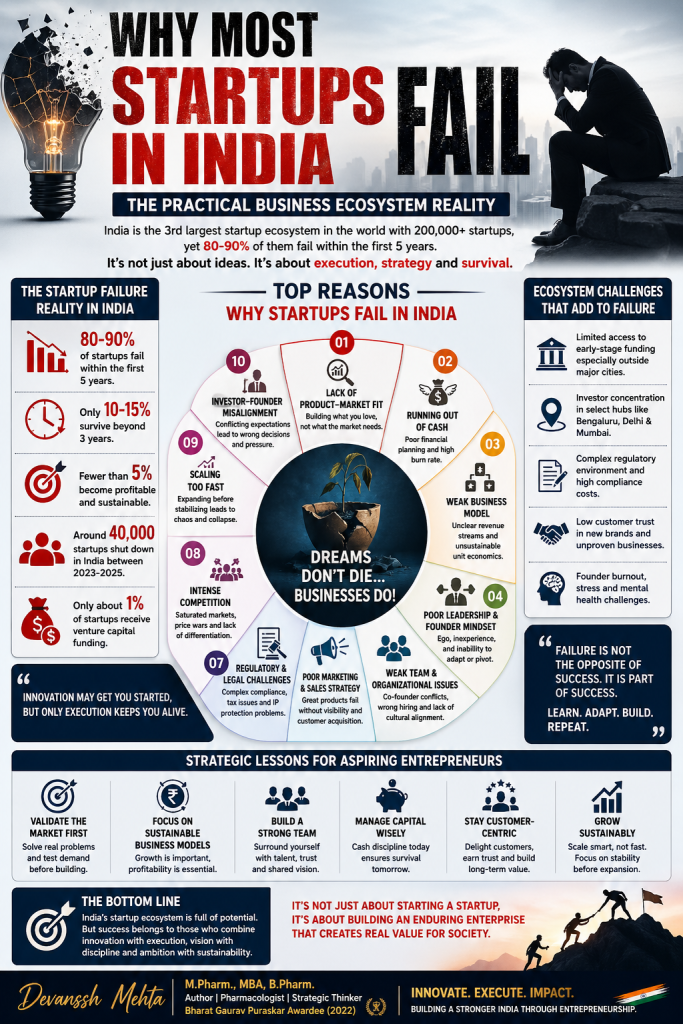
Over the past decade, India has emerged as one of the world’s most dynamic startup ecosystems. With more than 200,000 recognized startups and a rapidly expanding entrepreneurial culture, India is now the third-largest startup ecosystem globally. Yet behind this remarkable growth lies a stark reality: approximately 80–90% of startups in India fail within the first five years of operation. (Open Magazine)
This paradox presents an important question for policymakers, entrepreneurs, investors, and scholars:
Why do most startups fail despite the enthusiasm, capital inflow, and technological opportunities available in India?
The answer lies not in a single cause but in a complex interplay of market realities, founder psychology, structural constraints, financial mismanagement, and strategic mistakes.
From a practical business perspective, startups fail when vision is not supported by execution, innovation is not aligned with market needs, and ambition is not supported by sustainable business models.
This article explores the real reasons behind startup failures in India, analyzing the practical ecosystem challenges that destroy promising ventures.
1. The Reality of Startup Failure in India
Before understanding the causes, it is important to examine the scale of the phenomenon.
Research and industry reports consistently reveal alarming statistics:
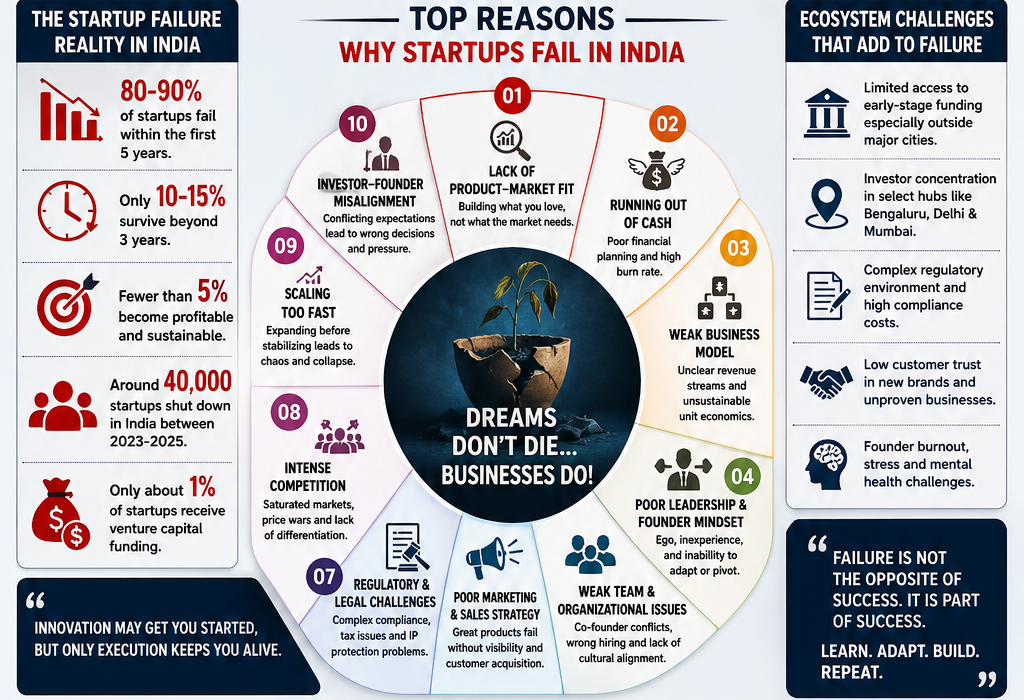
- Nearly 90% of startups fail within five years in India. (Open Magazine)
- Only 10–15% survive beyond three years, and fewer than 5% become profitable. (BizPlan AI Pro)
- India’s startup success rate is around 10%, compared to the global average of 33%. (Filing Buddy)
In addition, thousands of startups shut down each year due to financial, strategic, or operational failures. Between 2023 and 2025 alone, nearly 40,000 startups ceased operations in India, highlighting the fragile nature of the ecosystem. (The India Jobs)
Thus, the startup landscape resembles a high-risk experimentation arena, where only a small minority of companies survive long enough to become unicorns or profitable enterprises.
2. Lack of Product–Market Fit: The Most Fatal Mistake
One of the most fundamental reasons for startup failure is lack of product–market fit.
Studies suggest that 34–42% of startup failures occur because founders build products that the market does not actually need. (LinkedIn)
This mistake usually occurs due to three key factors:
Founder Bias
Entrepreneurs often fall in love with their ideas rather than real problems.
Instead of validating demand through research, they assume that innovation automatically creates demand.
Poor Market Research
Many founders fail to conduct proper:
- consumer behavior analysis
- pricing studies
- demand forecasting
Without these insights, startups create solutions that customers simply ignore.
Copycat Entrepreneurship
Another widespread phenomenon in India is copying Western business models without adapting them to local realities. (Forbes)
For example:
Silicon Valley business models often assume:
- high purchasing power
- digital maturity
- homogeneous markets
India, however, is a highly price-sensitive and fragmented market, making direct replication ineffective.
Thus, startups that copy global ideas without localization often collapse.
3. Running Out of Cash: Financial Mismanagement
The second major cause of startup failure is running out of money.
Research shows that 29–35% of startup failures occur due to poor financial management. (LinkedIn)
Unlike traditional businesses, startups typically operate with high burn rates, meaning they spend large amounts of capital on:
- technology development
- marketing campaigns
- talent acquisition
- infrastructure
However, many founders underestimate how quickly cash disappears.
Common financial mistakes include:
Unrealistic Revenue Projections
Founders often assume exponential growth without considering:
- customer acquisition costs
- operational expenses
- market adoption speed.
Overdependence on Venture Capital
Only about 1% of startups receive venture capital funding, meaning most startups struggle to secure financial backing. (BizPlan AI Pro)
Without funding, startups collapse before reaching profitability.
Poor Unit Economics
Many startups pursue growth at the cost of profitability, offering heavy discounts and subsidies.
This strategy may increase user numbers temporarily but destroys long-term sustainability.
4. Weak Business Models
A brilliant idea alone cannot sustain a startup.
What matters is the business model that converts innovation into revenue.
Many startups fail because their business models are fundamentally flawed.
Common weaknesses include:
Unclear Revenue Streams
Some startups prioritize user growth while ignoring how money will actually be generated.
This leads to the phenomenon known as “growth without profitability.”
Excessive Discount Culture
In sectors like:
- food delivery
- ride-sharing
- e-commerce
companies often rely on discounts to attract customers.
However, once discounts stop, users disappear.
Lack of Scalability
A startup must grow without proportional increases in costs.
If operational costs increase faster than revenue, the business becomes unsustainable.
5. Poor Leadership and Founder Mindset
Another critical but often ignored factor is founder psychology and leadership quality.
Startups are not just businesses — they are human systems built around founders.
When founders lack leadership maturity, startups collapse.
Common founder mistakes include:
Ego-Driven Decisions
Many founders refuse to accept criticism or pivot when the market signals failure.
Lack of Business Experience
Young entrepreneurs often have technical skills but limited knowledge of:
- finance
- operations
- human resource management.
Vision Without Execution
Great ideas require disciplined execution.
Without operational discipline, vision alone cannot sustain a company.
6. Weak Teams and Organizational Dysfunction
Startups are team efforts, not individual achievements.
Yet many startups fail because of team conflicts and poor hiring decisions.
Typical problems include:
Founder Disputes
Co-founders frequently disagree over:
- equity distribution
- strategy
- leadership roles.
These conflicts often destroy the company.
Hiring the Wrong Talent
Startups sometimes recruit:
- overqualified employees with high salaries
- inexperienced staff lacking necessary skills.
Both situations create operational inefficiencies.
Lack of Cultural Alignment
Without shared values and mission clarity, startup teams lose cohesion.
7. Poor Sales and Marketing Strategy
Even the best product fails if customers never hear about it.
Research shows that inadequate sales and marketing strategy is one of the most common reasons for startup failure. (ResearchGate)
Many startups mistakenly assume that technology alone will attract customers.
However, successful businesses require:
- strategic branding
- customer acquisition strategies
- distribution channels.
Startups that neglect marketing often disappear from the market despite having innovative products.
8. Regulatory and Legal Challenges
India’s regulatory environment can also hinder startup success.
Entrepreneurs often face difficulties related to:
- taxation
- compliance requirements
- licensing
- intellectual property protection.
For example, patent approvals for startups remain limited, reflecting challenges in protecting innovation. (NEXT IAS)
Regulatory complexity increases operational costs and slows growth.
9. Intense Competition and Market Saturation
The Indian startup ecosystem is becoming increasingly crowded.
Many entrepreneurs launch startups in already saturated sectors, such as:
- fintech
- food delivery
- e-commerce
- edtech.
Without differentiation, startups become trapped in price wars and customer acquisition battles. (Medium)
When multiple companies offer similar products, only those with the strongest funding survive.
10. Scaling Too Fast
Rapid scaling is often celebrated in startup culture.
However, scaling prematurely can destroy companies.
Startups frequently expand into new markets before stabilizing their core operations.
This leads to:
- operational chaos
- rising costs
- declining service quality.
Instead of sustainable growth, startups experience financial collapse.
11. Misalignment Between Investors and Founders
Another overlooked issue is the conflict between venture capital expectations and business reality.
Investors typically demand:
- rapid growth
- aggressive expansion
- large market capture.
However, sustainable businesses require gradual scaling and financial discipline.
When founders prioritize investor expectations over business fundamentals, companies become unstable.
12. Infrastructure and Ecosystem Limitations
While India’s startup ecosystem has improved significantly, structural challenges remain.
These include:
- limited access to early-stage funding
- geographic concentration of investors in cities like Bengaluru and Delhi
- weak support systems in smaller regions.
Startups outside major tech hubs struggle to gain visibility and investment opportunities.
13. Customer Trust Deficit
In India, consumers are often skeptical about new brands.
Building trust requires:
- strong service quality
- consistent product reliability
- transparent communication.
Startups that fail to deliver reliable experiences lose customers quickly.
Customer dissatisfaction can rapidly destroy brand reputation.
14. Technology Without Strategy
Many startups focus excessively on technology while ignoring business fundamentals.
Innovation alone does not guarantee success.
What matters is the strategic integration of technology with market needs and operational execution.
Startups that prioritize engineering over strategy often struggle to generate revenue.
15. Psychological Burnout Among Founders
Startup entrepreneurship is extremely demanding.
Founders face:
- financial pressure
- investor expectations
- long working hours
- constant uncertainty.
Psychological burnout can impair decision-making and leadership effectiveness.
Without resilience and emotional stability, founders struggle to sustain their ventures.
Strategic Lessons for Entrepreneurs
Understanding startup failures offers valuable lessons for aspiring founders.
The following principles increase the probability of success:
Validate the Market Before Building
Entrepreneurs must ensure that real customer demand exists.
Focus on Sustainable Unit Economics
Growth must be supported by profitable business models.
Build Strong Teams
Successful startups rely on complementary skills and shared vision.
Manage Capital Carefully
Financial discipline is essential during early stages.
Stay Customer-Centric
Customer satisfaction must remain the central priority.
The Future of the Indian Startup Ecosystem
Despite high failure rates, India’s startup ecosystem continues to evolve.
The coming decade will likely witness:
- greater emphasis on deep-tech innovation
- improved startup governance
- stronger founder education
- better investor discipline.
As the ecosystem matures, startup success rates are expected to improve.
Conclusion: Failure as a Necessary Evolution
Startup failure should not be viewed purely as a negative outcome.
In innovation-driven economies, failure is often an essential component of experimentation and learning.
The Indian startup ecosystem is still in its developmental stage, where entrepreneurs, investors, and policymakers are collectively learning how to build sustainable businesses.
Ultimately, the true challenge for Indian entrepreneurs is not merely launching startups but creating enduring enterprises capable of delivering real value to society.
Only when startups combine innovation, financial discipline, customer understanding, and strategic leadership will India witness the emergence of globally dominant entrepreneurial companies.