
The Architecture of Authorship
A Strategic and Intellectual Guide to Writing a Meaningful Book in the Modern Era
Introduction: Writing a Book as an Intellectual Journey
Writing a book is one of the most powerful acts of human expression. Across centuries, books have served as vessels of knowledge, carriers of culture, and instruments of societal transformation. From scientific treatises that revolutionized medicine to philosophical works that reshaped civilizations, the written word has consistently demonstrated its ability to influence human thought and progress.
In the modern era, writing a book has become both more accessible and more competitive. Digital publishing platforms, online bookstores, and global distribution networks have democratized authorship. At the same time, this accessibility has increased the number of aspiring authors entering the literary ecosystem. Consequently, writing a successful book today requires not only creativity but also strategy, discipline, intellectual clarity, and structured execution.
The process of writing a book is not merely about assembling words into chapters. It is about transforming ideas into structured narratives, developing coherent arguments, and communicating insights that resonate with readers. A meaningful book is built on intellectual rigor, thoughtful organization, and a deep understanding of the audience it intends to serve.
This article explores the complete process of writing a book—from conceptualization to publication—through a structured and strategic framework.
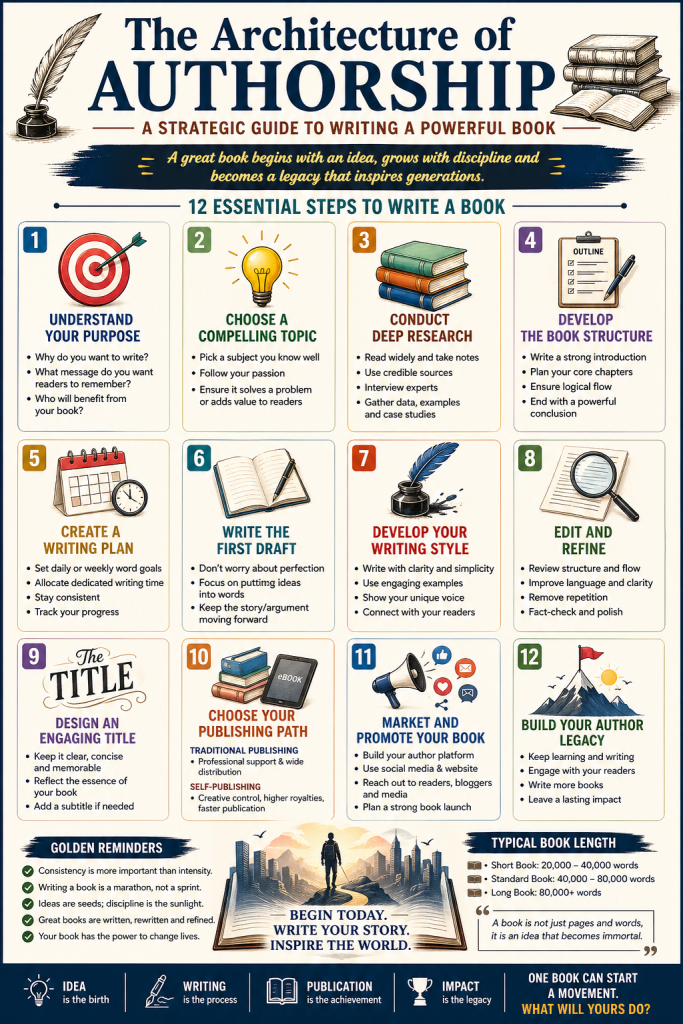
1. Understanding the Purpose of Writing a Book
Every meaningful book begins with a purpose. Without a clear objective, writing can quickly become directionless and fragmented.
Authors generally write books for one or more of the following reasons:
Knowledge dissemination – sharing expertise, research findings, or professional insights.
Storytelling – narrating fictional or real-life experiences that engage readers emotionally.
Thought leadership – presenting new ideas that influence public thinking or policy.
Personal expression – documenting personal journeys, reflections, or philosophies.
Before beginning the writing process, an author must ask fundamental questions:
- Why do I want to write this book?
- What message do I want readers to remember?
- Who will benefit from this book?
A clear purpose acts as the intellectual compass that guides the entire writing process.
2. Choosing a Compelling Topic
The foundation of any book lies in its topic. Selecting the right subject determines the relevance, impact, and market potential of the work.
An effective book topic typically satisfies three important criteria:
Expertise – The author should possess substantial knowledge or experience related to the subject.
Passion – Writing a book requires sustained effort; passion ensures long-term commitment.
Relevance – The topic should address questions, problems, or curiosities that readers genuinely care about.
For example, books often fall into major categories such as:
- Educational and academic works
- Scientific and technical books
- Business and leadership literature
- Self-development and psychology
- Fiction and storytelling
- Biographies and memoirs
Choosing a topic aligned with both personal expertise and reader interest significantly increases the chances of creating a meaningful book.
3. Conducting Deep Research
Research forms the backbone of intellectually credible writing. Even in fiction, authenticity often depends on well-researched contexts.
A strong research process may include:
- Reading academic papers and reference books
- Studying historical and contemporary developments
- Interviewing subject experts
- Analyzing case studies and real-world examples
- Collecting data from reliable sources
Research not only enriches the content but also prevents misinformation and strengthens the author’s authority.
For non-fiction books especially, rigorous research distinguishes serious scholarship from superficial commentary.
4. Developing the Book Structure
One of the most critical stages in writing a book is designing its structure. A well-structured book provides logical flow and intellectual coherence.
Most books follow a basic framework:
Introduction
The introduction sets the stage for the entire book. It introduces the topic, explains its significance, and prepares readers for the journey ahead.
Core Chapters
These chapters form the main body of the book. Each chapter should explore a specific aspect of the central theme.
A useful strategy is to ensure that:
- Each chapter answers a specific question.
- Chapters logically build upon one another.
- The narrative progresses gradually toward deeper insights.
Conclusion
The conclusion summarizes the key ideas of the book and reinforces the central message.
For academic and analytical works, this section may also present future implications and broader reflections.
5. Creating a Writing Plan
Writing a book is a marathon, not a sprint. Without a disciplined writing routine, many promising projects remain unfinished.
Successful authors often create structured writing schedules. For example:
- Writing 500–1000 words daily
- Allocating specific hours each day for writing
- Setting weekly chapter targets
Consistency is more important than intensity. Even modest daily progress can lead to the completion of a full manuscript over time.
A typical book manuscript ranges from 40,000 to 80,000 words, depending on genre and complexity.
6. Writing the First Draft
The first draft represents the transformation of ideas into written form. At this stage, perfection should not be the primary concern.
Many aspiring authors struggle because they attempt to produce flawless writing immediately. This approach often leads to writer’s block.
Instead, the first draft should focus on:
- Capturing ideas freely
- Developing the narrative flow
- Expanding chapter outlines into detailed discussions
Editing and refinement can occur later. The priority during drafting is simply completing the manuscript.
7. Developing a Distinct Writing Style
A book becomes memorable not only because of its ideas but also because of the voice through which those ideas are expressed.
Effective writing style often involves:
- Clarity and readability
- Logical argumentation
- Engaging storytelling
- Balanced use of examples and explanations
For analytical books, authors may adopt a structured approach combining narrative and intellectual depth.
A strong writing style allows readers to feel both informed and intellectually stimulated.
8. Editing and Refinement
Once the first draft is complete, the manuscript enters the most critical stage: editing.
Editing improves clarity, coherence, and overall quality.
The editing process usually involves multiple layers:
Structural Editing
Ensures the overall organization of chapters and arguments is logical.
Language Editing
Improves grammar, sentence flow, and readability.
Content Editing
Verifies facts, strengthens explanations, and removes redundant material.
Many successful authors rewrite their manuscripts multiple times before finalizing them.
9. Designing an Engaging Title
The title of a book plays a crucial role in attracting readers. It should communicate the essence of the book while generating curiosity.
A strong title typically:
- Clearly reflects the book’s theme
- Is concise and memorable
- Sparks intellectual interest
Subtitles are often used to clarify the book’s scope and value proposition.
For example:
Title: The Architecture of Authorship
Subtitle: A Strategic Guide to Writing Powerful Books in the Modern Age
10. Publishing Options in the Modern Era
Today’s authors have several publishing pathways.
Traditional Publishing
In this model, authors submit manuscripts to publishing houses. If accepted, the publisher manages editing, printing, and distribution.
Advantages include professional editing and established distribution networks.
However, acceptance rates are often low.
Self-Publishing
Self-publishing platforms such as digital bookstores allow authors to publish independently.
Advantages include:
- Complete creative control
- Faster publication
- Higher royalty percentages
However, authors must manage editing, design, and marketing themselves.
11. Marketing and Promoting the Book
Writing a great book is only half the journey. Reaching readers requires strategic promotion.
Modern authors often use:
- Personal websites and blogs
- Social media platforms
- Author interviews and podcasts
- Book launch events
- Email newsletters
Effective marketing ensures that the intellectual effort invested in writing the book reaches the intended audience.
12. Developing Long-Term Author Identity
Writing one book can be an achievement. Writing multiple books can establish an intellectual legacy.
Authors who aim to build long-term influence often develop a consistent thematic focus. For example:
- Leadership and management
- Science and innovation
- National policy and strategy
- Personal development and psychology
Over time, such thematic consistency builds authority and recognition.
Conclusion: Writing a Book as a Legacy of Thought
Writing a book is far more than a creative exercise. It is an act of intellectual contribution. Each book adds a new perspective to the collective knowledge of humanity.
The journey from idea to published manuscript requires vision, discipline, research, and perseverance. Yet the rewards extend far beyond financial success or recognition. A well-written book can inspire minds, influence decisions, and shape the thinking of future generations.
In an era defined by rapid information exchange and digital transformation, books continue to hold unique power. They provide depth in a world of distractions and reflection in a culture of speed.
For those who aspire to write, the most important step is simple: begin.
Every great book once started as a single idea in the mind of an author willing to transform thought into words—and words into lasting impact.