A Comprehensive Guide to Careers in Pharmacy
Navigating Opportunities, Specializations, and Future Pathways in Pharmaceutical Sciences
Introduction
Pharmacy is one of the most intellectually stimulating and socially impactful professions in the modern healthcare ecosystem. Positioned at the intersection of medicine, chemistry, biology, and technology, the field of pharmacy plays a pivotal role in ensuring that scientific discoveries are transformed into safe, effective, and accessible therapeutic solutions for patients across the world.
In recent decades, the pharmaceutical profession has undergone a remarkable transformation. Traditionally perceived merely as the science of drug dispensing, pharmacy has evolved into a multidisciplinary domain encompassing drug discovery, clinical therapeutics, regulatory science, pharmacovigilance, biotechnology, health economics, digital health, and global pharmaceutical policy.
For aspiring students, professionals seeking career transitions, and individuals interested in healthcare innovation, pharmacy offers an extraordinary spectrum of opportunities. From research laboratories developing life-saving medicines to regulatory agencies safeguarding drug safety, from hospital settings optimizing therapeutic outcomes to pharmaceutical companies shaping global healthcare markets, pharmacists contribute profoundly to human wellbeing.
This article presents a detailed guide to careers in pharmacy, exploring the educational pathways, professional specializations, emerging opportunities, and strategic considerations necessary for building a successful and meaningful career in the pharmaceutical sciences.
Understanding Pharmacy as a Scientific Discipline
Pharmacy, in its broadest sense, is the science and practice of discovering, developing, producing, and ensuring the safe and effective use of medications.
The profession integrates knowledge from several scientific domains including:
- Pharmaceutical Chemistry – designing and synthesizing new drug molecules
- Pharmacology – studying the biological effects of drugs on living systems
- Pharmaceutics – developing drug delivery systems and dosage forms
- Pharmacognosy – exploring medicines derived from natural sources
- Clinical Pharmacy – optimizing drug therapy for individual patients
Pharmacists act as the critical bridge between scientific discovery and patient care. They ensure that medications are not only scientifically sound but also administered safely, ethically, and effectively.
In a rapidly evolving healthcare environment characterized by biotechnology breakthroughs, personalized medicine, and digital health technologies, pharmacists are increasingly recognized as essential healthcare professionals and scientific innovators.
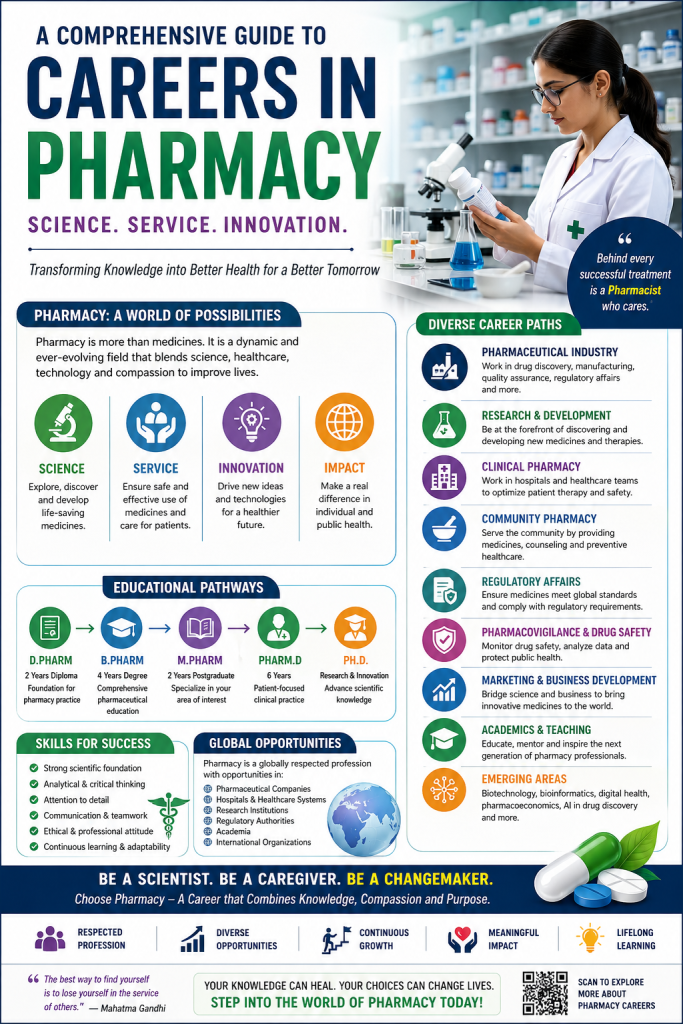
Educational Pathways in Pharmacy
The journey toward a pharmacy career typically begins with formal education in pharmaceutical sciences. Several academic pathways are available depending on career aspirations.
Diploma in Pharmacy (D.Pharm)
The Diploma in Pharmacy is a two-year foundational program designed primarily for individuals interested in community pharmacy practice and retail pharmacy operations. After completing this program, graduates can register with state pharmacy councils and work as pharmacists in medical stores, hospitals, and pharmaceutical distribution networks.
Bachelor of Pharmacy (B.Pharm)
The Bachelor of Pharmacy is the most widely pursued undergraduate degree in pharmaceutical sciences. This four-year program provides comprehensive knowledge in areas such as pharmaceutics, pharmacology, pharmaceutical chemistry, pharmacognosy, and pharmaceutical analysis.
Graduates of B.Pharm programs can pursue careers in:
- Pharmaceutical manufacturing
- Quality control laboratories
- Regulatory affairs
- Medical writing
- Sales and marketing
- Hospital pharmacy
Master of Pharmacy (M.Pharm)
The Master of Pharmacy is a postgraduate specialization program that allows students to develop deeper expertise in specific domains such as:
- Pharmacology
- Pharmaceutics
- Pharmaceutical Chemistry
- Pharmaceutical Analysis
- Pharmacognosy
- Regulatory Affairs
- Industrial Pharmacy
An M.Pharm degree often opens doors to research roles, academic careers, and higher positions within pharmaceutical industries.
Doctor of Pharmacy (Pharm.D)
The Pharm.D program focuses primarily on clinical pharmacy practice and patient-centered pharmaceutical care. This program prepares pharmacists to work closely with physicians and healthcare teams in hospitals, optimizing medication therapy and ensuring patient safety.
Doctoral Research (Ph.D.)
For individuals passionate about scientific discovery and academic leadership, pursuing a Ph.D. in pharmaceutical sciences represents the highest academic pathway. Doctoral researchers contribute to drug discovery, clinical research, pharmacokinetics, biotechnology innovation, and healthcare policy.
Core Career Domains in Pharmacy
The pharmaceutical profession offers diverse career paths, each aligned with different interests, skills, and professional aspirations.
Pharmaceutical Industry
The pharmaceutical industry remains one of the largest employment sectors for pharmacy graduates. Professionals in this domain contribute to the entire lifecycle of medicines—from discovery to commercialization.
Key roles include:
- Drug formulation scientists
- Production managers
- Quality assurance specialists
- Regulatory affairs professionals
- Clinical research associates
- Medical science liaisons
The industry environment demands strong scientific knowledge, regulatory understanding, and strategic thinking.
Research and Development
Drug discovery and development represent one of the most intellectually rewarding aspects of pharmacy. Researchers in pharmaceutical R&D laboratories work on identifying novel therapeutic targets, designing drug molecules, and developing advanced drug delivery systems.
Research careers may involve:
- Medicinal chemistry research
- Pharmacological studies
- Toxicological evaluations
- Biopharmaceutical innovation
- Nanotechnology-based drug delivery
Pharmaceutical research plays a central role in addressing global health challenges such as cancer, infectious diseases, neurodegenerative disorders, and metabolic diseases.
Clinical Pharmacy and Hospital Practice
Clinical pharmacists work directly with healthcare teams to ensure that patients receive safe and effective medication therapy.
Their responsibilities often include:
- Reviewing prescriptions for drug interactions
- Monitoring therapeutic outcomes
- Advising physicians on optimal drug selection
- Educating patients about medication use
With the rise of personalized medicine and complex treatment regimens, clinical pharmacy is becoming increasingly important in modern healthcare systems.
Community Pharmacy
Community pharmacists serve as the most accessible healthcare professionals for the public. Working in retail pharmacies and community health centers, they provide essential services such as:
- Dispensing medications
- Counseling patients on drug use
- Managing minor health conditions
- Promoting preventive healthcare
In many countries, community pharmacists also participate in vaccination programs and public health initiatives.
Pharmaceutical Regulatory Affairs
Regulatory affairs professionals ensure that pharmaceutical products comply with national and international regulatory standards before they reach the market.
Their responsibilities include:
- Preparing regulatory submissions
- Interacting with drug regulatory authorities
- Ensuring compliance with Good Manufacturing Practices (GMP)
- Monitoring post-marketing drug safety
Regulatory professionals play a vital role in maintaining the integrity and safety of pharmaceutical products.
Pharmacovigilance and Drug Safety
Pharmacovigilance is the science of monitoring the safety of medicines after they are approved for public use. Specialists in this field analyze adverse drug reactions, identify safety signals, and contribute to improving drug safety policies.
With the expansion of global pharmaceutical markets, pharmacovigilance has become a rapidly growing career domain.
Pharmaceutical Marketing and Business Development
The pharmaceutical industry requires professionals who understand both scientific concepts and business strategies. Marketing professionals communicate scientific information about medicines to healthcare professionals and ensure that pharmaceutical innovations reach patients effectively.
Careers in this domain include:
- Medical representatives
- Product managers
- Pharmaceutical brand strategists
- Market research analysts
These roles demand strong communication skills, scientific understanding, and strategic thinking.
Academic and Teaching Careers
Pharmacy graduates with advanced degrees can pursue careers in academia, teaching the next generation of pharmaceutical scientists and healthcare professionals.
Academic professionals contribute through:
- Classroom teaching
- Scientific research
- Publication of scholarly articles
- Mentoring future researchers
Universities and research institutions offer intellectually stimulating environments for those passionate about education and innovation.
Emerging Career Opportunities in Modern Pharmacy
The pharmaceutical landscape is rapidly evolving due to technological advances and global healthcare challenges. Several emerging domains are shaping the future of pharmacy careers.
Biotechnology and Biopharmaceuticals
Biologic medicines such as monoclonal antibodies, gene therapies, and cell-based therapies represent the next frontier of pharmaceutical innovation. Professionals with expertise in biotechnology are highly sought after in global pharmaceutical companies.
Bioinformatics and Computational Drug Design
The integration of artificial intelligence, machine learning, and computational biology is revolutionizing drug discovery. Bioinformatics specialists analyze biological data to identify potential drug targets and optimize molecular design.
Pharmacoeconomics and Health Policy
As healthcare costs rise worldwide, pharmacoeconomics plays a critical role in evaluating the cost-effectiveness of medicines. Professionals in this field contribute to healthcare policy decisions and drug reimbursement strategies.
Digital Health and Pharmaceutical Technology
The convergence of healthcare and digital technologies has created new opportunities in areas such as:
- Telepharmacy
- Digital therapeutics
- AI-assisted drug discovery
- Electronic health record systems
Pharmacy professionals with technological expertise are increasingly valuable in the modern healthcare ecosystem.
Skills Required for a Successful Career in Pharmacy
While academic knowledge forms the foundation of pharmacy education, several additional competencies are essential for long-term success.
Key professional skills include:
- Scientific curiosity and analytical thinking
- Attention to detail and precision
- Strong communication abilities
- Ethical responsibility in healthcare practice
- Continuous learning and adaptability
The pharmaceutical profession demands individuals who combine scientific intelligence with ethical integrity and social responsibility.
Global Opportunities for Pharmacy Professionals
Pharmacy is a globally recognized profession with opportunities across multiple countries.
Pharmacists can pursue careers in:
- International pharmaceutical companies
- Global clinical research organizations
- Regulatory agencies such as drug authorities
- Academic research institutions
Countries such as the United States, Canada, the United Kingdom, Australia, and several European nations offer structured licensing pathways for qualified pharmacy professionals.
Challenges in the Pharmacy Profession
Despite its immense opportunities, the pharmaceutical profession also faces several challenges.
These include:
- Increasing regulatory complexity
- Intense competition in pharmaceutical markets
- Ethical dilemmas in drug pricing and accessibility
- Rapid technological changes requiring continuous skill development
Addressing these challenges requires a commitment to professional integrity, lifelong learning, and responsible scientific practice.
Strategic Advice for Aspiring Pharmacy Professionals
Students entering the field of pharmacy should approach their careers with a clear vision and strategic mindset.
Key recommendations include:
- Develop strong scientific fundamentals during academic training.
- Pursue internships and practical exposure in pharmaceutical industries or hospitals.
- Stay updated with emerging trends such as biotechnology and digital health.
- Build professional networks through conferences and scientific collaborations.
- Consider higher education and research opportunities for long-term career growth.
Strategic planning and intellectual curiosity are essential for navigating the dynamic pharmaceutical landscape.
Conclusion
Pharmacy stands as one of the most impactful and intellectually rewarding professions within the healthcare sciences. From discovering life-saving drugs to ensuring their safe and effective use in patients, pharmacists contribute profoundly to human health and societal wellbeing.
The profession offers an extraordinary diversity of career pathways—spanning research laboratories, pharmaceutical industries, hospitals, regulatory agencies, academic institutions, and emerging biotechnology enterprises.
In an era defined by scientific innovation, global health challenges, and technological transformation, the role of pharmacists is becoming increasingly vital. Those who pursue careers in pharmacy are not merely entering a profession; they are joining a global mission to improve human life through scientific knowledge, ethical responsibility, and compassionate healthcare.
For aspiring students and professionals alike, pharmacy represents not just a career, but a lifelong journey of discovery, service, and innovation in the noble pursuit of better health for humanity.