Pharmacology of COVID-19 Vaccines: Mechanisms, Immunological Principles, and Clinical Impact
The emergence of the global pandemic caused by the severe acute respiratory syndrome coronavirus 2 (SARS-CoV-2) represented one of the most profound public health crises of the twenty-first century. First identified in late 2019, the virus rapidly spread across continents, causing widespread morbidity, mortality, and unprecedented disruption of social and economic systems worldwide. The urgent need to control viral transmission and prevent severe disease accelerated scientific collaboration on an unprecedented scale, leading to the rapid development of vaccines against COVID-19.
Vaccination has long been one of the most effective tools in preventing infectious diseases. Historically, vaccines have successfully controlled or eradicated devastating pathogens such as smallpox, polio, and measles. The development of COVID-19 vaccines built upon decades of research in immunology, virology, molecular biology, and vaccine technology, allowing scientists to design effective vaccines within a remarkably short period.
Unlike traditional vaccine development timelines that often span many years, COVID-19 vaccines were developed and authorized within approximately one year after the identification of the virus. This rapid progress was made possible through advances in genomic sequencing, mRNA technology, viral vector platforms, and global scientific collaboration.
The pharmacology of COVID-19 vaccines involves understanding how these vaccines interact with the human immune system to generate protective immunity. These vaccines work by stimulating the body to produce immune responses against specific components of the virus—particularly the spike (S) protein, which SARS-CoV-2 uses to enter human cells.
This article explores the pharmacological principles underlying COVID-19 vaccines, including their mechanisms of action, types of vaccine platforms, immune responses, pharmacokinetics, safety considerations, and their role in global public health.
Biological Basis of SARS-CoV-2 Infection
To understand vaccine pharmacology, it is essential to first examine the biological characteristics of SARS-CoV-2.
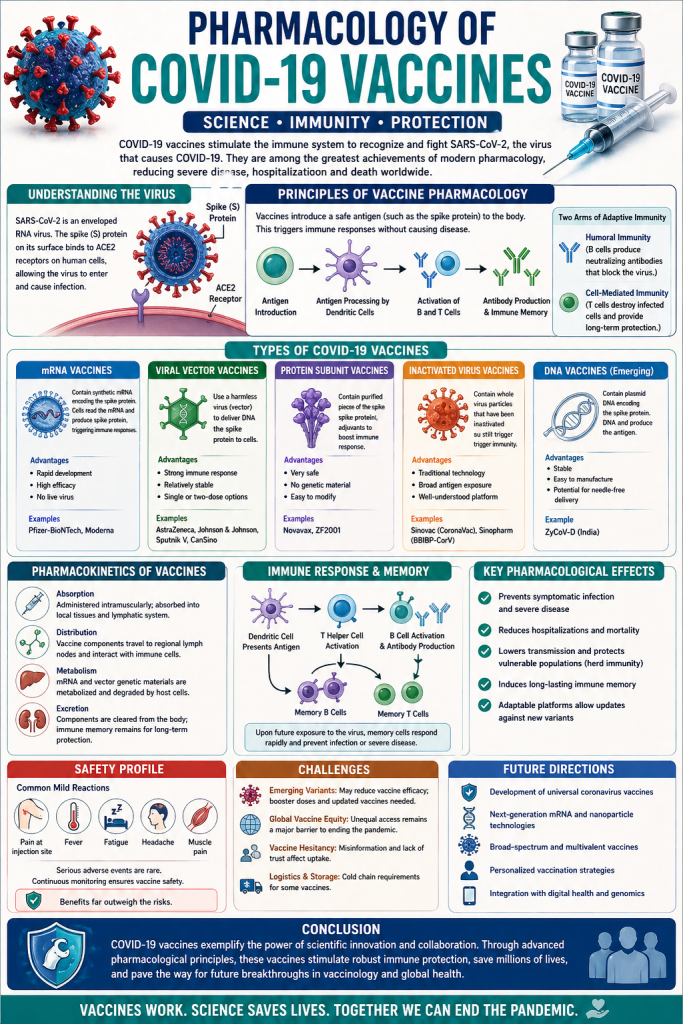
SARS-CoV-2 is an enveloped, positive-sense single-stranded RNA virus belonging to the coronavirus family. The virus contains several structural proteins, including:
- Spike (S) protein
- Membrane (M) protein
- Envelope (E) protein
- Nucleocapsid (N) protein
Among these, the spike protein plays a critical role in viral infection. It binds to the angiotensin-converting enzyme 2 (ACE2) receptor on human cells, allowing the virus to enter and infect host tissues.
Because of its central role in viral entry, the spike protein became the primary target for vaccine development.
Principles of Vaccine Pharmacology
Vaccines function by stimulating the immune system to recognize and respond to pathogens without causing disease.
When a vaccine introduces an antigen—such as the SARS-CoV-2 spike protein—the immune system responds by activating both innate and adaptive immune mechanisms.
The adaptive immune response involves two major components:
Humoral Immunity
B lymphocytes produce antibodies that recognize and neutralize viral antigens.
Neutralizing antibodies bind to the spike protein and prevent the virus from entering host cells.
Cell-Mediated Immunity
T lymphocytes recognize infected cells and eliminate them, preventing viral replication.
Both antibody-mediated and cellular immune responses contribute to vaccine-induced protection.
Types of COVID-19 Vaccines
Multiple vaccine platforms were developed to combat COVID-19. These platforms differ in their pharmacological mechanisms and methods of antigen delivery.
mRNA Vaccines
Messenger RNA (mRNA) vaccines represent one of the most innovative technologies used during the pandemic.
These vaccines contain synthetic mRNA encoding the SARS-CoV-2 spike protein.
After injection, the mRNA enters host cells and directs cellular machinery to produce the spike protein.
The immune system then recognizes the spike protein as a foreign antigen and generates an immune response.
Key advantages of mRNA vaccines include:
- Rapid development
- High efficacy
- Absence of live virus
- Flexibility for modification
However, mRNA molecules are inherently unstable and require lipid nanoparticle carriers for delivery and protection.
Viral Vector Vaccines
Viral vector vaccines use modified viruses as delivery systems for genetic material encoding the spike protein.
In these vaccines, a harmless virus—often an adenovirus—is engineered to carry the spike protein gene.
Once inside host cells, the viral vector expresses the spike protein, triggering immune responses.
These vaccines combine strong immunogenicity with relatively stable storage requirements.
Protein Subunit Vaccines
Protein subunit vaccines contain purified fragments of the SARS-CoV-2 spike protein.
These proteins are often combined with adjuvants, substances that enhance immune responses.
This approach is similar to many traditional vaccines and has a long history of safety.
Inactivated Virus Vaccines
Inactivated vaccines contain whole SARS-CoV-2 virus particles that have been chemically or physically inactivated so they cannot replicate.
Although the virus is no longer infectious, it still contains viral antigens capable of stimulating immune responses.
These vaccines present the immune system with multiple viral components, potentially broadening immune recognition.
Pharmacokinetics of COVID-19 Vaccines
Unlike conventional drugs that produce pharmacological effects through receptor interactions, vaccines operate primarily through immune system activation.
Nevertheless, pharmacokinetic principles still apply to vaccine components.
Absorption
COVID-19 vaccines are typically administered intramuscularly.
Following injection, vaccine components are absorbed into local tissues and lymphatic circulation.
Distribution
Antigens and vaccine components travel to regional lymph nodes, where immune cells initiate adaptive immune responses.
Metabolism
mRNA and viral vector genetic materials are rapidly degraded by cellular processes after protein expression.
Elimination
Vaccine components are eventually cleared from the body, while immune memory persists.
Immune Response and Memory
One of the key goals of vaccination is the generation of immunological memory.
Following vaccination:
- Antigen-presenting cells process viral proteins.
- T helper cells activate B cells.
- B cells produce neutralizing antibodies.
- Memory B cells and T cells are generated.
These memory cells allow the immune system to respond rapidly if the individual is later exposed to the virus.
Safety and Adverse Effects
COVID-19 vaccines underwent extensive clinical testing to evaluate safety and efficacy.
Most vaccine-related adverse effects are mild and temporary.
Common side effects include:
- Injection site pain
- Fatigue
- Fever
- Headache
- Muscle pain
Rare adverse events such as allergic reactions or immune-mediated complications have been reported but remain uncommon compared with the benefits of vaccination.
Continuous pharmacovigilance programs monitor vaccine safety worldwide.
Role in Public Health
COVID-19 vaccines have played a crucial role in controlling the pandemic.
Vaccination programs have contributed to:
- Reduction in severe disease
- Decreased hospitalization rates
- Lower mortality
- Prevention of healthcare system overload
Vaccines also help limit viral transmission and reduce the emergence of new variants.
Challenges in Vaccine Pharmacology
Despite remarkable success, several challenges remain.
Viral Variants
Mutations in the spike protein may reduce vaccine effectiveness, requiring updated formulations.
Global Vaccine Equity
Unequal access to vaccines has highlighted disparities in global healthcare infrastructure.
Vaccine Hesitancy
Public confidence in vaccination programs remains essential for achieving widespread immunity.
Future Directions
The scientific achievements during the COVID-19 pandemic have accelerated vaccine innovation.
Future developments may include:
- Universal coronavirus vaccines
- Next-generation mRNA technologies
- Personalized immunization strategies
- Improved thermostable vaccine formulations
These advancements may transform vaccine pharmacology and preparedness for future pandemics.
Conclusion
The development of COVID-19 vaccines represents one of the most extraordinary achievements in modern biomedical science. By leveraging advances in molecular biology, immunology, and biotechnology, scientists were able to rapidly design vaccines capable of inducing protective immunity against a novel virus.
From mRNA vaccines and viral vector platforms to protein subunit and inactivated virus vaccines, these technologies demonstrate the evolving sophistication of modern vaccine pharmacology. Their ability to stimulate both humoral and cellular immune responses has played a vital role in reducing the global burden of COVID-19.
Beyond their immediate impact on the pandemic, COVID-19 vaccines have also reshaped the future of vaccinology. The lessons learned from their development are likely to influence the design of vaccines against other infectious diseases and potentially even non-infectious conditions such as cancer.
Ultimately, the pharmacology of COVID-19 vaccines highlights the remarkable power of science, innovation, and global collaboration in addressing one of the greatest health challenges of our time.