Therapeutics of Povidone–Iodine: A Comprehensive Pharmacological Perspective
Infectious diseases have remained a major challenge for global healthcare systems, particularly in the context of hospital-acquired infections, surgical site infections, and emerging viral outbreaks. The effective prevention and control of microbial infections require reliable antiseptic agents capable of eliminating a broad spectrum of pathogens while maintaining safety for human tissues. Among the various antiseptics available in modern medicine, povidone–iodine (PVP-I) stands out as one of the most widely used and trusted agents.
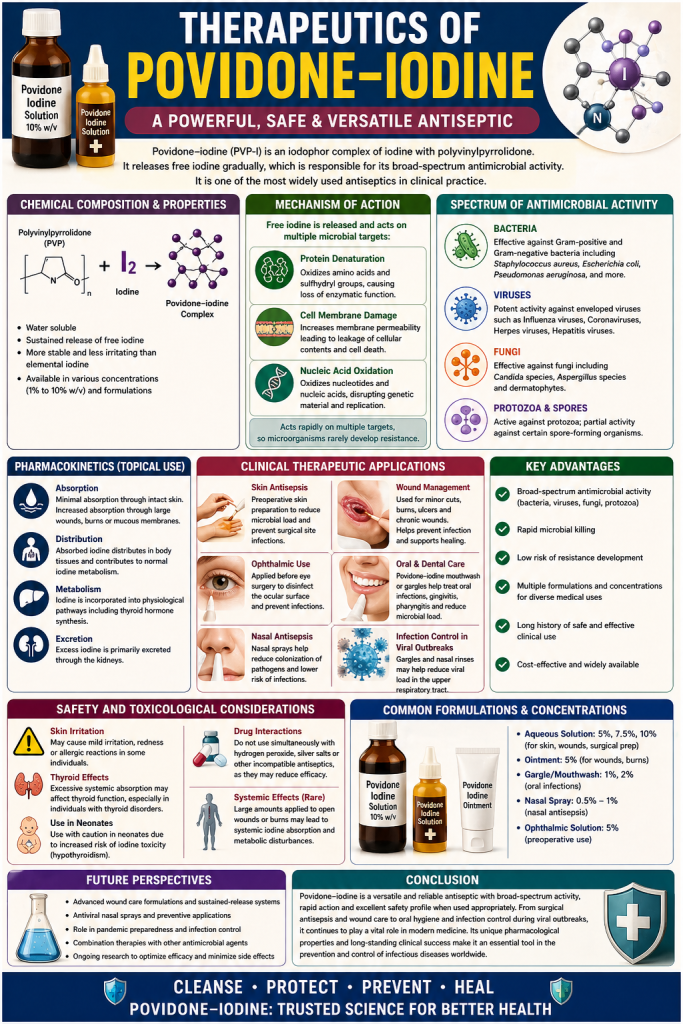
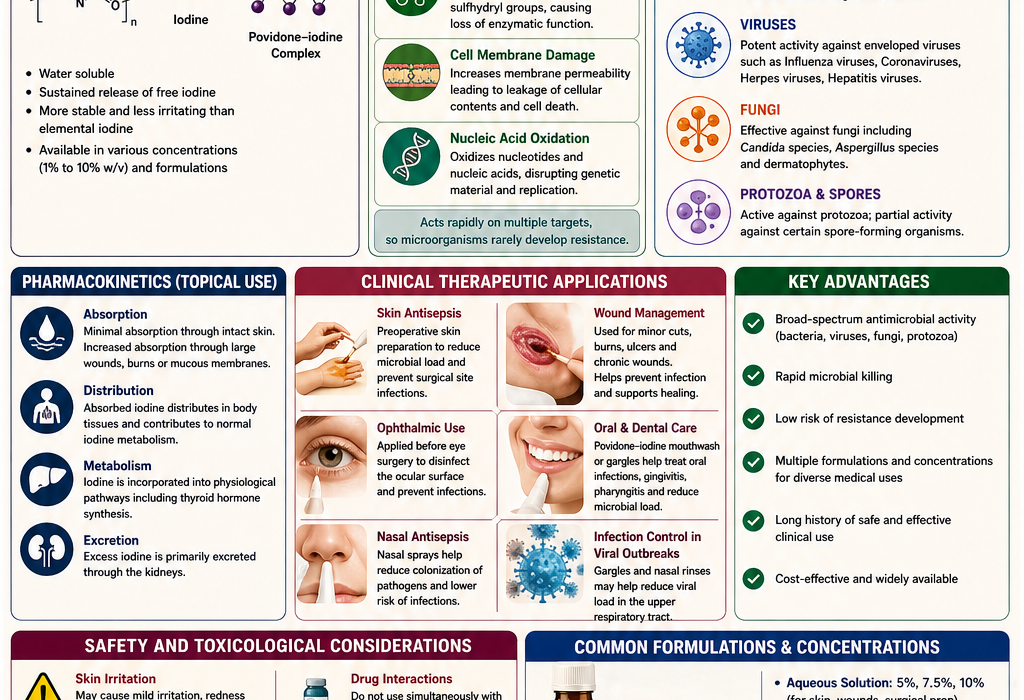
Povidone–iodine is an iodophor compound consisting of iodine complexed with polyvinylpyrrolidone (povidone). This complex acts as a reservoir that gradually releases free iodine, which is responsible for its antimicrobial activity. The formulation improves iodine’s solubility, stability, and tolerability compared with elemental iodine, making it suitable for medical use.
Since its introduction in the mid-twentieth century, povidone–iodine has become an indispensable antiseptic in clinical practice. It is widely used for skin disinfection, wound care, surgical preparation, ophthalmic procedures, oral hygiene, and infection control. Its broad-spectrum antimicrobial activity includes effectiveness against bacteria, viruses, fungi, protozoa, and certain spores.
During recent global health crises such as the COVID-19 pandemic, povidone–iodine gained renewed attention due to its potent virucidal activity against enveloped viruses, including coronaviruses. This has led to increased interest in its use in nasal sprays, gargles, and oral rinses as preventive measures against respiratory viral infections.
This article explores the pharmacology, mechanisms of action, therapeutic applications, safety considerations, and future prospects of povidone–iodine in modern medicine.
Chemical Composition and Properties
Povidone–iodine is a complex formed between polyvinylpyrrolidone (PVP) and elemental iodine.
The polyvinylpyrrolidone component acts as a carrier molecule that stabilizes iodine and facilitates its gradual release in solution.
Key physicochemical properties include:
- Water solubility
- Sustained iodine release
- Reduced irritation compared with free iodine
- Broad antimicrobial activity
The complex equilibrium between bound iodine and free iodine ensures continuous antimicrobial activity while minimizing toxicity.
Mechanism of Action
The antimicrobial activity of povidone–iodine is primarily attributed to the release of free iodine molecules.
These molecules interact with microbial cells through multiple mechanisms.
Protein Denaturation
Iodine disrupts the structure of microbial proteins by oxidizing amino acids and sulfhydryl groups, leading to loss of enzymatic function.
Cell Membrane Damage
Free iodine damages microbial cell membranes, increasing permeability and leading to cell death.
Nucleic Acid Oxidation
Iodine can also oxidize nucleotides and nucleic acids, disrupting genetic material and preventing microbial replication.
Rapid Microbial Killing
Because povidone–iodine acts on multiple cellular targets simultaneously, microorganisms rarely develop resistance.
This multi-target mechanism distinguishes it from many conventional antimicrobial agents.
Spectrum of Antimicrobial Activity
Povidone–iodine possesses one of the broadest antimicrobial spectra among antiseptics.
Its activity includes effectiveness against:
Bacteria
Both Gram-positive and Gram-negative bacteria are susceptible to povidone–iodine.
Common targets include:
- Staphylococcus aureus
- Escherichia coli
- Pseudomonas aeruginosa
Viruses
Povidone–iodine exhibits strong virucidal activity against enveloped viruses such as:
- Influenza viruses
- Coronaviruses
- Herpes viruses
Fungi
The antiseptic is effective against fungal organisms including Candida species.
Protozoa and Spores
Although spores are more resistant, povidone–iodine still demonstrates partial activity against certain spore-forming organisms.
Pharmacokinetics
Although povidone–iodine is primarily used topically, certain pharmacokinetic considerations are relevant.
Absorption
Minimal systemic absorption occurs when povidone–iodine is applied to intact skin.
However, absorption may increase when applied to large wounds, burns, or mucous membranes.
Distribution
Absorbed iodine can distribute throughout body tissues and contribute to iodine metabolism.
Metabolism
Iodine is incorporated into normal physiological pathways, including thyroid hormone synthesis.
Excretion
Excess iodine is primarily eliminated through the kidneys.
Clinical Therapeutic Applications
Skin Antisepsis
One of the most common uses of povidone–iodine is preoperative skin preparation.
It is applied to disinfect surgical sites and reduce the risk of postoperative infections.
Wound Management
Povidone–iodine is widely used for the treatment of:
- Minor cuts
- Burns
- Ulcers
- Chronic wounds
Its antimicrobial activity helps prevent infection and promote wound healing.
Ophthalmic Use
Special formulations of povidone–iodine are used in ophthalmology.
They are applied before eye surgery to prevent ocular infections.
Oral and Dental Applications
Povidone–iodine mouthwash and gargles are used to treat:
- Oral infections
- Gingivitis
- Pharyngitis
These formulations help reduce microbial load in the oral cavity.
Nasal Antisepsis
Nasal sprays containing povidone–iodine are used in some healthcare settings to reduce nasal colonization of pathogenic bacteria.
Infection Control During Viral Outbreaks
During respiratory viral outbreaks, povidone–iodine gargles and nasal rinses have been studied for their ability to reduce viral load in the upper respiratory tract.
This approach may contribute to reducing viral transmission.
Safety and Toxicological Considerations
Although povidone–iodine is generally safe when used appropriately, certain precautions should be considered.
Skin Irritation
Some individuals may experience mild irritation or allergic reactions.
Thyroid Effects
Excessive systemic absorption of iodine may influence thyroid function, particularly in individuals with thyroid disorders.
Use in Neonates
Careful monitoring is required when povidone–iodine is used in neonates due to their increased sensitivity to iodine absorption.
Drug Interactions
Povidone–iodine should not be used simultaneously with certain antiseptics such as hydrogen peroxide or silver-based compounds, as interactions may reduce efficacy.
Advantages of Povidone–Iodine
Several characteristics make povidone–iodine a valuable antiseptic.
Key advantages include:
- Broad-spectrum antimicrobial activity
- Rapid microbial killing
- Low risk of resistance
- Multiple formulations for diverse medical applications
- Long history of safe clinical use
Future Perspectives
Research continues to explore new applications of povidone–iodine in infection control.
Potential areas of interest include:
- Advanced wound care formulations
- Antiviral nasal sprays
- Use in pandemic preparedness
- Combination therapies with other antimicrobial agents
The continued study of povidone–iodine may further expand its therapeutic utility.
Conclusion
Povidone–iodine remains one of the most versatile and widely used antiseptic agents in modern medicine. Its unique pharmacological properties—particularly its broad-spectrum antimicrobial activity and low potential for resistance—have made it an indispensable tool in infection prevention and wound management.
From surgical antisepsis and wound care to oral hygiene and infection control during viral outbreaks, povidone–iodine continues to play a critical role in healthcare practice worldwide. While careful consideration of safety and appropriate usage is necessary, its long-standing record of effectiveness and reliability underscores its importance in modern therapeutics.
As research advances and new formulations emerge, povidone–iodine is likely to remain a cornerstone of antiseptic therapy, contributing significantly to the prevention and control of infectious diseases in both clinical and community settings.