Therapeutics of Cervical Cancer: Advances in Prevention, Pharmacotherapy, and Precision Oncology
Cervical cancer remains one of the most significant malignancies affecting women worldwide, particularly in low- and middle-income countries where access to screening and vaccination programs is limited. Despite being largely preventable and highly treatable when detected early, cervical cancer continues to cause substantial morbidity and mortality. According to global epidemiological estimates, hundreds of thousands of new cases are diagnosed each year, with a significant proportion resulting in death due to late diagnosis and inadequate access to treatment.
From a biomedical perspective, cervical cancer is closely associated with persistent infection by high-risk human papillomavirus (HPV) types, particularly HPV-16 and HPV-18. These oncogenic viruses integrate into host cellular DNA and disrupt tumor suppressor pathways, ultimately leading to malignant transformation of cervical epithelial cells.
Over the past several decades, therapeutic strategies for cervical cancer have evolved significantly. Traditional management approaches such as surgery, radiation therapy, and cytotoxic chemotherapy have been complemented by newer modalities including targeted therapy, immunotherapy, and personalized oncology approaches. Advances in molecular biology and pharmacology have enhanced the understanding of tumor biology, enabling the development of therapies that selectively target cancer cells while minimizing damage to normal tissues.
This article explores the therapeutic landscape of cervical cancer, including the pharmacological basis of treatment, conventional and advanced therapies, and emerging innovations that are shaping the future of cervical cancer management.
Pathophysiology of Cervical Cancer
Cervical cancer arises primarily from the transformation zone of the cervix, where the squamous epithelium meets the glandular epithelium. Persistent infection with oncogenic HPV strains plays a central role in the pathogenesis of the disease.
HPV infection introduces viral oncoproteins E6 and E7, which interfere with key tumor suppressor proteins:
- p53, responsible for DNA repair and apoptosis
- Retinoblastoma protein (pRb), which regulates cell cycle progression
By disabling these protective mechanisms, HPV allows uncontrolled cellular proliferation, accumulation of genetic mutations, and eventual malignant transformation.
Cervical cancer typically develops through a series of precancerous stages known as cervical intraepithelial neoplasia (CIN) before progressing to invasive carcinoma.
Therapeutic Strategies in Cervical Cancer
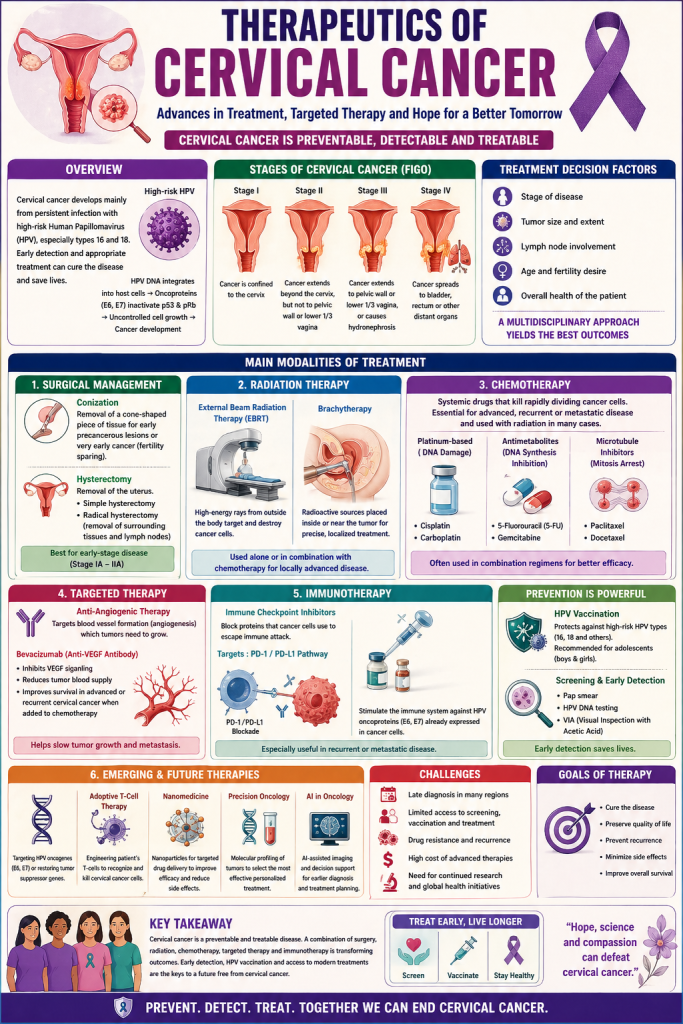
The choice of treatment for cervical cancer depends on several factors, including:
- Stage of the disease
- Tumor size and extent
- Lymph node involvement
- Patient age and reproductive considerations
Therapeutic approaches generally fall into three major categories:
- Surgical treatment
- Radiotherapy
- Pharmacological therapy
Modern oncology often employs a multimodal treatment strategy combining several of these modalities.
Surgical Management
Surgery remains the primary treatment for early-stage cervical cancer.
Conization
For very early disease, cervical conization may be performed to remove precancerous lesions or early malignant tissue while preserving fertility.
Hysterectomy
More advanced cases may require removal of the uterus through:
- Simple hysterectomy
- Radical hysterectomy
Radical hysterectomy involves removal of surrounding tissues and lymph nodes to prevent disease spread.
Radiation Therapy
Radiation therapy plays a critical role in the treatment of cervical cancer, particularly in locally advanced disease.
Two main types of radiation therapy are used:
External Beam Radiation Therapy (EBRT)
High-energy radiation beams are directed at the tumor to destroy cancer cells.
Brachytherapy
In brachytherapy, radioactive sources are placed inside or near the tumor, delivering localized radiation while minimizing exposure to surrounding tissues.
Radiation therapy is often combined with chemotherapy to enhance therapeutic effectiveness.
Chemotherapy in Cervical Cancer
Chemotherapy remains a cornerstone of cervical cancer treatment, especially for advanced or metastatic disease.
These drugs target rapidly dividing cancer cells by interfering with DNA replication or cellular division.
Platinum-Based Chemotherapy
The most widely used drugs include platinum compounds, which damage DNA and trigger apoptosis.
Examples include:
- Cisplatin
- Carboplatin
Cisplatin is frequently used in combination with radiation therapy as part of concurrent chemoradiation, the standard treatment for locally advanced cervical cancer.
Antimetabolites
Antimetabolites interfere with nucleotide synthesis and DNA replication.
Examples include:
- 5-Fluorouracil (5-FU)
- Gemcitabine
These drugs are often used in combination regimens.
Microtubule Inhibitors
Drugs that disrupt microtubule dynamics can prevent cancer cells from completing mitosis.
Examples include:
- Paclitaxel
- Docetaxel
These agents are commonly used in metastatic cervical cancer therapy.
Targeted Therapy
Advances in molecular oncology have led to the development of targeted therapies that interfere with specific pathways involved in tumor growth.
Anti-Angiogenic Therapy
Tumors require blood vessels to supply nutrients and oxygen. The process of new blood vessel formation is known as angiogenesis.
Targeting angiogenesis can inhibit tumor growth.
One important drug used in cervical cancer is bevacizumab, a monoclonal antibody that inhibits vascular endothelial growth factor (VEGF).
By blocking VEGF signaling, bevacizumab reduces tumor vascularization and slows cancer progression.
Clinical studies have demonstrated that adding bevacizumab to chemotherapy improves survival in patients with advanced cervical cancer.
Immunotherapy in Cervical Cancer
Immunotherapy has emerged as one of the most promising advances in oncology.
These therapies stimulate the immune system to recognize and attack cancer cells.
Immune Checkpoint Inhibitors
Cancer cells often evade immune detection by activating inhibitory pathways known as immune checkpoints.
Checkpoint inhibitors block these pathways, restoring immune activity.
Examples include drugs targeting:
- PD-1 (programmed cell death protein 1)
- PD-L1 (programmed death-ligand 1)
These therapies have shown encouraging results in patients with recurrent or metastatic cervical cancer.
Therapeutic Vaccines
Unlike preventive HPV vaccines, therapeutic vaccines are designed to stimulate immune responses against existing cancer cells.
These vaccines target viral oncoproteins such as E6 and E7.
Research into therapeutic vaccines remains ongoing but represents an exciting frontier in cervical cancer therapy.
Role of HPV Vaccination in Prevention
While not a therapeutic intervention for existing cancer, HPV vaccination represents the most effective strategy for preventing cervical cancer.
Vaccines protect against the most common oncogenic HPV strains responsible for the majority of cervical cancer cases.
Widespread vaccination programs have the potential to dramatically reduce global cervical cancer incidence.
Emerging Therapies
Future cervical cancer therapies may include:
- Gene therapy approaches targeting HPV oncogenes
- Adoptive T-cell therapies
- Nanomedicine-based drug delivery systems
- Artificial intelligence–guided precision oncology
These technologies aim to improve treatment specificity and reduce toxicity.
Challenges in Cervical Cancer Treatment
Despite significant progress, several challenges remain.
Late Diagnosis
Many cases are diagnosed at advanced stages, limiting treatment options.
Healthcare Disparities
Access to screening, vaccination, and treatment varies significantly across regions.
Drug Resistance
Cancer cells may develop resistance to chemotherapy and targeted therapies.
Addressing these challenges requires improved screening programs, public health interventions, and continued research.
Future Perspectives
The future of cervical cancer therapeutics will likely involve a precision medicine approach, integrating molecular diagnostics with personalized treatment strategies.
Advances in genomics, immunotherapy, and biotechnology are expected to further improve patient outcomes.
Global health initiatives focused on HPV vaccination, screening, and early detection will also play a critical role in reducing the burden of cervical cancer worldwide.
Conclusion
The therapeutic management of cervical cancer has evolved from traditional surgical and radiation approaches to a sophisticated multidisciplinary strategy incorporating chemotherapy, targeted therapy, and immunotherapy. Advances in molecular biology and pharmacology have deepened our understanding of cervical cancer pathogenesis and enabled the development of therapies that more effectively target tumor biology.
While significant challenges remain, continued progress in biomedical research and public health initiatives offers hope for improved outcomes and eventual global reduction of cervical cancer incidence. Through the combined efforts of clinicians, researchers, and policymakers, cervical cancer may ultimately become a preventable and highly manageable disease in the decades ahead.