Diagnostics for Cancer: Modern Strategies for Early Detection and Precision Oncology
Cancer remains one of the most significant global health challenges of the modern era. Despite remarkable progress in therapeutics and biomedical research, the burden of cancer continues to increase due to aging populations, environmental factors, lifestyle changes, and improved detection methods. A critical determinant of successful cancer treatment is early and accurate diagnosis, which allows timely intervention before the disease progresses to advanced stages.
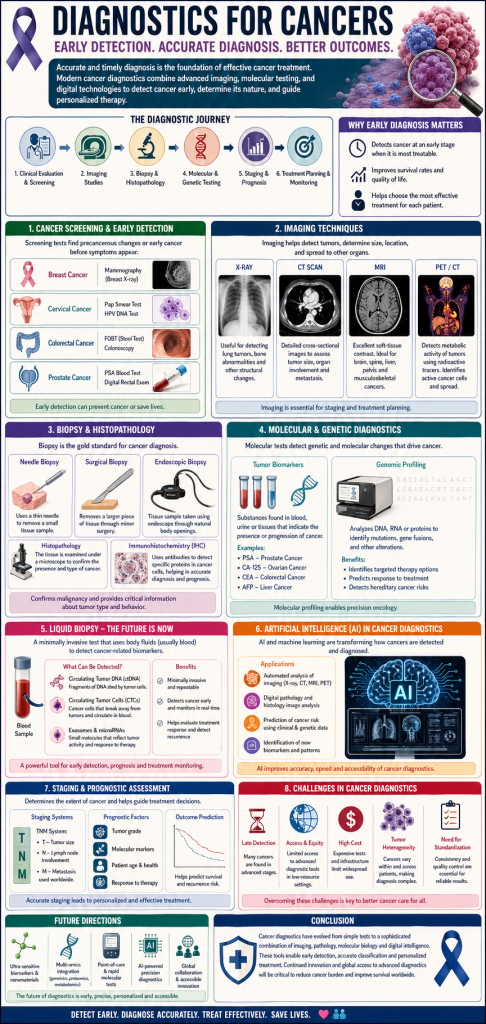
Historically, cancer diagnosis relied largely on clinical examination and histopathological analysis of tumor tissues. While these traditional approaches remain fundamental, advances in molecular biology, imaging technologies, and bioinformatics have transformed the field of cancer diagnostics. Modern diagnostic strategies now integrate imaging modalities, molecular biomarkers, genomic profiling, liquid biopsies, and artificial intelligence–driven analytics to detect malignancies with unprecedented accuracy.
Cancer diagnostics not only confirm the presence of malignancy but also provide essential information regarding tumor type, stage, genetic alterations, and potential therapeutic targets. This information forms the foundation of precision oncology, where treatment strategies are tailored to the unique biological characteristics of each patient’s tumor.
This article explores the evolving landscape of cancer diagnostics, examining the major diagnostic approaches, emerging technologies, and future directions in early cancer detection and personalized medicine.
Principles of Cancer Diagnosis
The diagnostic process for cancer typically involves several stages designed to confirm the presence of malignancy and determine the extent of disease.
These stages generally include:
- Clinical evaluation and screening
- Imaging studies
- Histopathological examination
- Molecular and genetic testing
- Staging and prognostic assessment
Each of these components provides valuable information that guides clinical decision-making and therapeutic planning.
Cancer Screening and Early Detection
Screening programs aim to detect cancer at an early stage, often before symptoms appear. Early detection significantly improves treatment outcomes and survival rates.
Common Cancer Screening Methods
Several screening strategies have been implemented for specific cancers.
Breast Cancer Screening
Breast cancer screening commonly involves mammography, an imaging technique capable of detecting small tumors that are not yet palpable.
Cervical Cancer Screening
Screening for cervical cancer includes Pap smear testing and human papillomavirus (HPV) testing, both of which detect precancerous changes in cervical cells.
Colorectal Cancer Screening
Colorectal cancer screening may involve:
- Fecal occult blood testing
- Colonoscopy
- Flexible sigmoidoscopy
Prostate Cancer Screening
Screening for prostate cancer often includes measurement of prostate-specific antigen (PSA) levels in blood.
These screening methods have significantly reduced mortality rates for several cancer types.
Imaging Techniques in Cancer Diagnosis
Medical imaging plays a central role in detecting tumors, evaluating their size and location, and determining whether the cancer has spread.
X-ray Imaging
X-ray imaging provides basic visualization of internal structures and is often used in the detection of lung tumors or bone abnormalities.
Computed Tomography (CT)
CT scanning uses multiple X-ray images to create detailed cross-sectional views of the body.
It is widely used to evaluate:
- Tumor size
- Organ involvement
- Metastatic spread
Magnetic Resonance Imaging (MRI)
MRI uses powerful magnetic fields and radio waves to generate highly detailed images of soft tissues.
This technique is particularly useful in diagnosing cancers of the brain, spinal cord, liver, and pelvic organs.
Positron Emission Tomography (PET)
PET imaging evaluates metabolic activity within tissues.
Cancer cells typically exhibit increased metabolic activity, which can be detected using radiolabeled tracers.
PET scans are frequently combined with CT scans to provide both anatomical and functional information.
Histopathology and Biopsy
Despite advances in imaging and molecular diagnostics, biopsy remains the gold standard for cancer diagnosis.
A biopsy involves removing a sample of tissue from the suspected tumor for microscopic examination.
Types of Biopsy
Needle Biopsy
A thin needle is used to extract a small sample of tissue.
Surgical Biopsy
A larger tissue sample is obtained through minor surgery.
Endoscopic Biopsy
Tissue samples are collected using endoscopic instruments inserted through natural body openings.
Once obtained, the tissue sample is examined by a pathologist to determine whether cancer cells are present.
Molecular and Genetic Diagnostics
Advances in molecular biology have revolutionized cancer diagnostics by enabling the identification of genetic alterations associated with tumor development.
Tumor Biomarkers
Tumor biomarkers are molecules produced by cancer cells or by the body in response to cancer.
Examples include:
- PSA for prostate cancer
- CA-125 for ovarian cancer
- Alpha-fetoprotein (AFP) for liver cancer
Although biomarkers are useful for monitoring disease progression, they are often used alongside other diagnostic methods.
Genomic Profiling
Genomic profiling involves analyzing the DNA of tumor cells to identify mutations that drive cancer growth.
This approach can reveal alterations in genes involved in cell proliferation, apoptosis, and signaling pathways.
Genomic profiling allows clinicians to select targeted therapies based on the molecular characteristics of the tumor.
Liquid Biopsy
One of the most promising developments in cancer diagnostics is the liquid biopsy.
Unlike traditional biopsies that require tissue samples, liquid biopsies analyze cancer-related molecules circulating in body fluids such as blood.
These may include:
- Circulating tumor DNA (ctDNA)
- Circulating tumor cells (CTCs)
- Exosomes and microRNAs
Liquid biopsies offer several advantages:
- Minimally invasive
- Real-time monitoring of tumor progression
- Detection of treatment resistance
This technology holds great promise for early cancer detection and personalized treatment monitoring.
Artificial Intelligence in Cancer Diagnostics
Artificial intelligence (AI) is increasingly being applied to cancer diagnostics.
AI algorithms can analyze complex datasets from imaging studies, genomic sequencing, and electronic health records.
Applications include:
- Automated detection of tumors in imaging scans
- Prediction of cancer risk based on genetic profiles
- Identification of novel diagnostic biomarkers
AI-driven diagnostic systems have the potential to improve accuracy and reduce diagnostic errors.
Challenges in Cancer Diagnostics
Despite significant technological progress, several challenges remain.
Late Detection
Many cancers remain asymptomatic in early stages, leading to delayed diagnosis.
Access to Diagnostic Technologies
Advanced diagnostic tools may not be readily available in low-resource settings.
Cost and Infrastructure
High costs and specialized infrastructure requirements can limit widespread implementation.
Addressing these challenges requires continued innovation and global healthcare investment.
Future Directions
The future of cancer diagnostics is likely to be shaped by advances in precision medicine, nanotechnology, and digital health technologies.
Emerging innovations include:
- Ultra-sensitive biomarker detection
- Nanotechnology-based diagnostic sensors
- Multi-omics approaches integrating genomics, proteomics, and metabolomics
- AI-powered diagnostic platforms
These technologies aim to detect cancer earlier and guide personalized treatment strategies.
Conclusion
Cancer diagnostics have evolved from traditional histopathological methods to highly sophisticated technologies integrating imaging, molecular biology, and computational science. Early detection and accurate diagnosis remain essential for improving survival rates and guiding effective treatment strategies.
The integration of genomic profiling, liquid biopsy technologies, and artificial intelligence is transforming cancer diagnostics into a cornerstone of precision oncology. As scientific research continues to advance, future diagnostic tools will likely become more sensitive, less invasive, and increasingly personalized.
Ultimately, the goal of modern cancer diagnostics is not only to identify malignancies but also to understand their molecular characteristics, enabling clinicians to deliver the most effective therapies for each individual patient. Through continued innovation and global collaboration, the future of cancer diagnosis holds great promise for improving outcomes and reducing the global burden of cancer.