Biomarkers for Cervical Cancer: Molecular Indicators for Early Detection, Prognosis, and Precision Therapy
Cervical cancer remains one of the most significant malignancies affecting women worldwide, particularly in regions where access to screening and vaccination programs remains limited. Despite major advances in preventive strategies such as human papillomavirus (HPV) vaccination and cytological screening, cervical cancer continues to pose a substantial public health challenge due to delayed diagnosis and disease progression.
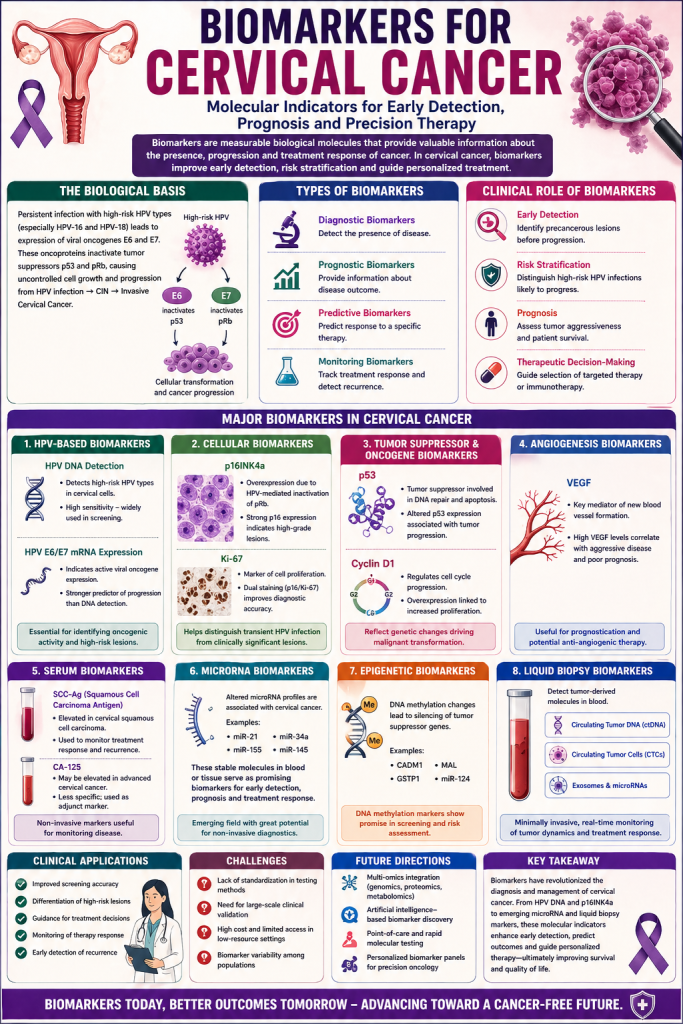
A deeper understanding of the molecular biology underlying cervical cancer has led to the identification of biomarkers—biological molecules that provide measurable indicators of normal or pathological processes. In oncology, biomarkers are invaluable tools for early detection, disease monitoring, prognosis assessment, and therapeutic decision-making.
Cervical cancer development is closely associated with persistent infection by high-risk HPV types, particularly HPV-16 and HPV-18. However, not all HPV infections lead to cancer. The progression from HPV infection to cervical intraepithelial neoplasia (CIN) and eventually invasive carcinoma involves complex molecular alterations within host cells. Biomarkers play a crucial role in identifying these molecular changes and distinguishing benign infections from lesions that are likely to progress to malignancy.
Modern cervical cancer diagnostics increasingly incorporate molecular biomarkers, genomic profiling, and immunohistochemical markers to complement traditional screening methods such as Pap smear testing. These advances are transforming cervical cancer management from a purely morphological diagnosis toward a molecularly informed precision medicine approach.
This article explores the role of biomarkers in cervical cancer, including their classification, mechanisms, clinical applications, and future potential in improving early detection and patient outcomes.
Understanding Biomarkers in Oncology
A biomarker is defined as a measurable biological characteristic that reflects physiological or pathological processes or responses to therapeutic interventions.
In cancer biology, biomarkers may include:
- Proteins
- Genes
- RNA molecules
- Metabolic products
- Cellular alterations
These molecules can be detected in tissues, blood, or other body fluids and provide valuable information regarding tumor development and progression.
Cancer biomarkers are generally classified into several categories:
- Diagnostic biomarkers
- Prognostic biomarkers
- Predictive biomarkers
- Monitoring biomarkers
Each category serves a different clinical purpose.
Role of Biomarkers in Cervical Cancer
Biomarkers contribute to multiple aspects of cervical cancer management.
Early Detection
Biomarkers help identify precancerous lesions before they progress to invasive cancer.
Risk Stratification
They assist clinicians in determining which HPV infections are likely to progress toward malignancy.
Prognosis
Certain biomarkers correlate with disease severity, tumor aggressiveness, and patient survival.
Therapeutic Decision-Making
Biomarkers may guide the selection of targeted therapies or immunotherapies.
HPV-Based Biomarkers
Because persistent HPV infection is the primary cause of cervical cancer, viral markers are among the most important biomarkers in cervical oncology.
HPV DNA Detection
HPV DNA testing identifies the presence of high-risk HPV types within cervical cells.
This method is more sensitive than traditional cytology and is widely used in modern screening programs.
Detection of HPV DNA indicates viral infection but does not necessarily confirm malignant transformation.
HPV mRNA Expression
Detection of HPV E6 and E7 mRNA transcripts provides stronger evidence of oncogenic activity.
These viral oncogenes inactivate key tumor suppressor proteins such as p53 and retinoblastoma protein (pRb).
High expression levels of E6 and E7 mRNA indicate a higher likelihood of disease progression.
Cellular Biomarkers
Host cellular responses to HPV infection lead to the expression of several proteins that serve as diagnostic biomarkers.
p16INK4a
One of the most widely studied cervical cancer biomarkers is p16INK4a, a cyclin-dependent kinase inhibitor.
HPV-mediated inactivation of pRb leads to overexpression of p16INK4a.
Strong p16INK4a expression in cervical cells is considered a reliable indicator of high-grade cervical lesions.
Immunohistochemical staining for p16 is frequently used to distinguish between benign HPV infections and precancerous lesions.
Ki-67
Ki-67 is a marker of cellular proliferation.
In cervical lesions, simultaneous expression of p16 and Ki-67 indicates abnormal cell cycle regulation associated with HPV-driven carcinogenesis.
Dual staining for p16 and Ki-67 has improved the accuracy of cervical cancer screening.
Tumor Suppressor and Oncogene Biomarkers
Genetic alterations affecting tumor suppressor genes and oncogenes are important indicators of malignant transformation.
p53
The tumor suppressor protein p53 plays a critical role in regulating DNA repair and apoptosis.
HPV E6 protein promotes degradation of p53, impairing cellular defense mechanisms against DNA damage.
Alterations in p53 expression may serve as indicators of tumor progression.
Cyclin D1
Cyclin D1 regulates cell cycle progression.
Overexpression of Cyclin D1 has been associated with increased cellular proliferation in cervical cancer.
Angiogenesis Biomarkers
Tumor growth and metastasis require the formation of new blood vessels.
Vascular Endothelial Growth Factor (VEGF)
VEGF is a key mediator of angiogenesis.
Elevated VEGF expression in cervical tumors is associated with aggressive disease and poor prognosis.
Measurement of VEGF levels may help assess tumor progression and therapeutic response.
Serum Biomarkers
Certain biomarkers can be detected in blood and may serve as non-invasive indicators of cervical cancer.
Squamous Cell Carcinoma Antigen (SCC-Ag)
SCC antigen is commonly elevated in patients with cervical squamous cell carcinoma.
It is frequently used to monitor treatment response and detect disease recurrence.
CA-125
Although primarily associated with ovarian cancer, CA-125 levels may also increase in advanced cervical cancer.
MicroRNA Biomarkers
MicroRNAs (miRNAs) are small non-coding RNA molecules that regulate gene expression.
Alterations in specific microRNA profiles have been observed in cervical cancer.
Examples include:
- miR-21
- miR-34a
- miR-155
These molecules may serve as promising biomarkers for early detection and prognosis.
Epigenetic Biomarkers
Epigenetic changes such as DNA methylation also play a role in cervical carcinogenesis.
Hypermethylation of tumor suppressor genes can lead to gene silencing and contribute to cancer progression.
Methylation markers are being investigated as potential tools for cervical cancer screening.
Liquid Biopsy in Cervical Cancer
Advances in molecular diagnostics have introduced the concept of liquid biopsy, which involves detecting tumor-derived molecules in blood.
Liquid biopsy can identify:
- Circulating tumor DNA (ctDNA)
- Circulating tumor cells (CTCs)
- Extracellular vesicles
This minimally invasive approach enables real-time monitoring of tumor dynamics and treatment response.
Clinical Applications of Biomarkers
Biomarkers are increasingly integrated into clinical practice.
Applications include:
- Improved screening strategies
- Differentiation of high-risk lesions
- Monitoring treatment response
- Detection of disease recurrence
By combining biomarker analysis with imaging and histopathology, clinicians can achieve more accurate diagnosis and personalized treatment planning.
Challenges in Biomarker Research
Despite promising progress, several challenges remain.
Standardization
Variability in biomarker testing methods can affect diagnostic reliability.
Clinical Validation
Many biomarkers require large-scale clinical trials before routine clinical use.
Accessibility
Advanced molecular diagnostic tools may not be widely available in low-resource settings.
Future Directions
The future of cervical cancer diagnostics lies in the integration of multiple biomarker technologies.
Emerging approaches include:
- Multi-omics profiling (genomics, proteomics, metabolomics)
- Artificial intelligence–based diagnostic algorithms
- Point-of-care molecular testing
- Personalized biomarker panels
These innovations aim to improve early detection and guide precision oncology.
Conclusion
Biomarkers have become essential components of modern cervical cancer diagnostics and management. By revealing the molecular alterations underlying cervical carcinogenesis, biomarkers provide critical insights into disease development, progression, and therapeutic response.
From HPV DNA testing and p16INK4a expression to emerging microRNA and epigenetic markers, these molecular indicators are transforming cervical cancer detection and treatment strategies. Continued research and technological innovation are expected to further expand the role of biomarkers in precision medicine.
Ultimately, the integration of biomarker-based diagnostics with effective screening programs, HPV vaccination, and advanced therapeutics holds the promise of significantly reducing the global burden of cervical cancer and improving outcomes for millions of women worldwide.