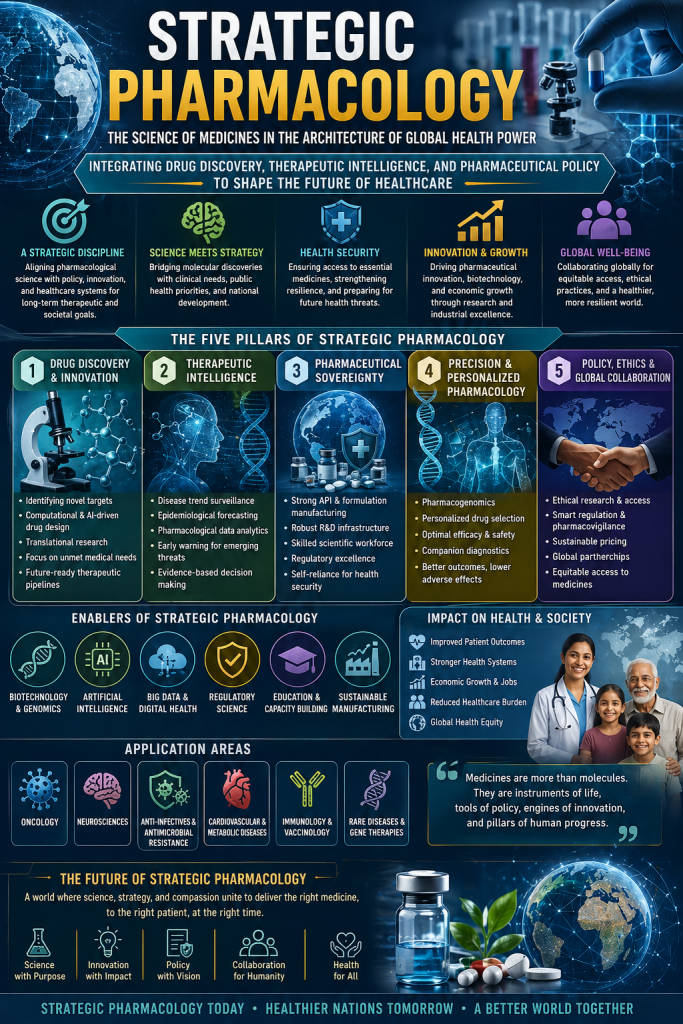
Strategic Pharmacology: The Science of Medicines in the Architecture of Global Health Power
Integrating Drug Discovery, Therapeutic Intelligence, and Pharmaceutical Policy to Shape the Future of Healthcare
Introduction: Medicines Beyond Molecules
Pharmacology has traditionally been understood as the science of drugs—the study of how chemical substances interact with biological systems to prevent, diagnose, and treat disease. However, in the modern world, pharmacology has evolved into something far more influential and multidimensional. It is no longer confined to laboratory experiments or clinical therapeutics. Instead, it has become a powerful strategic discipline that shapes global health security, economic competitiveness, and technological innovation.
This broader perspective gives rise to the concept of strategic pharmacology—an interdisciplinary framework that integrates pharmacological science with healthcare policy, pharmaceutical manufacturing, global supply chains, and biomedical innovation. Strategic pharmacology examines not only how medicines work but also how they are developed, distributed, regulated, and utilized within complex global systems.
The importance of strategic pharmacology has become particularly evident in recent decades during public health emergencies, global pandemics, antimicrobial resistance crises, and the rapid emergence of biotechnological therapies. These developments have demonstrated that medicines are not merely therapeutic tools; they are instruments of national capability, economic strength, and societal resilience.
Thus, strategic pharmacology represents the intersection where scientific knowledge, healthcare systems, and geopolitical priorities converge.
Conceptual Foundations of Strategic Pharmacology
Strategic pharmacology can be defined as the systematic integration of pharmacological science, drug innovation, healthcare policy, and pharmaceutical infrastructure to achieve long-term therapeutic, economic, and public health objectives.
While classical pharmacology focuses on understanding drug mechanisms and therapeutic applications, strategic pharmacology extends this perspective to address broader questions such as:
- How can nations ensure reliable access to essential medicines?
- What policies promote sustainable pharmaceutical innovation?
- How should healthcare systems prepare for emerging disease threats?
- How can pharmacological knowledge be translated into population-level health improvements?
In this sense, strategic pharmacology operates simultaneously at multiple levels:
- Molecular Level – understanding drug–receptor interactions and biochemical mechanisms.
- Clinical Level – optimizing therapeutic interventions for patients.
- Population Level – improving public health outcomes through rational pharmacotherapy.
- National Level – developing pharmaceutical self-reliance and innovation ecosystems.
- Global Level – addressing transnational health challenges through coordinated pharmacological strategies.
This integrated framework transforms pharmacology into a strategic discipline guiding the future of medicine and healthcare systems.
The Evolution of Pharmacological Strategy
The history of pharmacology reveals a gradual transformation from empirical drug use to sophisticated biomedical science.
Early civilizations relied on herbal remedies and natural substances whose therapeutic effects were discovered through observation and experimentation. Over time, the development of chemistry and physiology enabled scientists to isolate active compounds and understand their mechanisms of action.
The nineteenth and twentieth centuries marked the emergence of modern pharmacology as a scientific discipline. Researchers such as Paul Ehrlich introduced the concept of selective toxicity and the idea that drugs could be designed to specifically target disease-causing organisms.
The discovery of antibiotics, vaccines, and synthetic pharmaceuticals revolutionized medicine during the twentieth century. However, these breakthroughs also revealed the complexity of drug development, regulation, and global distribution.
Today, pharmacology operates within a vast biomedical ecosystem that includes biotechnology companies, regulatory authorities, clinical research organizations, and international health agencies such as the World Health Organization.
This evolution has transformed pharmacology from a purely experimental science into a strategic infrastructure essential for global health governance.
Strategic Dimensions of Drug Discovery
Drug discovery represents the foundational stage of pharmacological innovation. However, the process is extremely complex, often requiring more than a decade of research and billions of dollars in investment.
Strategic pharmacology emphasizes the importance of aligning scientific discovery with long-term healthcare needs. This involves identifying therapeutic areas where innovation can produce the greatest societal impact, such as:
- Cancer therapies
- Neurodegenerative disease treatments
- Antimicrobial agents
- Immunotherapies
- Personalized medicines
Modern drug discovery increasingly relies on advanced technologies such as computational modeling, genomic analysis, and artificial intelligence. These tools enable scientists to identify novel drug targets and accelerate the development of therapeutic compounds.
Strategic pharmacology therefore involves not only scientific creativity but also careful prioritization of research investments.
Pharmacological Intelligence and Therapeutic Forecasting
One of the most important elements of strategic pharmacology is the ability to anticipate future healthcare challenges.
Pharmacological intelligence involves the systematic analysis of epidemiological data, disease trends, therapeutic pipelines, and healthcare infrastructure. This information allows policymakers and researchers to forecast emerging medical needs.
For example, the rapid rise of antimicrobial resistance has created an urgent need for new classes of antibiotics. Strategic pharmacology addresses this challenge by promoting research incentives, regulatory reforms, and global collaborations aimed at revitalizing antibiotic development.
Similarly, demographic changes such as aging populations require increased attention to chronic diseases including diabetes, cardiovascular disorders, and neurodegenerative conditions.
Through proactive analysis and forecasting, strategic pharmacology enables healthcare systems to prepare for future therapeutic demands.
Pharmaceutical Sovereignty and National Security
In recent years, many countries have recognized that access to medicines is closely linked to national security.
Dependence on foreign pharmaceutical supply chains can create vulnerabilities during geopolitical tensions or global crises. Shortages of essential medicines during pandemics or conflicts may jeopardize healthcare systems.
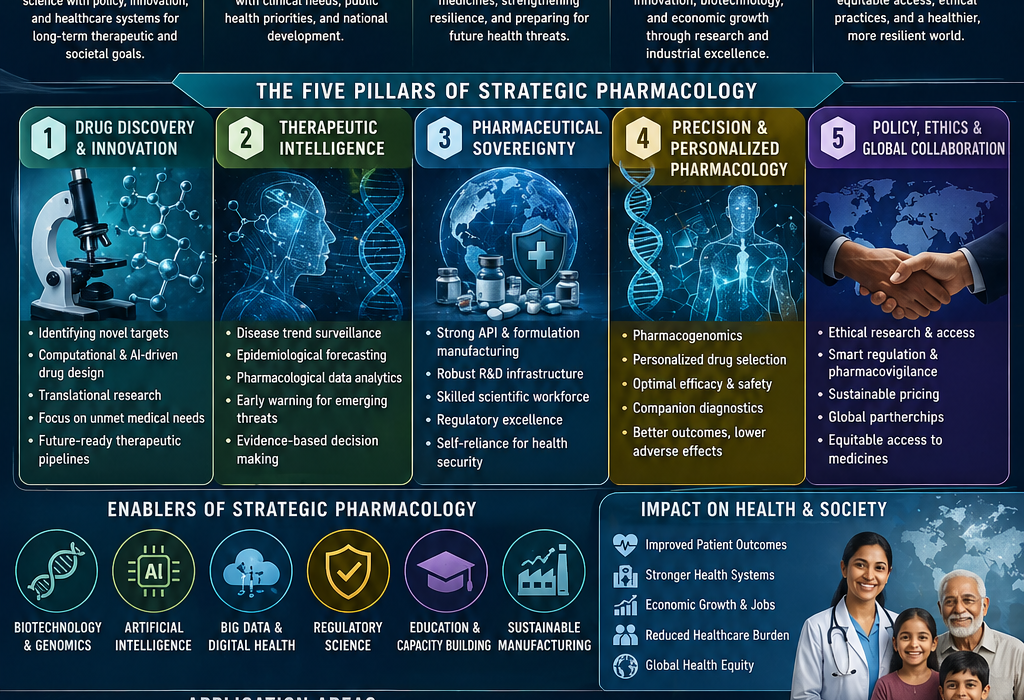
Strategic pharmacology therefore emphasizes the development of pharmaceutical sovereignty, which refers to a nation’s ability to produce, regulate, and distribute essential medicines independently.
This objective requires investment in several key areas:
- Domestic pharmaceutical manufacturing
- Active pharmaceutical ingredient (API) production
- Research and development infrastructure
- Skilled scientific workforce
- Regulatory excellence
Countries that build robust pharmaceutical ecosystems are better equipped to protect public health and maintain healthcare resilience during global disruptions.
Precision Medicine and Personalized Pharmacology
One of the most transformative developments in modern pharmacology is the emergence of precision medicine—an approach that tailors treatments according to individual genetic and molecular characteristics.
Advances in genomics have revealed that patients may respond differently to the same medication due to variations in metabolic enzymes, receptor structures, and immune responses.
This field, often referred to as pharmacogenomics, enables clinicians to select therapies that are most effective for specific patient populations.
Precision pharmacology represents a major strategic shift in healthcare, moving away from generalized treatments toward individualized therapeutic strategies.
By optimizing drug selection and dosage, personalized pharmacotherapy can improve treatment outcomes while minimizing adverse effects.
Strategic Pharmacology and Global Health Emergencies
Public health crises highlight the importance of coordinated pharmacological strategies.
During infectious disease outbreaks, rapid development and distribution of vaccines and therapeutics become critical. Effective responses require collaboration between governments, research institutions, pharmaceutical companies, and international organizations.
The development of vaccines during the pandemic caused by COVID-19 demonstrated the extraordinary capabilities of modern biomedical science. However, it also revealed significant challenges related to vaccine equity, supply chain management, and global health governance.
Strategic pharmacology addresses these issues by promoting international cooperation, strengthening regulatory systems, and improving manufacturing capacity.
The ultimate goal is to ensure that lifesaving medicines can be developed and delivered rapidly during future global health emergencies.
Ethical and Regulatory Dimensions
Pharmacological innovation must be guided by rigorous ethical and regulatory standards.
Drug development involves extensive clinical testing to ensure safety and efficacy. Regulatory agencies evaluate scientific evidence before approving new medicines for public use.
However, strategic pharmacology recognizes that regulatory systems must balance patient safety with innovation efficiency. Excessively slow regulatory processes may delay access to life-saving therapies, while insufficient oversight may expose patients to harmful risks.
Therefore, effective pharmaceutical governance requires transparent regulations, robust pharmacovigilance systems, and continuous evaluation of drug safety after market approval.
Ethical considerations also extend to issues such as equitable access to medicines, fair pricing policies, and responsible marketing practices.
Technological Transformation of Pharmacology
Technological innovation is rapidly reshaping pharmacological research and drug development.
Artificial intelligence is increasingly used to analyze molecular structures, predict drug interactions, and identify new therapeutic targets. Advanced computational platforms can simulate biological systems and accelerate experimental processes.
Biotechnology has also enabled the development of biologic drugs, gene therapies, and RNA-based medicines that target diseases at the molecular level.
These technological advancements are expanding the possibilities of pharmacology and transforming it into a highly interdisciplinary scientific enterprise.
Strategic pharmacology therefore requires collaboration among chemists, molecular biologists, clinicians, data scientists, and public health experts.
The Future Landscape of Strategic Pharmacology
Looking ahead, several trends are likely to shape the future of pharmacological strategy.
First, global demand for innovative medicines will continue to increase as populations grow and life expectancy rises.
Second, biotechnology and genomic medicine will enable new classes of therapies that address previously untreatable diseases.
Third, digital health technologies will integrate pharmacological treatment with real-time patient monitoring and personalized healthcare systems.
Fourth, international collaboration will become increasingly important for addressing global health challenges such as emerging infections and antimicrobial resistance.
Countries that invest in pharmacological research, scientific education, and healthcare infrastructure will play leading roles in the future biomedical economy.
Conclusion: Pharmacology as a Strategic Pillar of Human Progress
Strategic pharmacology represents a profound evolution in the role of drug science within society. It expands the scope of pharmacology beyond laboratory experiments to encompass healthcare policy, industrial innovation, and global health governance.
By integrating scientific discovery with strategic planning, nations can develop pharmaceutical systems capable of addressing both present and future healthcare challenges.
In a world confronted by complex diseases, demographic changes, and emerging pathogens, medicines will remain among humanity’s most powerful tools for protecting health and improving quality of life.
Strategic pharmacology therefore stands as a pillar of modern civilization—linking science, policy, and innovation in the pursuit of a healthier and more resilient world.