Artificial Intelligence in Drug Discovery: Transforming Target Identification, Molecule Design, and Clinical Development
Abstract
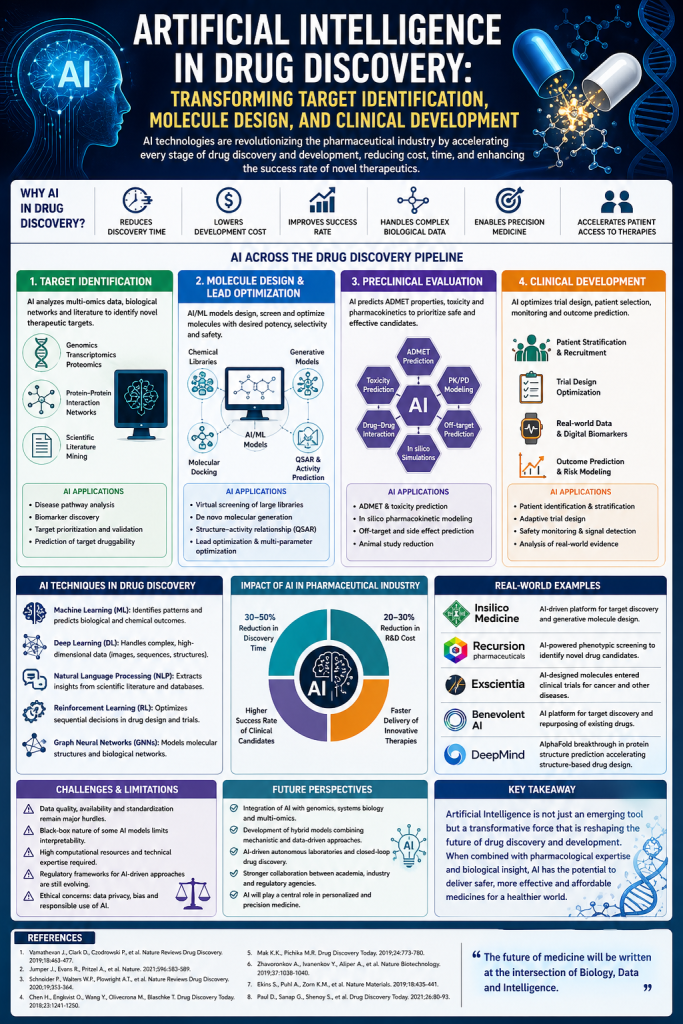
The pharmaceutical industry is undergoing a paradigm shift driven by the integration of artificial intelligence (AI) into drug discovery and development. Traditional drug discovery processes are costly, time-consuming, and associated with high failure rates, often requiring over a decade of research and billions of dollars in investment to bring a single therapeutic agent to market. AI technologies—including machine learning, deep learning, and natural language processing—are increasingly being utilized to accelerate target identification, optimize molecule design, predict pharmacokinetics and toxicity, and enhance clinical trial efficiency. These computational approaches enable the analysis of vast biological datasets, thereby facilitating the identification of novel therapeutic targets and the rapid generation of candidate molecules with desirable pharmacological properties. This review explores the role of AI across the drug development pipeline, including target discovery, molecular design, preclinical evaluation, and clinical trial optimization. Furthermore, it discusses the contributions of AI-driven platforms developed by pharmaceutical companies and biotechnology startups, as well as the challenges associated with data quality, regulatory acceptance, and ethical considerations. The integration of AI with pharmacology, genomics, and systems biology has the potential to reshape the pharmaceutical landscape and significantly reduce drug development timelines. As regulatory agencies increasingly recognize the value of computational methods, AI-driven drug discovery may become a cornerstone of future pharmaceutical innovation.
Keywords: Artificial intelligence, drug discovery, machine learning, pharmacology, precision medicine, computational drug design, pharmaceutical innovation
1. Introduction
The discovery and development of pharmaceutical drugs have historically relied on labor-intensive experimental processes, high-throughput screening methodologies, and iterative medicinal chemistry approaches. Despite technological advancements, the traditional drug development pipeline remains inefficient, with success rates for clinical candidates estimated to be below 10%. The increasing complexity of disease biology, coupled with the escalating cost of pharmaceutical research and development, has necessitated the adoption of innovative technological solutions.
Artificial intelligence has emerged as a transformative force in biomedical research and pharmaceutical sciences. AI encompasses a broad spectrum of computational techniques designed to simulate human cognitive processes, including pattern recognition, learning, and decision-making. Within drug discovery, AI algorithms can analyze extensive datasets derived from genomics, proteomics, chemical libraries, and clinical records to identify hidden biological relationships that may lead to novel therapeutic interventions.
Recent advances in machine learning and deep neural networks have enabled researchers to predict protein structures, design drug-like molecules, and optimize clinical trial protocols with unprecedented accuracy. These developments have significantly reduced the time required for early-stage drug discovery and have enhanced the probability of identifying successful drug candidates.
This review provides a comprehensive analysis of the application of AI in drug discovery, focusing on target identification, molecular design, and clinical development. It further explores the opportunities and limitations associated with AI-driven pharmaceutical research.
2. Artificial Intelligence in Target Identification
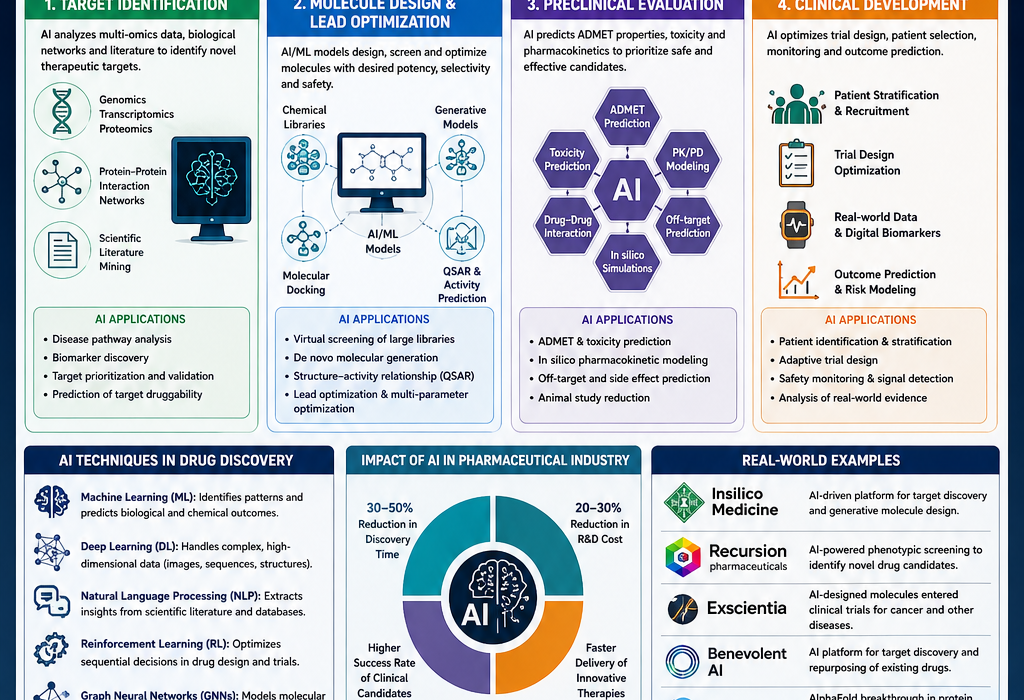
Target identification represents the initial and one of the most critical stages of drug discovery. It involves identifying biological molecules—typically proteins or genes—that play a central role in disease pathogenesis and can be modulated therapeutically.
AI has significantly enhanced the ability of researchers to identify potential drug targets by integrating diverse biological datasets. Machine learning algorithms can analyze genomic sequencing data, gene expression profiles, and protein interaction networks to identify disease-associated pathways. These computational approaches allow researchers to uncover complex biological relationships that may not be apparent through traditional experimental methods.
Deep learning models have also been used to predict protein structures and functions, enabling the identification of previously uncharacterized therapeutic targets. The application of AI in structural biology gained global recognition when advanced neural network systems successfully predicted three-dimensional protein structures with remarkable accuracy.
Furthermore, AI-driven platforms can integrate data from multiple omics technologies—including genomics, transcriptomics, proteomics, and metabolomics—to generate comprehensive models of disease biology. Such integrative analyses enable the identification of novel therapeutic targets for complex diseases such as cancer, neurodegenerative disorders, and autoimmune conditions.
3. AI-Assisted Molecular Design and Lead Optimization
After a therapeutic target has been identified, the next step involves discovering molecules capable of interacting with the target in a therapeutically beneficial manner. Traditionally, medicinal chemists relied on high-throughput screening and iterative chemical modification to identify lead compounds. AI technologies have significantly accelerated this process.
Machine learning models can analyze large chemical libraries to predict the biological activity of potential drug candidates. These predictive models are trained on datasets containing information about chemical structures and their associated pharmacological properties. Once trained, the models can rapidly screen millions of compounds to identify molecules with desirable characteristics.
Generative deep learning algorithms have further revolutionized molecular design by enabling the creation of entirely new chemical structures. These models can design novel molecules that satisfy multiple criteria simultaneously, such as target affinity, metabolic stability, and low toxicity.
AI tools are also widely used for quantitative structure–activity relationship (QSAR) modeling, which predicts the biological activity of compounds based on their molecular features. By integrating molecular docking simulations with machine learning predictions, researchers can optimize lead compounds more efficiently and reduce the time required for preclinical drug development.
4. AI in Preclinical Pharmacology and Toxicity Prediction
One of the major causes of drug development failure is unexpected toxicity or poor pharmacokinetic properties. AI technologies are increasingly used to predict these properties during the early stages of drug development.
Machine learning models can analyze chemical structures and biological datasets to predict absorption, distribution, metabolism, excretion, and toxicity (ADMET) characteristics. These predictive models allow researchers to identify potential safety concerns before expensive laboratory or animal studies are conducted.
AI-based toxicity prediction systems can detect structural features associated with hepatotoxicity, cardiotoxicity, or genotoxicity. Such predictive capabilities significantly reduce the risk of late-stage drug failure.
Moreover, AI-driven platforms can simulate drug interactions within biological systems, providing insights into potential side effects and drug–drug interactions. These computational approaches enable pharmaceutical companies to prioritize the most promising drug candidates for further development.
5. AI in Clinical Trial Design and Optimization
Clinical trials represent the most expensive and time-consuming stage of drug development. AI technologies are increasingly being utilized to improve clinical trial design, patient recruitment, and data analysis.
Machine learning algorithms can analyze electronic health records and genomic datasets to identify suitable patient populations for clinical trials. This approach enables more precise patient stratification, thereby increasing the likelihood of demonstrating therapeutic efficacy.
AI can also optimize clinical trial protocols by predicting potential adverse events and identifying optimal dosing strategies. Real-world data collected from wearable devices and digital health platforms can further enhance the monitoring of patient responses during clinical trials.
Additionally, natural language processing tools can analyze scientific literature, clinical trial databases, and regulatory documents to identify relevant information that may guide clinical research strategies.
6. Challenges and Limitations of AI in Drug Discovery
Despite its significant potential, the application of AI in drug discovery faces several challenges. One of the most critical limitations is the availability and quality of data used to train AI models. Inaccurate or incomplete datasets may lead to unreliable predictions and flawed conclusions.
Another challenge involves the interpretability of complex AI models. Deep learning algorithms often function as “black boxes,” making it difficult for researchers to understand the rationale behind specific predictions.
Regulatory acceptance of AI-driven methodologies also remains a developing area. Regulatory agencies must establish guidelines for validating AI-generated predictions and ensuring the safety and efficacy of AI-assisted drug development.
Ethical considerations, including data privacy and algorithmic bias, must also be addressed to ensure responsible use of AI technologies in biomedical research.
7. Future Perspectives
The future of pharmaceutical innovation is likely to be heavily influenced by the continued integration of AI with emerging technologies such as genomics, systems biology, and high-performance computing. Advances in computational power and data availability will further enhance the predictive capabilities of AI models.
Collaborative partnerships between pharmaceutical companies, biotechnology startups, and academic institutions are expected to accelerate the development of AI-driven drug discovery platforms. As regulatory frameworks evolve, AI-based approaches may become an integral component of pharmaceutical research and development.
8. Conclusion
Artificial intelligence is rapidly transforming the pharmaceutical industry by enabling more efficient drug discovery and development processes. From target identification to clinical trial optimization, AI technologies provide powerful tools for analyzing complex biological data and generating novel therapeutic insights. While challenges related to data quality, interpretability, and regulatory acceptance remain, the continued advancement of AI methodologies promises to significantly reduce drug development timelines and improve the success rate of pharmaceutical innovation. The integration of artificial intelligence with pharmacology and biomedical research represents a pivotal step toward the development of safer, more effective, and personalized medicines for patients worldwide.
References
- Vamathevan J., Clark D., Czodrowski P., et al. (2019). Applications of machine learning in drug discovery and development. Nature Reviews Drug Discovery, 18, 463–477.
- Jumper J., Evans R., Pritzel A., et al. (2021). Highly accurate protein structure prediction with AlphaFold. Nature, 596, 583–589.
- Schneider P., Walters W.P., Plowright A.T., et al. (2020). Rethinking drug design in the artificial intelligence era. Nature Reviews Drug Discovery, 19, 353–364.
- Chen H., Engkvist O., Wang Y., Olivecrona M., Blaschke T. (2018). The rise of deep learning in drug discovery. Drug Discovery Today, 23, 1241–1250.
- Mak K.K., Pichika M.R. (2019). Artificial intelligence in drug development: present status and future prospects. Drug Discovery Today, 24, 773–780.
- Zhavoronkov A., Ivanenkov Y., Aliper A., et al. (2019). Deep learning enables rapid identification of potent DDR1 kinase inhibitors. Nature Biotechnology, 37, 1038–1040.
- Ekins S., Puhl A., Zorn K.M., et al. (2019). Exploiting machine learning for end-to-end drug discovery and development. Nature Materials, 18, 435–441.
- Paul D., Sanap G., Shenoy S., et al. (2021). Artificial intelligence in drug discovery and development. Drug Discovery Today, 26, 80–93.