Regulatory Affairs in India: Navigating the Evolving Landscape of Pharmaceutical Governance
Institutional Transformation, Regulatory Modernization, and the Strategic Future of Drug Regulation
Introduction: The Strategic Importance of Regulatory Affairs in Modern Pharmaceutical Systems
Regulatory affairs represent one of the most critical pillars of the pharmaceutical ecosystem, functioning as the interface between scientific innovation, public health protection, and pharmaceutical commercialization. In India—one of the world’s largest pharmaceutical producers and exporters—the regulatory landscape has undergone substantial transformation in recent years.
The current scenario of regulatory affairs in India reflects a dynamic interplay of modernization, policy reforms, quality oversight, digitalization, and global regulatory alignment. These changes are driven by several factors: the expansion of India’s pharmaceutical industry, rising international scrutiny of drug quality, the emergence of biologics and advanced therapies, and the need to accelerate drug approvals while ensuring patient safety.
At the center of this regulatory architecture lies the Central Drugs Standard Control Organization (CDSCO), the national authority responsible for regulating pharmaceuticals, medical devices, clinical trials, and biological products in India. Together with state drug regulatory authorities, CDSCO ensures that drugs manufactured, imported, and marketed in India meet stringent safety, quality, and efficacy standards. (PSR Compliance)
Today, regulatory affairs in India are transitioning from a traditional compliance-focused discipline toward a strategic regulatory science framework, integrating faster approvals, digital governance, enhanced quality monitoring, and international harmonization.
Regulatory Framework Governing Pharmaceuticals in India
Legal Foundations of Drug Regulation
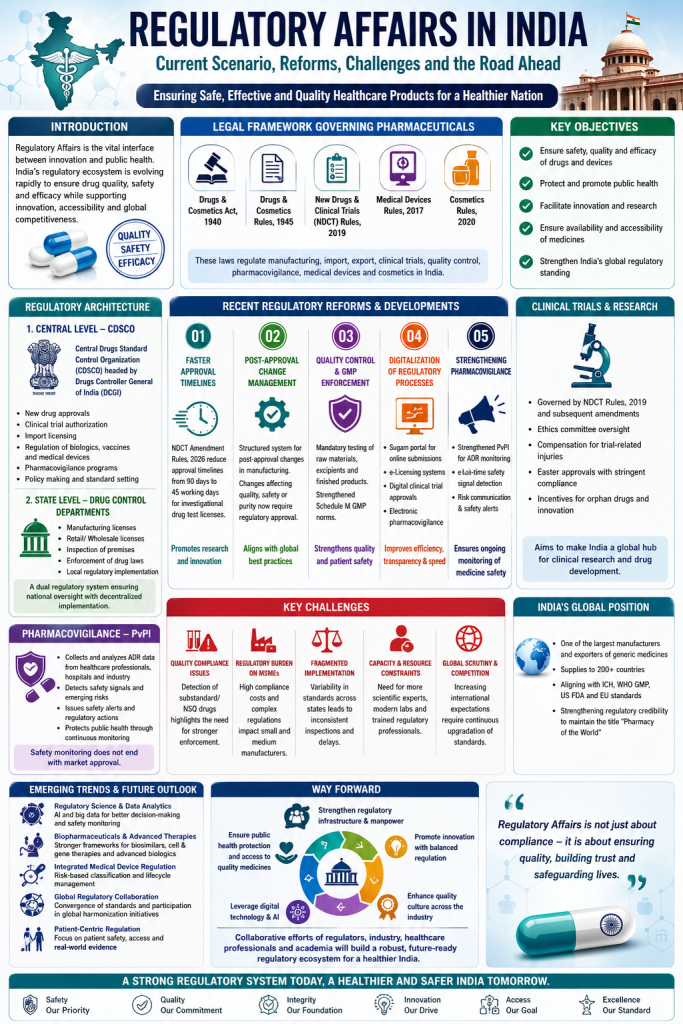
India’s pharmaceutical regulatory system is primarily governed by the following legislative instruments:
- Drugs and Cosmetics Act, 1940
- Drugs and Cosmetics Rules, 1945
- New Drugs and Clinical Trials (NDCT) Rules, 2019
- Medical Devices Rules, 2017
- Cosmetic Rules, 2020
These laws collectively regulate:
- Drug manufacturing and licensing
- Import and export of pharmaceuticals
- Clinical trials and investigational drugs
- Post-marketing surveillance
- Medical device regulation
- Quality control and pharmacovigilance
Together, these regulations create a multi-layered regulatory ecosystem, combining central oversight with state-level implementation.
Institutional Architecture of Regulatory Affairs in India
Central Drugs Standard Control Organization (CDSCO)
The CDSCO, headed by the Drugs Controller General of India (DCGI), is the apex regulatory authority responsible for:
- Approval of new drugs
- Clinical trial authorization
- Import licensing
- Regulation of biologics and vaccines
- Pharmacovigilance programs
- Regulation of medical devices
In recent years, the government has proposed strengthening CDSCO by expanding its scientific workforce and institutional capacity in order to accelerate drug approvals and improve regulatory efficiency. (The Economic Times)
Additionally, policy initiatives such as the Biopharma Shakti program aim to modernize regulatory infrastructure and support India’s transition toward advanced biopharmaceutical innovation. (The Economic Times)
State Drug Regulatory Authorities
While CDSCO oversees national regulatory policy, State Drug Control Departments regulate:
- Manufacturing licenses
- Retail pharmacy licenses
- Quality inspection of pharmaceutical facilities
- Local enforcement of drug laws
This dual regulatory structure creates a federal regulatory model, which ensures decentralized implementation while maintaining national oversight.
However, this structure also presents challenges related to regulatory consistency across states.
Recent Regulatory Reforms and Policy Developments
India has recently undertaken multiple regulatory reforms aimed at improving transparency, efficiency, and global credibility.
1. Faster Drug Approval Timelines
The New Drugs and Clinical Trials (NDCT) Amendment Rules 2026 have significantly reduced approval timelines for investigational drug test licenses.
Previously, approvals could take up to 90 days, but the revised rules now mandate decisions within 45 working days. (CliniExperts)
This reform aims to:
- Accelerate clinical research
- Promote pharmaceutical innovation
- Improve India’s attractiveness for global clinical trials
At the same time, stricter compliance obligations and inspection requirements have been introduced to ensure that faster approvals do not compromise safety. (CliniExperts)
2. Post-Approval Change Management Framework
India is introducing a structured system for post-approval changes in drug manufacturing, categorizing changes based on their potential impact on product quality.
Manufacturers must now obtain regulatory approval for significant manufacturing modifications that could affect the identity, potency, purity, or safety of the drug product. (RAPS)
This reform aligns India’s regulatory processes with international regulatory systems such as:
- US FDA change control systems
- European Medicines Agency (EMA) variation categories
3. Strengthening Quality Control and GMP Enforcement
Recent directives emphasize mandatory testing of raw materials, excipients, and finished pharmaceutical formulations to prevent quality failures. (Nishith Desai Associates)
These measures follow increasing global scrutiny of pharmaceutical quality and aim to enhance India’s reputation as a reliable global supplier of medicines.
In parallel, updated Schedule M Good Manufacturing Practice (GMP) norms are being implemented to align Indian manufacturing standards with WHO and international GMP guidelines.
4. Digitalization of Regulatory Processes
India’s regulatory ecosystem is undergoing significant digital transformation.
Key initiatives include:
- Sugam portal for online regulatory submissions
- Digital licensing platforms
- Electronic pharmacovigilance databases
- Digital clinical trial approvals
Digitalization improves regulatory efficiency and transparency while reducing bureaucratic delays.
Regulation of Clinical Trials and Research
Clinical research regulation has undergone major reform with the introduction of the New Drugs and Clinical Trials Rules, 2019, which created a structured framework for:
- Ethics committee oversight
- Compensation for clinical trial injuries
- Accelerated approval pathways
- Orphan drug development incentives
Recent amendments aim to further simplify clinical trial approvals while strengthening regulatory oversight and compliance.
These reforms seek to position India as a global destination for clinical research and pharmaceutical innovation.
Pharmacovigilance and Post-Marketing Surveillance
Regulatory affairs in India increasingly emphasize post-marketing drug safety monitoring.
The Pharmacovigilance Programme of India (PvPI) collects and analyzes adverse drug reaction (ADR) data from hospitals, physicians, and pharmaceutical companies.
This system enables regulators to:
- Identify emerging safety signals
- Issue safety alerts
- Withdraw unsafe drugs from the market
Recent regulatory reforms are strengthening pharmacovigilance requirements to improve drug safety monitoring nationwide.
Challenges in the Current Regulatory Landscape
Despite significant progress, several challenges remain in India’s regulatory affairs ecosystem.
Quality Compliance Issues
Periodic reports reveal the presence of substandard or “Not of Standard Quality” (NSQ) drugs detected during regulatory surveillance programs. (The Times of India)
Such findings highlight the need for stronger enforcement mechanisms and improved quality assurance across the pharmaceutical manufacturing sector.
Regulatory Burden on Small Manufacturers
Increasing regulatory requirements—including mandatory bioequivalence studies—have raised concerns among small and medium pharmaceutical manufacturers regarding compliance costs. (The Times of India)
Balancing regulatory rigor with industry sustainability remains a key policy challenge.
Fragmented Regulatory Implementation
India’s dual regulatory structure sometimes results in:
- Variability in enforcement standards across states
- Inconsistent inspection practices
- Delays in regulatory approvals
Efforts are underway to standardize licensing and regulatory practices nationwide.
India’s Global Regulatory Position
India is one of the largest suppliers of generic medicines globally, accounting for a substantial share of global pharmaceutical exports.
Consequently, Indian regulatory authorities increasingly aim to align domestic regulations with international standards such as:
- International Council for Harmonisation (ICH) guidelines
- WHO Good Manufacturing Practices
- US FDA regulatory expectations
This alignment is essential to maintain India’s reputation as the “pharmacy of the world.”
Emerging Trends Shaping the Future of Regulatory Affairs
Several emerging developments are likely to shape the future of regulatory affairs in India.
1. Regulatory Science and Data-Driven Regulation
Artificial intelligence and advanced analytics are expected to play a growing role in regulatory decision-making and drug safety monitoring.
2. Biopharmaceutical Regulation
India is strengthening regulatory frameworks for:
- Biosimilars
- Cell and gene therapies
- Advanced biologics
3. Integrated Medical Device Regulation
Medical devices are increasingly regulated under a dedicated framework to ensure quality and patient safety.
4. Global Regulatory Collaboration
India is expanding cooperation with international regulatory agencies to harmonize standards and facilitate global pharmaceutical trade.
Conclusion: Regulatory Affairs as the Strategic Backbone of India’s Pharmaceutical Future
The regulatory affairs landscape in India is undergoing a profound transformation. Through regulatory modernization, digital governance, faster approval mechanisms, and strengthened quality oversight, India is steadily evolving toward a more efficient and globally harmonized pharmaceutical regulatory system.
However, regulatory authorities must continue to balance three critical priorities:
- Patient safety and drug quality
- Industrial growth and innovation
- Global regulatory credibility
For professionals in regulatory affairs, the future demands not merely procedural expertise but also strategic regulatory intelligence, interdisciplinary scientific knowledge, and a deep understanding of evolving global standards.
In the coming decades, regulatory affairs will not only regulate pharmaceuticals but will also shape the trajectory of India’s pharmaceutical leadership in the global healthcare landscape.