Strategic Pharmacotherapeutics: Designing Intelligent Drug Therapy for a Complex World
A Systems-Oriented Approach to Precision Treatment, Therapeutic Optimization, and Future-Ready Clinical Pharmacology
Introduction: The Emergence of Strategic Thinking in Pharmacotherapy
Modern medicine is witnessing a profound transformation in the way therapeutic decisions are conceptualized and executed. Historically, pharmacotherapy was largely guided by standardized treatment protocols, empirical clinical observations, and population-based therapeutic responses. While these approaches have yielded remarkable medical progress, the complexity of contemporary diseases—ranging from multidimensional metabolic disorders to heterogeneous cancers and emerging infectious threats—has necessitated a more sophisticated and strategic approach to drug therapy.
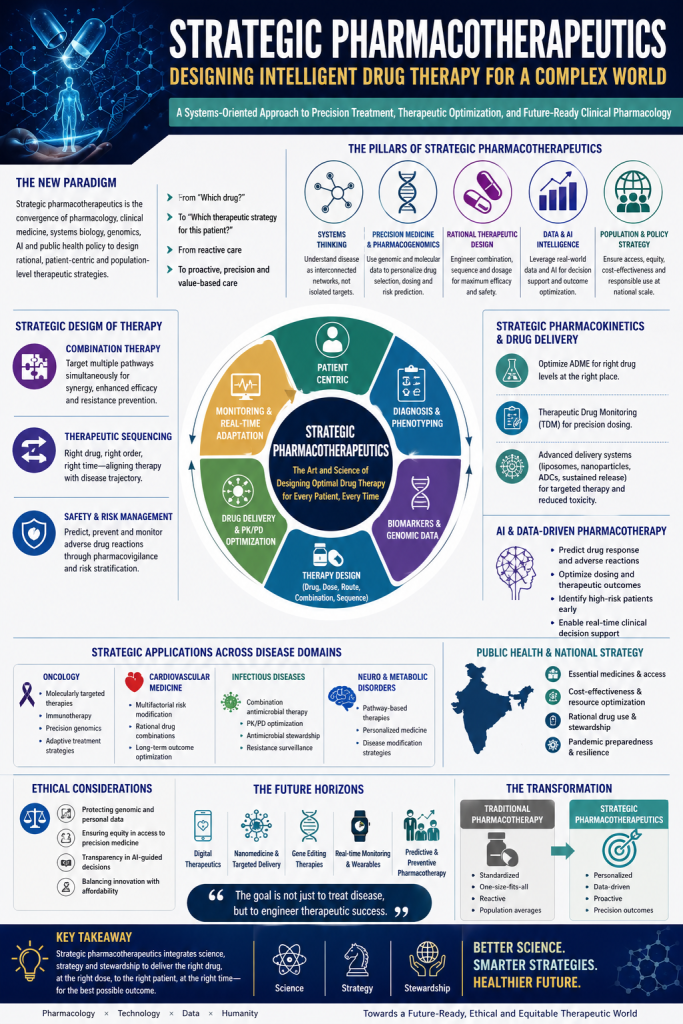
This evolving paradigm may be termed Strategic Pharmacotherapeutics, an advanced framework that integrates pharmacology, clinical medicine, systems biology, artificial intelligence, pharmacogenomics, and public health policy into a unified model of rational therapeutic design.
Strategic pharmacotherapeutics moves beyond the simplistic question of “Which drug should be given?” and instead addresses deeper and more nuanced inquiries:
- Which therapeutic strategy will deliver the most optimal outcome for this specific patient?
- How can drug combinations be rationally designed to maximize efficacy and minimize toxicity?
- How can predictive models guide therapeutic interventions before disease progression occurs?
- How can national health systems deploy pharmacotherapy strategically to manage large populations?
In essence, strategic pharmacotherapeutics represents the convergence of pharmacological science with strategic decision-making, transforming pharmacotherapy from a reactive practice into a proactive and precision-driven discipline.
The Conceptual Foundations of Strategic Pharmacotherapeutics
Strategic pharmacotherapeutics rests upon a set of foundational scientific principles that collectively guide the rational design and implementation of drug therapies.
1. Systems Thinking in Therapeutics
Traditional pharmacology often focuses on isolated biological targets such as receptors, enzymes, or ion channels. However, human physiology operates as a complex network of interconnected systems, where modulation of one pathway inevitably influences others.
Strategic pharmacotherapeutics therefore adopts a systems pharmacology perspective, examining how drugs interact within entire biological networks rather than isolated targets.
For example:
- Cancer therapies now target multiple signaling pathways simultaneously
- Cardiovascular treatments address hemodynamics, inflammation, and metabolic factors
- Neuropharmacology increasingly considers neural network modulation rather than single neurotransmitters
This systems approach enables clinicians to design therapies that are holistic rather than reductionist, improving therapeutic durability and reducing unintended consequences.
2. Precision Medicine and Pharmacogenomics
One of the most transformative elements of strategic pharmacotherapeutics is the integration of genomic information into therapeutic planning.
Individual patients exhibit significant variability in drug response due to genetic differences affecting:
- Drug metabolism enzymes
- Transport proteins
- Receptor sensitivity
- Immune responses
For instance:
- Variations in CYP450 enzymes influence drug metabolism
- Genetic mutations determine response to targeted cancer therapies
- Certain alleles predict susceptibility to drug-induced toxicity
Strategic pharmacotherapeutics therefore incorporates pharmacogenomic profiling to personalize drug therapy.
Rather than prescribing medications purely on population averages, clinicians can now design genotype-guided treatment strategies, dramatically improving therapeutic outcomes.
Rational Design of Therapeutic Strategies
Strategic pharmacotherapeutics emphasizes therapeutic architecture, meaning that treatment plans are carefully engineered rather than merely selected.
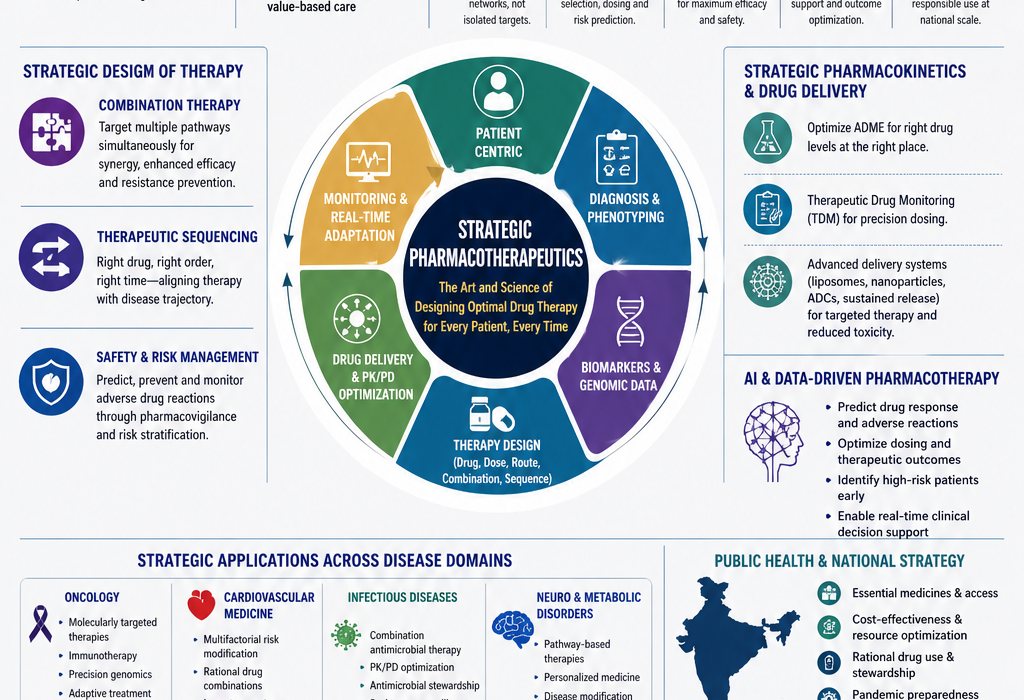
Combination Therapy as Strategic Design
Many diseases involve multiple biological pathways. Consequently, combination therapy has become a cornerstone of strategic pharmacotherapy.
Examples include:
- Antiretroviral therapy for HIV
- Multidrug regimens for tuberculosis
- Polypharmacy in cardiovascular disease
- Targeted combination therapies in oncology
The strategic design of drug combinations requires careful consideration of:
- Pharmacokinetic compatibility
- Pharmacodynamic synergy
- Toxicity overlap
- Resistance prevention
The goal is to create therapeutic synergy, where the combined effect of drugs exceeds the sum of their individual actions.
Therapeutic Sequencing
Strategic pharmacotherapeutics also recognizes that the order in which drugs are administered can influence clinical outcomes.
This concept, known as therapeutic sequencing, is particularly important in:
- Oncology
- Immunotherapy
- Autoimmune disease management
- Chronic infectious diseases
For instance, initial therapy may aim to reduce disease burden, followed by maintenance therapy designed to prevent relapse.
This staged approach ensures that pharmacotherapy evolves alongside the disease trajectory.
Strategic Pharmacokinetics and Drug Delivery
An essential pillar of strategic pharmacotherapeutics is the optimization of drug delivery and pharmacokinetics.
Pharmacokinetic Optimization
Drug therapy effectiveness depends heavily on achieving appropriate drug concentrations at the target site. Strategic pharmacotherapy therefore involves careful management of:
- Absorption
- Distribution
- Metabolism
- Excretion
Advanced tools such as therapeutic drug monitoring (TDM) enable clinicians to adjust drug dosages dynamically based on measured plasma concentrations.
This is particularly important for drugs with narrow therapeutic indices, such as:
- Immunosuppressants
- Antiepileptics
- Certain antibiotics
- Anticancer agents
Advanced Drug Delivery Technologies
Modern pharmaceutical science is rapidly advancing toward targeted drug delivery systems, including:
- Liposomal formulations
- Nanoparticle-based delivery
- Antibody-drug conjugates
- Controlled release systems
These technologies allow drugs to reach their intended targets with greater precision while minimizing systemic toxicity.
Strategic pharmacotherapeutics therefore integrates drug delivery engineering as an essential component of therapeutic design.
Artificial Intelligence and Data-Driven Pharmacotherapy
The digital revolution has introduced powerful computational tools capable of transforming pharmacotherapy.
Artificial intelligence can analyze vast datasets derived from:
- Electronic health records
- Clinical trials
- Genomic databases
- Pharmacovigilance reports
These systems can assist clinicians in predicting:
- Drug response probabilities
- Adverse drug reactions
- Optimal dosing strategies
- Disease progression patterns
In the near future, AI-assisted clinical decision systems may become central to strategic pharmacotherapy, providing real-time guidance for therapeutic optimization.
Strategic Pharmacotherapy in Major Disease Domains
The practical application of strategic pharmacotherapeutics can be observed across several major therapeutic fields.
Oncology
Cancer therapy has perhaps embraced strategic pharmacotherapeutics more fully than any other medical discipline.
Modern oncology employs:
- Targeted molecular therapies
- Immune checkpoint inhibitors
- Precision genomic medicine
- Adaptive therapeutic regimens
Instead of treating cancer as a single disease, strategic pharmacotherapy views it as a dynamic evolutionary system, requiring adaptive therapeutic strategies.
Cardiovascular Medicine
Cardiovascular diseases involve complex pathophysiological processes including:
- Hypertension
- Dyslipidemia
- Inflammation
- Endothelial dysfunction
- Thrombosis
Strategic pharmacotherapy addresses these mechanisms simultaneously through carefully designed drug combinations such as:
- Antihypertensives
- Antiplatelet agents
- Lipid-lowering drugs
- Metabolic regulators
This integrated strategy significantly reduces long-term cardiovascular risk.
Infectious Disease Management
The emergence of antimicrobial resistance has made strategic pharmacotherapeutics essential in infectious disease control.
Modern antimicrobial strategies emphasize:
- Combination antimicrobial therapy
- Pharmacokinetic/pharmacodynamic optimization
- Resistance surveillance
- Targeted antimicrobial stewardship
Strategic pharmacotherapy thus functions as a critical tool in preserving the effectiveness of existing antimicrobial agents.
Public Health and National Pharmacotherapeutic Strategy
Strategic pharmacotherapeutics is not limited to individual patient care; it also plays a vital role in national health policy and pharmaceutical strategy.
Countries must design pharmacotherapeutic frameworks that address:
- Drug accessibility
- Cost-effectiveness
- Essential medicines policies
- Rational drug use
- Pandemic preparedness
For a nation like India—with its vast population and diverse healthcare needs—strategic pharmacotherapeutics can help optimize healthcare resource utilization while ensuring equitable access to life-saving medicines.
Ethical Dimensions of Strategic Pharmacotherapeutics
As pharmacotherapy becomes increasingly technologically advanced, ethical considerations become more significant.
Key ethical questions include:
- How should genomic data be protected?
- How can equitable access to precision medicine be ensured?
- Who bears responsibility for AI-guided therapeutic decisions?
- How can drug pricing be balanced with innovation incentives?
Strategic pharmacotherapeutics must therefore operate within a framework of ethical responsibility, ensuring that technological progress benefits society as a whole.
Future Horizons: The Evolution of Therapeutic Intelligence
The future of pharmacotherapy will likely be shaped by several emerging innovations:
- Digital therapeutics
- Personalized nanomedicine
- Gene editing therapies
- Synthetic biology-based drug systems
- Real-time therapeutic monitoring through wearable technologies
These developments may eventually enable a new era of predictive pharmacotherapy, where diseases are treated—or even prevented—before clinical symptoms appear.
Strategic pharmacotherapeutics thus represents the intellectual bridge between traditional pharmacology and the medicine of the future.
Conclusion: From Drug Prescription to Therapeutic Strategy
The practice of pharmacotherapy is undergoing a profound transformation. No longer confined to prescribing medications based on standardized guidelines, modern clinicians must increasingly think like strategists, designing therapeutic systems tailored to complex biological realities.
Strategic pharmacotherapeutics embodies this evolution. By integrating pharmacology, genomics, artificial intelligence, drug delivery science, and public health policy, it offers a powerful framework for optimizing drug therapy in an increasingly complex medical landscape.
Ultimately, the goal of strategic pharmacotherapeutics is not merely to treat disease but to engineer therapeutic success, ensuring that medical interventions are intelligent, precise, ethical, and sustainable.
In doing so, pharmacology moves beyond the realm of chemistry and biology, entering the domain of strategic medicine—where science, technology, and human insight converge to redefine the future of healthcare.