Precision Pharmacotherapy: Integrating Pharmacogenomics, Biomarkers, and Digital Health
Abstract
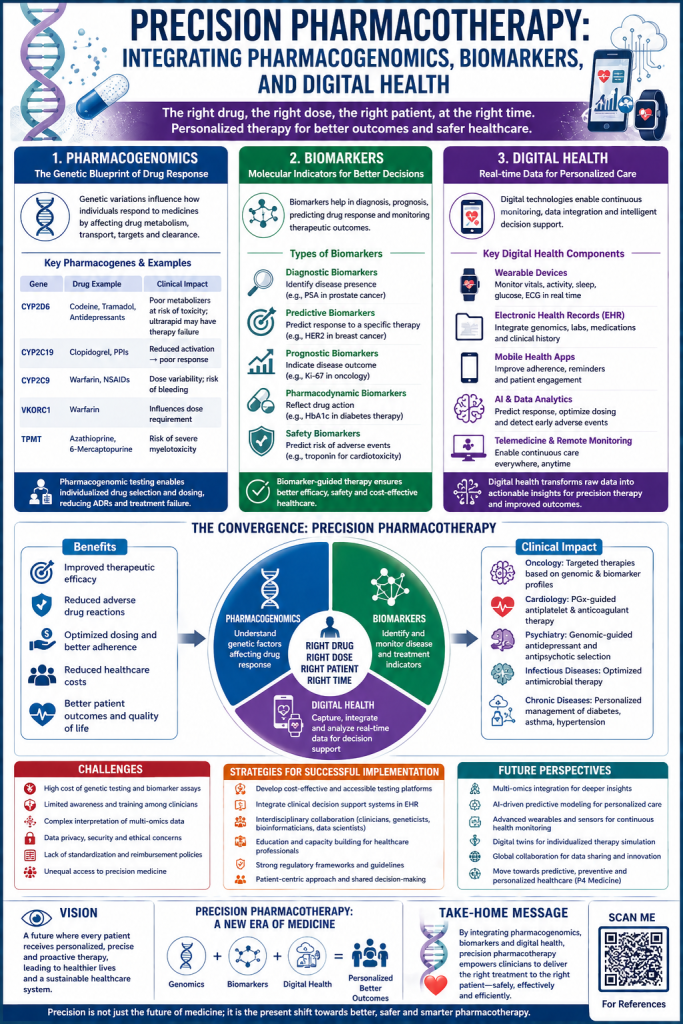
The paradigm of pharmacotherapy is undergoing a profound transformation as medicine transitions from population-based treatment models to individualized therapeutic strategies. Precision pharmacotherapy represents an emerging clinical framework that integrates pharmacogenomics, molecular biomarkers, and digital health technologies to optimize drug therapy for individual patients. Variability in drug response remains a major challenge in clinical medicine, with genetic, environmental, and physiological factors contributing significantly to differences in drug efficacy and safety. Pharmacogenomics enables the identification of genetic determinants influencing drug metabolism, transport, and pharmacodynamic responses, thereby guiding personalized drug selection and dosing strategies. Concurrently, biomarker-driven diagnostics provide valuable insights into disease mechanisms and therapeutic response prediction. Advances in digital health technologies—including wearable sensors, electronic health records, and artificial intelligence-driven analytics—are further enhancing the capacity for real-time patient monitoring and personalized therapeutic decision-making. This review explores the scientific foundations and clinical applications of precision pharmacotherapy, emphasizing the integration of pharmacogenomics, biomarker discovery, and digital health infrastructures. The article also discusses regulatory considerations, implementation challenges, and the potential impact of precision pharmacotherapy on healthcare systems and pharmaceutical innovation. The integration of these technologies promises to improve therapeutic outcomes, minimize adverse drug reactions, and usher in a new era of personalized medicine.
Keywords: Precision pharmacotherapy, pharmacogenomics, biomarkers, personalized medicine, digital health, therapeutic optimization, pharmacology
1. Introduction
Modern pharmacotherapy has historically been guided by standardized dosing regimens derived from clinical trials conducted on heterogeneous patient populations. While such approaches have enabled the development of numerous effective medicines, they often fail to account for individual variability in drug response. Clinical evidence suggests that many commonly prescribed medications demonstrate significant variability in therapeutic efficacy and adverse effect profiles among different individuals.
Adverse drug reactions represent a major global healthcare challenge and are estimated to contribute substantially to morbidity, mortality, and healthcare expenditure. In addition, a considerable proportion of patients do not achieve optimal therapeutic outcomes with conventional treatment strategies.
The concept of precision pharmacotherapy seeks to address these limitations by tailoring drug therapy according to the unique biological characteristics of each patient. This approach integrates insights from pharmacogenomics, molecular biomarkers, and digital health technologies to develop individualized therapeutic strategies.
The emergence of precision pharmacotherapy has been facilitated by rapid advances in genomics, bioinformatics, and biomedical data analytics. The mapping of the human genome and the increasing accessibility of genomic sequencing technologies have enabled researchers to identify genetic variants that influence drug metabolism and pharmacological response.
This article provides a comprehensive review of precision pharmacotherapy, focusing on the integration of pharmacogenomics, biomarkers, and digital health technologies as key components of personalized therapeutic strategies.
2. Pharmacogenomics and Personalized Drug Response
Pharmacogenomics represents one of the most important scientific pillars of precision pharmacotherapy. It examines how genetic variations influence drug absorption, distribution, metabolism, and pharmacodynamic responses.
Genetic polymorphisms in drug-metabolizing enzymes, transporters, and receptors can significantly alter drug efficacy and toxicity. Among the most extensively studied genetic determinants of drug metabolism are polymorphisms in cytochrome P450 enzymes.
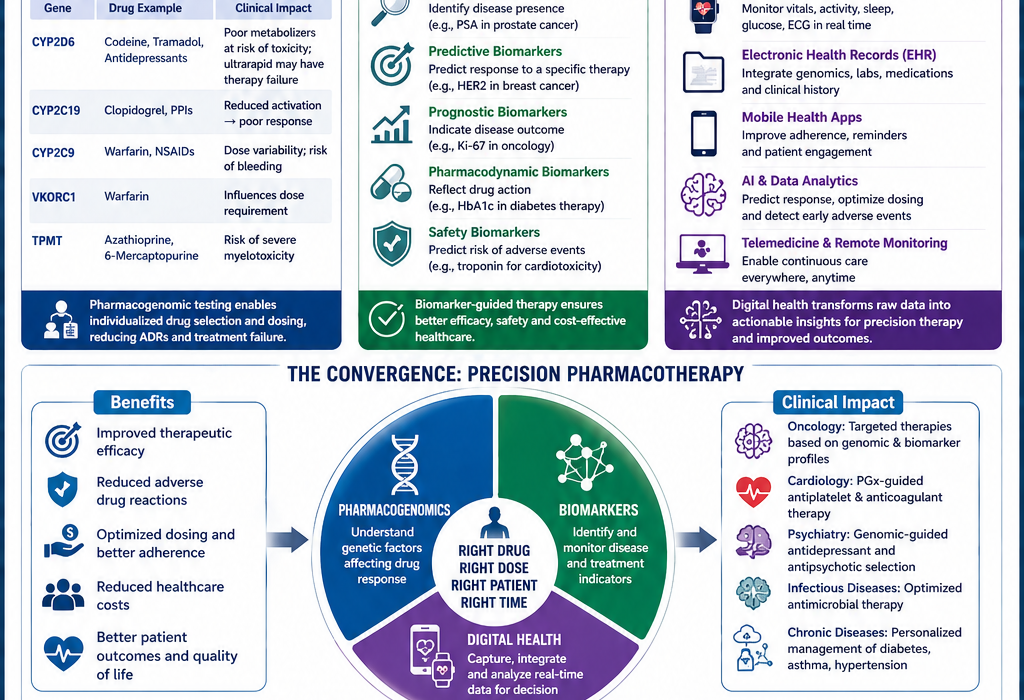
Variants in genes such as CYP2D6, CYP2C19, and CYP2C9 are known to affect the metabolism of numerous therapeutic agents, including antidepressants, antiplatelet drugs, and anticoagulants. For example, polymorphisms in the CYP2C19 gene influence the metabolic activation of the antiplatelet drug Clopidogrel, thereby affecting its therapeutic efficacy in cardiovascular patients.
Similarly, genetic variants affecting the metabolism of Warfarin have been shown to influence optimal dosing requirements and bleeding risk. Genetic testing for variants in the VKORC1 and CYP2C9 genes is increasingly used to guide individualized warfarin therapy.
Pharmacogenomic testing has also become particularly relevant in oncology, where tumor-specific genetic alterations guide targeted therapy selection. For example, mutations in the EGFR gene influence the response of non-small cell lung cancer patients to tyrosine kinase inhibitors.
The integration of pharmacogenomic data into clinical decision-making has the potential to improve drug efficacy, reduce adverse drug reactions, and enhance overall treatment outcomes.
3. Biomarkers in Precision Pharmacotherapy
Biomarkers play a crucial role in the development and implementation of precision pharmacotherapy. A biomarker can be defined as a measurable biological indicator that reflects physiological processes, disease states, or therapeutic responses.
Biomarkers are widely used in modern medicine for disease diagnosis, prognosis, and therapeutic monitoring. In the context of pharmacotherapy, biomarkers help identify patients who are most likely to benefit from specific treatments.
In oncology, biomarker-driven therapies have transformed cancer treatment. For example, overexpression of the HER2 receptor in breast cancer patients predicts responsiveness to the monoclonal antibody therapy Trastuzumab.
Similarly, biomarkers such as PD-L1 expression levels are used to guide treatment decisions involving immune checkpoint inhibitors. These targeted therapies exemplify the shift toward personalized treatment strategies based on molecular characteristics.
Biomarkers also play an important role in monitoring treatment response and disease progression. For instance, circulating tumor DNA and other liquid biopsy technologies allow noninvasive assessment of tumor dynamics during therapy.
The continued discovery and validation of predictive biomarkers will be essential for expanding the scope of precision pharmacotherapy across diverse therapeutic areas.
4. Role of Digital Health Technologies in Precision Pharmacotherapy
Digital health technologies are increasingly contributing to the implementation of precision pharmacotherapy by enabling continuous monitoring of patient health and therapeutic outcomes.
Digital health encompasses a broad range of technologies, including wearable sensors, mobile health applications, telemedicine platforms, and artificial intelligence-driven clinical decision systems.
Wearable devices can monitor physiological parameters such as heart rate, physical activity, glucose levels, and sleep patterns. These real-time data streams provide valuable insights into patient health and treatment responses.
Electronic health records represent another critical component of digital health infrastructure. By integrating genomic information, clinical data, and medication history, electronic health records enable healthcare providers to make more informed therapeutic decisions.
Artificial intelligence algorithms are also being developed to analyze large healthcare datasets and identify patterns associated with drug efficacy and safety. These computational tools may help clinicians predict patient responses to specific medications and optimize treatment strategies.
Furthermore, digital therapeutics are emerging as a novel therapeutic modality that integrates software-based interventions with traditional pharmacological treatments.
5. Clinical Applications of Precision Pharmacotherapy
Precision pharmacotherapy has already demonstrated significant clinical impact in several therapeutic domains.
In oncology, targeted therapies guided by molecular diagnostics have improved survival outcomes for patients with specific genetic mutations. For example, targeted therapies for HER2-positive breast cancer and EGFR-mutated lung cancer have become standard clinical practice.
Cardiovascular medicine has also benefited from pharmacogenomic-guided therapy. Genetic testing can help determine appropriate dosing of anticoagulant and antiplatelet medications.
Psychiatric pharmacotherapy represents another area where pharmacogenomic testing is increasingly being explored to guide antidepressant and antipsychotic therapy.
In infectious diseases, precision approaches are being investigated to optimize antimicrobial therapy and address the growing challenge of antimicrobial resistance.
These examples highlight the potential of precision pharmacotherapy to improve therapeutic outcomes across diverse medical disciplines.
6. Challenges in Implementing Precision Pharmacotherapy
Despite its considerable promise, the widespread implementation of precision pharmacotherapy faces several challenges.
One of the primary barriers is the high cost associated with genomic testing and biomarker discovery. Although sequencing costs have declined significantly, integrating genomic data into routine clinical practice remains expensive.
Another challenge involves the interpretation of complex genomic data. Clinicians require specialized training and decision-support systems to effectively incorporate pharmacogenomic information into therapeutic decisions.
Regulatory frameworks must also evolve to accommodate precision medicine approaches. Regulatory agencies must establish clear guidelines for the clinical validation and approval of biomarker-based therapies.
Data privacy and ethical concerns represent additional challenges, particularly in relation to the management of genomic information and digital health data.
7. Future Perspectives
The future of precision pharmacotherapy is closely linked to advances in genomics, artificial intelligence, and biomedical informatics.
Next-generation sequencing technologies are expected to become increasingly accessible and affordable, enabling broader integration of genomic testing into routine healthcare.
Artificial intelligence and machine learning algorithms will likely play an essential role in analyzing complex biomedical datasets and identifying novel therapeutic insights.
Collaborative efforts between academia, pharmaceutical companies, and healthcare institutions will be crucial for advancing biomarker discovery and validating precision therapeutic strategies.
Ultimately, the integration of pharmacogenomics, biomarkers, and digital health technologies may fundamentally transform the practice of medicine, shifting healthcare toward a predictive, preventive, and personalized model.
8. Conclusion
Precision pharmacotherapy represents a transformative approach to drug therapy that seeks to optimize treatment outcomes through individualized therapeutic strategies. By integrating pharmacogenomics, biomarker-driven diagnostics, and digital health technologies, healthcare providers can tailor treatments according to the unique biological characteristics of each patient. While significant challenges remain in terms of cost, regulatory frameworks, and data integration, continued advances in biomedical science and technology are likely to accelerate the adoption of precision pharmacotherapy in clinical practice. The successful implementation of this approach has the potential to improve patient outcomes, reduce adverse drug reactions, and enhance the overall efficiency of healthcare systems.
References
- Relling M.V., Evans W.E. (2015). Pharmacogenomics in the clinic. Nature, 526, 343–350.
- Roden D.M., McLeod H.L., Relling M.V., et al. (2019). Pharmacogenomics. Lancet, 394, 521–532.
- Johnson J.A., Bootman J.L. (1997). Drug-related morbidity and mortality. Archives of Internal Medicine, 157, 1551–1556.
- Ashley E.A. (2016). Towards precision medicine. Nature Reviews Genetics, 17, 507–522.
- Collins F.S., Varmus H. (2015). A new initiative on precision medicine. New England Journal of Medicine, 372, 793–795.
- Schork N.J. (2015). Personalized medicine: Time for one-person trials. Nature, 520, 609–611.
- Hamburg M.A., Collins F.S. (2010). The path to personalized medicine. New England Journal of Medicine, 363, 301–304.
- Frueh F.W., Gurwitz D. (2004). From pharmacogenetics to personalized medicine. Nature Reviews Drug Discovery, 3, 187–198.