
Cognitive Enhancement Drugs: Neuropharmacology, Ethics, and the Future of Human Performance
Abstract
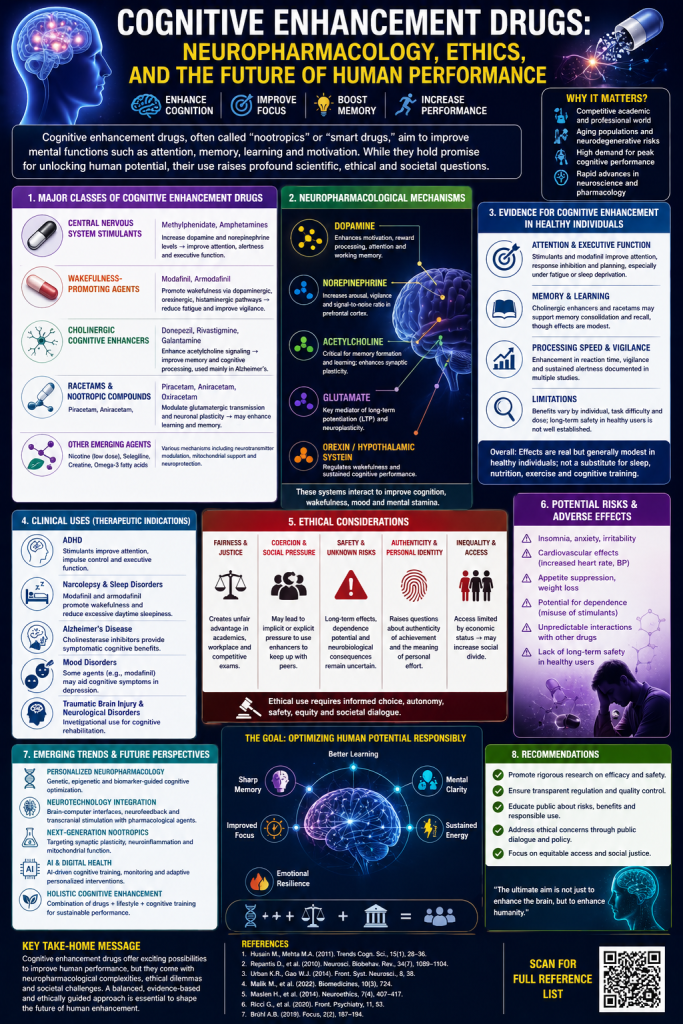
Cognitive enhancement drugs, often referred to as “nootropics” or “smart drugs,” have emerged as a significant area of interest within neuroscience, pharmacology, and bioethics. Originally developed for the treatment of neurological and psychiatric disorders, these pharmacological agents are increasingly used by healthy individuals seeking to improve cognitive functions such as attention, memory, motivation, and executive performance. Advances in neuropharmacology have revealed complex mechanisms through which cognitive enhancers modulate neurotransmitter systems, including dopaminergic, noradrenergic, cholinergic, and glutamatergic pathways. While drugs such as modafinil, methylphenidate, and amphetamine derivatives have demonstrated measurable effects on attention and wakefulness, their long-term safety and efficacy in healthy populations remain uncertain. Beyond neuropharmacological considerations, the use of cognitive enhancers raises profound ethical questions concerning fairness, coercion, societal inequality, and the boundaries of human enhancement. This review explores the neuropharmacological mechanisms underlying cognitive enhancement drugs, examines their clinical and non-medical uses, and critically analyzes the ethical debates surrounding pharmacological neuroenhancement. Finally, the article discusses emerging technologies and future prospects that may shape the development of next-generation cognitive enhancement strategies. Understanding these dimensions is essential for guiding responsible scientific innovation and regulatory policy in the era of human cognitive augmentation.
Keywords: Cognitive enhancement, neuropharmacology, nootropics, smart drugs, neuroethics, human enhancement, pharmacology
1. Introduction
The pursuit of improved cognitive performance has been a persistent theme in human history, ranging from educational strategies and lifestyle interventions to pharmacological approaches designed to enhance mental capabilities. In contemporary biomedical research, the development of cognitive enhancement drugs has gained considerable attention due to advances in neuroscience, psychopharmacology, and neurotechnology.
Cognitive enhancement drugs are pharmacological agents that improve aspects of cognition such as memory, attention, alertness, and executive functioning. These substances were initially developed to treat neurological disorders such as Alzheimer’s disease, narcolepsy, and attention deficit hyperactivity disorder (ADHD). However, their use has increasingly expanded beyond therapeutic contexts to include enhancement of cognitive performance in healthy individuals. (ScienceDirect)
The growing popularity of cognitive enhancers among students, professionals, and military personnel reflects the pressures of modern knowledge-based economies and highly competitive academic environments. Surveys indicate that substances such as methylphenidate, modafinil, and amphetamine derivatives are frequently used as “study drugs” to improve concentration, wakefulness, and productivity. (PMC)
Despite the potential benefits of these pharmacological interventions, their widespread use raises significant scientific and ethical concerns. The long-term effects of cognitive enhancers on brain function remain incompletely understood, and their use in healthy populations has stimulated debates within the emerging field of neuroethics.
This review examines the neuropharmacological basis of cognitive enhancement drugs, their therapeutic and non-therapeutic applications, and the ethical implications associated with pharmacological cognitive enhancement.
2. Concept and Classification of Cognitive Enhancement Drugs
Cognitive enhancement drugs—often termed nootropics—are substances that improve cognitive functions such as memory, learning, concentration, and mental stamina. (PMC)
These agents can be broadly classified into several categories:
2.1 Central Nervous System Stimulants
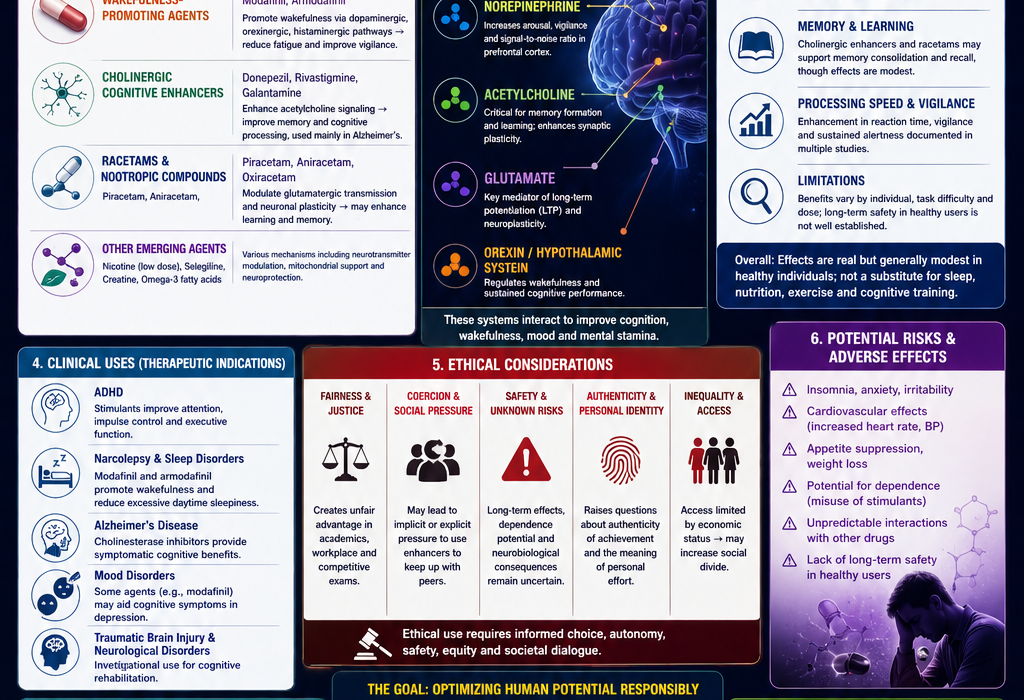
Central nervous system stimulants represent the most widely used class of pharmacological cognitive enhancers. Drugs such as methylphenidate and amphetamine derivatives increase the synaptic availability of dopamine and norepinephrine, thereby enhancing attention, alertness, and executive function.
These compounds are commonly prescribed for ADHD but are also used off-label for cognitive enhancement in healthy individuals.
2.2 Wakefulness-Promoting Agents
Wakefulness-promoting agents such as modafinil were originally developed to treat narcolepsy and sleep disorders. These drugs enhance alertness and cognitive performance by modulating dopaminergic and orexinergic neurotransmission pathways.
2.3 Cholinergic Cognitive Enhancers
Drugs targeting the cholinergic system—including acetylcholinesterase inhibitors—are primarily used for neurodegenerative disorders such as Alzheimer’s disease. These agents enhance memory and cognitive processing by increasing acetylcholine levels in the brain.
2.4 Racetams and Nootropic Compounds
Synthetic compounds such as piracetam and related racetams have been investigated for their potential to enhance memory and learning processes. Although their mechanisms are not fully understood, they are believed to modulate glutamatergic neurotransmission and neuronal plasticity.
3. Neuropharmacological Mechanisms of Cognitive Enhancers
The neuropharmacology of cognitive enhancement drugs involves complex interactions between neurotransmitter systems that regulate cognition, motivation, and arousal.
3.1 Dopaminergic and Noradrenergic Pathways
Many cognitive enhancers exert their effects by modulating dopamine and norepinephrine signaling in the prefrontal cortex. These neurotransmitters play a crucial role in attention, decision-making, and working memory.
Stimulant medications such as methylphenidate increase synaptic dopamine and norepinephrine by inhibiting their reuptake, thereby improving attentional control and cognitive processing speed. (PMC)
3.2 Modulation of Wakefulness Networks
Wakefulness-promoting drugs such as modafinil act through multiple neurotransmitter systems, including dopamine, histamine, glutamate, and orexin pathways. These mechanisms promote cortical activation and sustained alertness while reducing fatigue. (Wikipedia)
3.3 Cholinergic and Glutamatergic Systems
Memory formation and learning processes are strongly influenced by cholinergic neurotransmission within the hippocampus and cortex. Drugs that enhance acetylcholine signaling can improve memory retention and cognitive flexibility.
Glutamatergic signaling also plays a central role in synaptic plasticity and long-term potentiation, which are fundamental mechanisms underlying learning and memory.
4. Evidence for Cognitive Enhancement in Healthy Individuals
The efficacy of cognitive enhancement drugs in healthy populations remains a subject of ongoing research.
Studies indicate that certain stimulants can improve attention, vigilance, and working memory, particularly in sleep-deprived individuals. Modafinil, for example, has been shown to enhance decision-making and planning performance in controlled experimental settings. (Oxford University)
However, evidence suggests that the magnitude of cognitive improvement in healthy individuals is often modest. In some cases, subjective perceptions of improved performance may exceed objective cognitive benefits. (ScienceDirect)
Moreover, the long-term effects of chronic cognitive enhancer use remain poorly understood, particularly with respect to neural plasticity and brain development.
5. Ethical Issues in Pharmacological Cognitive Enhancement
The growing availability of cognitive enhancement drugs has generated intense ethical debate within the fields of bioethics, neuroscience, and public policy.
5.1 Fairness and Competitive Advantage
One of the primary ethical concerns relates to fairness in competitive environments such as education and professional performance. Critics argue that the use of cognitive enhancers may create unfair advantages similar to doping in sports.
5.2 Coercion and Social Pressure
If cognitive enhancement becomes widespread, individuals may feel pressured to use such drugs in order to remain competitive in academic or professional settings.
5.3 Safety and Medicalization
Another ethical concern involves the potential medicalization of normal cognitive variation. The widespread use of pharmacological cognitive enhancers may blur the distinction between therapy and enhancement.
5.4 Socioeconomic Inequality
Access to cognitive enhancement technologies may be limited by economic factors, potentially exacerbating existing social inequalities.
These ethical considerations highlight the need for thoughtful regulatory policies governing the use of pharmacological cognitive enhancement.
6. Emerging Technologies and the Future of Cognitive Enhancement
The future of cognitive enhancement is likely to be shaped by advances in neuroscience, biotechnology, and artificial intelligence.
Several emerging approaches may transform the landscape of human cognitive augmentation:
- Neurotechnology and brain-computer interfaces
- Gene-based therapies influencing neural plasticity
- Personalized neuropharmacology based on genetic profiles
- Integration of pharmacological and digital cognitive enhancement methods
Research into neuroplasticity and neural circuitry may lead to the development of next-generation cognitive enhancers capable of producing more targeted and sustained improvements in human cognition.
7. Conclusion
Cognitive enhancement drugs represent a rapidly evolving domain at the intersection of neuroscience, pharmacology, and ethics. Advances in neuropharmacology have enabled the development of compounds capable of modulating neurotransmitter systems associated with attention, memory, and motivation. While these drugs offer potential benefits in clinical settings and may provide modest cognitive improvements in healthy individuals, their broader societal implications remain complex.
The ethical challenges associated with pharmacological cognitive enhancement—including fairness, safety, and social equity—underscore the importance of responsible scientific and regulatory frameworks. As neuroscience continues to advance, future innovations in cognitive enhancement may reshape the boundaries of human performance and intellectual capacity.
A balanced approach that integrates scientific progress with ethical reflection will be essential for ensuring that cognitive enhancement technologies benefit society while minimizing potential risks.
References
- Husain M., Mehta M.A. (2011). Cognitive enhancement by drugs in health and disease. Trends in Cognitive Sciences, 15(1), 28–36. (ScienceDirect)
- Ricci G., et al. (2020). Pharmacological human enhancement: An overview of the debate. Frontiers in Psychiatry. (Frontiers)
- Malík M., et al. (2022). Nootropics as cognitive enhancers: Types, dosage and side effects. Biomedicines. (PMC)
- Maslen H., et al. (2014). Pharmacological cognitive enhancement. Neuroethics. (PMC)
- Repantis D., et al. (2010). Modafinil and methylphenidate for neuroenhancement. Neuroscience & Biobehavioral Reviews. (ScienceDirect)
- Urban K.R., Gao W.J. (2014). Performance enhancement and neural implications of nootropics. Frontiers in Systems Neuroscience. (Frontiers)
- Cheshire W.P. (2006). Drugs for enhancing cognition and their ethical implications. Expert Review of Neurotherapeutics. (Taylor & Francis Online)
- Brühl A.B. (2019). Neuroethical issues in cognitive enhancement. Focus. (PMC)