Pharmaceutical Supply Chain Sovereignty: Lessons from the COVID-19 Pandemic
Abstract
The COVID-19 pandemic exposed profound structural vulnerabilities in global pharmaceutical supply chains, highlighting the strategic importance of supply chain sovereignty in ensuring access to essential medicines and medical products. Modern pharmaceutical supply networks are highly globalized, relying on complex multi-tiered systems of raw material procurement, active pharmaceutical ingredient (API) manufacturing, formulation production, logistics, and distribution. During the pandemic, disruptions in manufacturing hubs, transportation networks, and international trade resulted in shortages of critical medicines, medical devices, and personal protective equipment across many countries. These disruptions revealed the risks associated with excessive reliance on geographically concentrated manufacturing and just-in-time supply strategies. Consequently, governments and healthcare institutions began reconsidering the balance between efficiency and resilience in pharmaceutical supply chains. This review examines the concept of pharmaceutical supply chain sovereignty, analyzes the structural weaknesses exposed during the COVID-19 pandemic, and discusses strategic policy responses aimed at strengthening supply chain resilience. Key lessons include the need for diversified manufacturing networks, strategic stockpiling of essential medicines, digital supply chain monitoring, and international collaboration. The article concludes by exploring future strategies that may enable nations to safeguard pharmaceutical supply security while maintaining the benefits of globalized pharmaceutical production.
Keywords: Pharmaceutical supply chain, supply chain sovereignty, COVID-19 pandemic, drug shortages, pharmaceutical policy, API manufacturing, supply chain resilience
1. Introduction
Pharmaceutical supply chains represent one of the most critical infrastructures within modern healthcare systems. These networks ensure the continuous availability of medicines, vaccines, and medical devices required for disease prevention and treatment. Over the past several decades, globalization has significantly transformed pharmaceutical manufacturing and distribution, leading to the development of complex international supply chains optimized primarily for efficiency and cost reduction.
While globalization has enabled large-scale production and affordable medicines, it has also introduced new vulnerabilities. The COVID-19 pandemic dramatically exposed these weaknesses as countries around the world experienced shortages of essential medicines, vaccines, and medical equipment.
During the early phases of the pandemic, disruptions in manufacturing and international trade created significant delays in the supply of active pharmaceutical ingredients, finished medicines, and medical devices. These shortages highlighted the risks associated with highly centralized production systems and heavy dependence on foreign suppliers.
The concept of pharmaceutical supply chain sovereignty has emerged as a policy framework aimed at ensuring national access to essential medicines during global crises. This concept emphasizes domestic manufacturing capacity, diversified supply networks, and strategic stockpiles of critical medical products.
This article examines the structural vulnerabilities exposed by the COVID-19 pandemic and explores strategies for strengthening pharmaceutical supply chain resilience in the future.
2. Structure of the Global Pharmaceutical Supply Chain
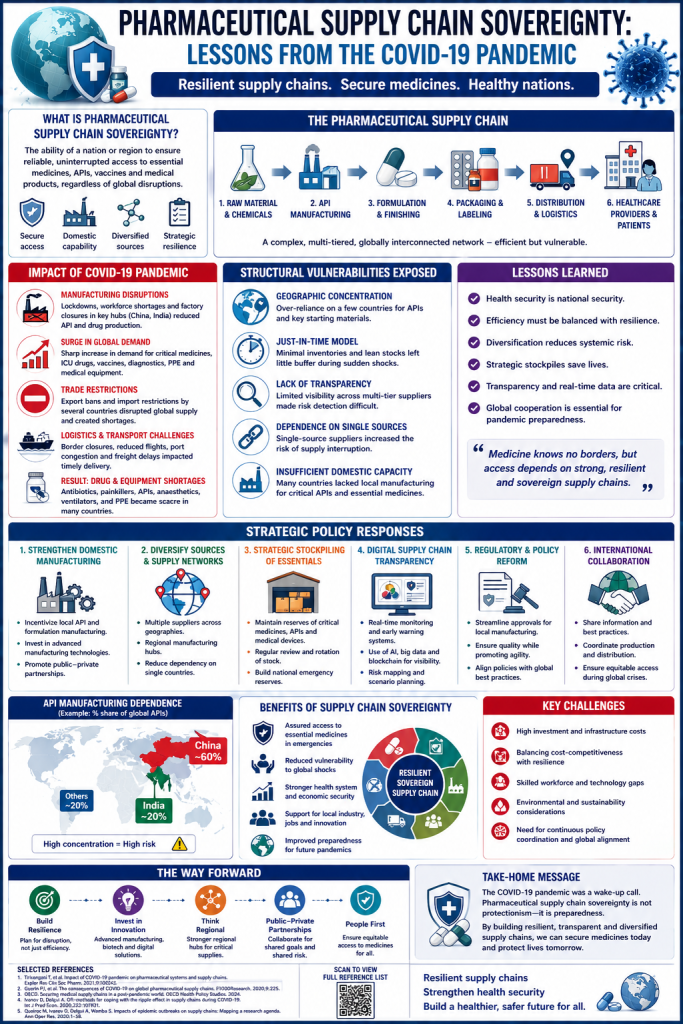
The pharmaceutical supply chain is a complex network involving multiple interconnected stages, including raw material procurement, API production, drug formulation, packaging, and distribution to healthcare providers and patients.
A typical pharmaceutical supply chain involves:
- Raw material suppliers
- Active pharmaceutical ingredient manufacturers
- Drug formulation manufacturers
- Packaging and labeling facilities
- Distribution and logistics networks
- Healthcare providers and pharmacies
Globalization has led to significant geographic concentration of certain manufacturing stages, particularly API production. Many countries rely heavily on imports of APIs from a limited number of regions.
For example, large portions of the global API supply originate from manufacturing hubs in Asia, particularly China and India. This concentration creates systemic risks when disruptions occur in these regions. (World Journal of Research)
3. Impact of the COVID-19 Pandemic on Pharmaceutical Supply Chains
The COVID-19 pandemic disrupted pharmaceutical supply chains at multiple levels, affecting manufacturing, logistics, and distribution.
3.1 Manufacturing Disruptions
Lockdowns and workforce shortages in major pharmaceutical manufacturing regions led to temporary shutdowns of production facilities. China and India, two major API producers, experienced factory closures during early pandemic phases, which significantly reduced global supply of pharmaceutical ingredients. (chemprogroup.com)
Because many pharmaceutical manufacturers depend on imported APIs, disruptions in ingredient production cascaded throughout the global supply chain, affecting drug manufacturing worldwide.
3.2 Increased Global Demand
The pandemic created an unprecedented surge in demand for specific medicines and medical supplies. Drugs used in intensive care units, antivirals, sedatives, and respiratory medications experienced rapid increases in demand.
Simultaneously, the demand for medical products such as ventilators, diagnostic reagents, and personal protective equipment rose dramatically, placing further pressure on already strained supply chains. (chemprogroup.com)
3.3 Trade Restrictions and Export Controls
In response to domestic shortages, several countries implemented export restrictions on essential medical supplies and pharmaceutical ingredients. While intended to protect domestic populations, these policies disrupted global supply networks and contributed to shortages in other regions.
These disruptions illustrated the fragility of international pharmaceutical trade systems during global emergencies.
3.4 Transportation and Logistics Challenges
Global transportation networks were severely disrupted during the pandemic due to border closures, reduced air cargo capacity, and restrictions on international travel.
Pharmaceutical supply chains rely heavily on timely logistics for transporting temperature-sensitive medicines and vaccines. Delays in transportation significantly increased lead times and reduced the availability of essential medicines.
4. Structural Vulnerabilities Revealed by the Pandemic
The COVID-19 crisis revealed several structural weaknesses within global pharmaceutical supply systems.
4.1 Geographic Concentration of Manufacturing
One of the most significant vulnerabilities is the concentration of pharmaceutical manufacturing capacity in a small number of geographic regions.
Heavy reliance on specific manufacturing hubs increases the risk that disruptions—such as pandemics, natural disasters, or geopolitical conflicts—can trigger widespread shortages of medicines.
4.2 Just-in-Time Manufacturing Practices
Many pharmaceutical companies adopted just-in-time inventory management strategies to reduce operational costs. While efficient under normal conditions, these strategies provide limited buffer capacity during sudden supply disruptions.
4.3 Lack of Supply Chain Transparency
The pharmaceutical supply chain involves multiple tiers of suppliers and subcontractors. Limited transparency across these tiers makes it difficult for regulators and manufacturers to identify vulnerabilities or anticipate disruptions.
4.4 Insufficient Domestic Manufacturing Capacity
Many countries lack domestic production capabilities for critical medicines and APIs. During the pandemic, these countries were particularly vulnerable to supply disruptions and global competition for medical resources.
5. Concept of Pharmaceutical Supply Chain Sovereignty
Pharmaceutical supply chain sovereignty refers to the ability of a nation or region to maintain reliable access to essential medicines and medical products regardless of global disruptions.
This concept does not necessarily imply complete self-sufficiency but emphasizes strategic resilience and reduced dependency on single sources of supply.
Key components of supply chain sovereignty include:
- domestic manufacturing capabilities
- diversified supply networks
- strategic stockpiles of essential medicines
- robust regulatory frameworks
- international cooperation for emergency response
The COVID-19 pandemic has accelerated global discussions regarding national pharmaceutical security and the need for resilient supply networks.
6. Policy Responses and Strategic Reforms
Following the disruptions caused by the pandemic, governments and international organizations have implemented several strategies to strengthen pharmaceutical supply chain resilience.
6.1 Reshoring and Regional Manufacturing
Some countries have introduced policies aimed at encouraging domestic pharmaceutical production. These initiatives include financial incentives for building local manufacturing facilities and supporting advanced pharmaceutical manufacturing technologies.
6.2 Strategic Stockpiling
Strategic reserves of essential medicines and APIs can help mitigate supply disruptions during crises. Such reserves provide temporary buffers that allow healthcare systems to maintain operations while supply chains recover.
6.3 Digital Supply Chain Monitoring
Advanced digital technologies—including blockchain, predictive analytics, and real-time monitoring systems—are increasingly being used to enhance supply chain transparency and risk management.
Digital systems allow governments and pharmaceutical companies to detect potential shortages early and coordinate responses more effectively.
6.4 International Collaboration
While supply chain sovereignty emphasizes national resilience, global cooperation remains essential for responding to global health emergencies.
Collaborative initiatives involving governments, pharmaceutical companies, and international organizations can facilitate information sharing, coordinated manufacturing efforts, and equitable distribution of medicines.
7. Future Perspectives
The lessons learned from the COVID-19 pandemic are likely to reshape pharmaceutical supply chain strategies for decades to come.
Future pharmaceutical supply systems may incorporate several structural reforms:
- Diversification of API production across multiple regions
- Adoption of advanced manufacturing technologies such as continuous manufacturing
- Integration of digital supply chain monitoring platforms
- Development of global early-warning systems for medicine shortages
- Public-private partnerships to strengthen pharmaceutical resilience
Balancing supply chain resilience with economic efficiency will remain a major challenge for policymakers and industry leaders.
8. Conclusion
The COVID-19 pandemic revealed critical vulnerabilities within global pharmaceutical supply chains, underscoring the strategic importance of supply chain sovereignty. Heavy reliance on geographically concentrated manufacturing, limited transparency, and just-in-time production models contributed to widespread shortages of essential medicines and medical supplies during the crisis.
Strengthening pharmaceutical supply chain resilience requires a multifaceted strategy that includes diversification of manufacturing capacity, strategic stockpiling, digital monitoring technologies, and international collaboration. By adopting these measures, governments and pharmaceutical industries can better prepare for future global health emergencies and ensure reliable access to essential medicines.
The pursuit of pharmaceutical supply chain sovereignty represents not only a response to the lessons of COVID-19 but also a strategic imperative for safeguarding global public health.
References
- Tirivangani T., et al. (2021). Impact of COVID-19 pandemic on pharmaceutical systems and supply chains. Exploratory Research in Clinical and Social Pharmacy. (ScienceDirect)
- Guerin P.J., et al. (2020). The consequences of COVID-19 on global pharmaceutical supply chains. F1000Research. (F1000Research)
- OECD (2024). Securing medical supply chains in a post-pandemic world. (OECD)
- Lee H., Pinto S. (2020). Building resilience in pharmaceutical supply chains: Lessons from COVID-19. MIT Sloan Management Review.
- Ivanov D., Dolgui A. (2020). OR-methods for coping with the ripple effect in supply chains during COVID-19. International Journal of Production Economics.
- Queiroz M., Ivanov D., Dolgui A., Wamba S. (2020). Impacts of epidemic outbreaks on supply chains. Annals of Operations Research.
- Homayoun S., et al. (2021). Global pharmaceutical supply chain risks and opportunities post-COVID-19. Journal of Pharmaceutical Policy and Practice.
- Strategic Active Pharmaceutical Ingredients Reserve. (Wikipedia)