India’s Role as the Global Pharmacy: Opportunities and Challenges in Affordable Medicine Manufacturing
Abstract
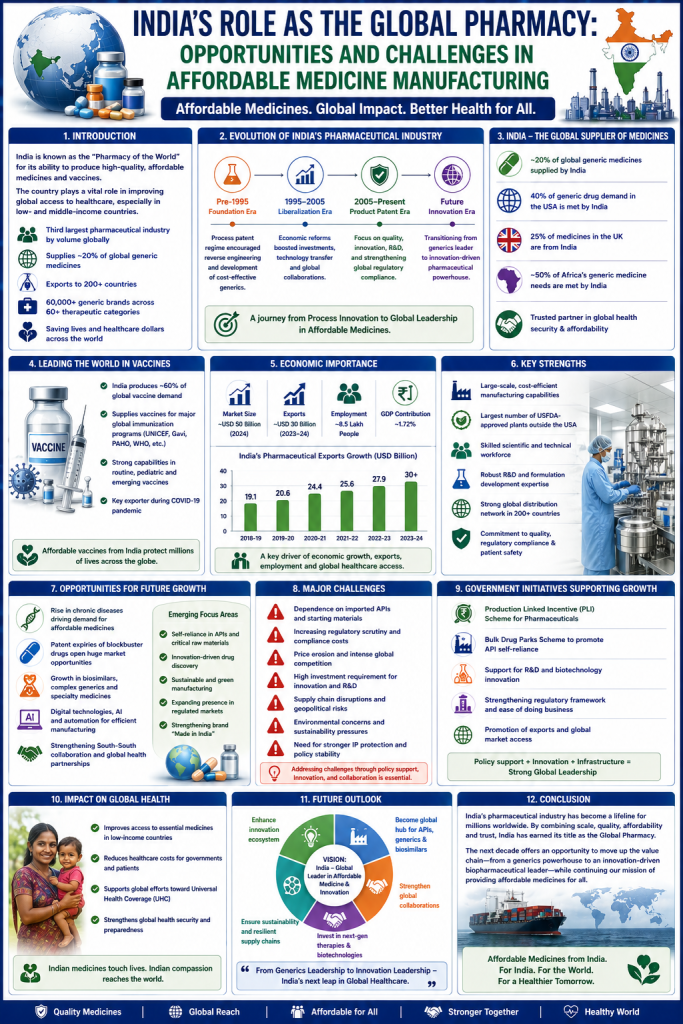
India has emerged as one of the most influential players in the global pharmaceutical landscape, widely recognized as the “pharmacy of the world” for its ability to produce and supply affordable medicines to both developed and developing nations. The country’s pharmaceutical industry is the third largest globally by volume and among the largest suppliers of generic medicines, accounting for nearly 20% of global generic drug supply and producing more than 60,000 generic brands across multiple therapeutic categories. (Press Information Bureau)
India’s pharmaceutical sector has played a crucial role in improving global access to medicines, particularly in low- and middle-income countries, by providing cost-effective generic drugs and vaccines. The industry exports medicines to more than 200 countries worldwide, with pharmaceutical exports reaching approximately USD 30 billion annually. (India Brand Equity Foundation)
Despite these achievements, the sector faces several structural challenges including supply chain vulnerabilities, regulatory compliance pressures, research investment gaps, and dependence on imported active pharmaceutical ingredients (APIs). This review article examines India’s evolving role as the global pharmacy, analyzing the economic, technological, and policy factors that have enabled the country to become a major supplier of affordable medicines. The article further explores the opportunities and challenges facing the Indian pharmaceutical industry as it seeks to strengthen global leadership in affordable drug manufacturing while transitioning toward innovation-driven pharmaceutical development.
Keywords: Generic medicines, pharmaceutical manufacturing, global pharmacy, drug affordability, India, pharmaceutical exports
1. Introduction
Access to affordable medicines remains one of the most critical challenges in global healthcare systems. Many life-saving drugs remain inaccessible in low- and middle-income countries due to high costs and limited manufacturing capacity. In this context, India has emerged as a vital contributor to global public health by producing and exporting large volumes of affordable generic medicines.
The Indian pharmaceutical industry has experienced remarkable growth over the past four decades. Today, the sector ranks third globally in terms of pharmaceutical production volume and supplies medicines to countries across every continent. (Wikipedia)
India’s pharmaceutical exports have expanded significantly in recent years, reaching more than USD 30 billion annually, reflecting the country’s expanding role in global drug supply chains. (India Brand Equity Foundation)
The global reliance on Indian pharmaceuticals became particularly evident during the COVID-19 pandemic, when Indian manufacturers supplied essential medicines and vaccines to numerous countries worldwide.
This article examines the historical evolution, economic significance, and global impact of India’s pharmaceutical manufacturing industry.
2. Evolution of India’s Pharmaceutical Industry
India’s pharmaceutical sector has evolved through several distinct phases that shaped its global leadership in affordable medicine manufacturing.
2.1 The Process Patent Era (1970–1995)
The Indian Patents Act of 1970 allowed pharmaceutical companies to produce medicines using alternative manufacturing processes without infringing product patents. This policy encouraged domestic firms to reverse-engineer patented medicines and produce affordable generic versions.
As a result, Indian pharmaceutical companies rapidly expanded their capabilities in chemical synthesis and process innovation.
2.2 Globalization and Industry Expansion (1995–2005)
Economic liberalization in the 1990s accelerated the growth of India’s pharmaceutical industry by encouraging foreign investment, technological collaboration, and international trade.
During this period, Indian pharmaceutical companies began exporting generic medicines to regulated markets such as the United States and Europe.
2.3 Product Patent Era and Global Integration (2005–Present)
India introduced product patents in 2005 under the WTO TRIPS agreement, transforming the country’s pharmaceutical innovation landscape. Since then, Indian companies have expanded their presence in global pharmaceutical markets while continuing to dominate the generic drug sector.
3. India as the Global Supplier of Generic Medicines
India’s pharmaceutical industry has earned the reputation of the “global pharmacy” due to its leadership in the production and export of generic medicines.
India currently supplies approximately 20% of the world’s generic medicines, making it the largest provider of generics globally. (Press Information Bureau)
The country also plays a critical role in supplying medicines to major international markets:
- India supplies 40% of generic drug demand in the United States
- Indian manufacturers provide 25% of medicines used in the United Kingdom
- Indian pharmaceutical companies supply nearly 50% of Africa’s generic medicine requirements (Bain)
These contributions demonstrate the global dependence on Indian pharmaceutical manufacturing for affordable medicines.
4. India’s Role in Vaccine Production
India has also become a global leader in vaccine manufacturing. Indian pharmaceutical companies supply a significant portion of vaccines used in international immunization programs.
India produces around 60% of global vaccine demand and supplies vaccines for several major global immunization programs including those operated by international organizations. (India Brand Equity Foundation)
Indian vaccine manufacturers play a major role in producing vaccines for diseases such as measles, diphtheria, and tuberculosis.
5. Economic Importance of the Pharmaceutical Industry
The pharmaceutical industry is one of the most important sectors of India’s economy.
The Indian pharmaceutical market is currently valued at approximately USD 50 billion, with exports accounting for a significant share of industry revenue. (Press Information Bureau)
The sector contributes significantly to:
- national GDP
- employment generation
- export earnings
- technological innovation
The industry’s contribution to global healthcare extends beyond economic benefits by improving access to essential medicines worldwide.
6. Opportunities for India in Affordable Medicine Manufacturing
Several factors position India to strengthen its leadership in global pharmaceutical manufacturing.
6.1 Cost-Efficient Manufacturing
Indian pharmaceutical companies have developed highly efficient manufacturing processes that enable the production of medicines at significantly lower costs compared with many developed countries.
6.2 Strong Manufacturing Infrastructure
India hosts the largest number of USFDA-approved pharmaceutical manufacturing plants outside the United States, demonstrating international confidence in the quality of Indian medicines. (Press Information Bureau)
6.3 Skilled Scientific Workforce
India produces thousands of scientists, pharmacists, and biomedical researchers each year, providing a large pool of skilled professionals for pharmaceutical manufacturing and research.
6.4 Expanding Global Demand for Generic Medicines
The expiration of patents on blockbuster drugs is creating new opportunities for Indian pharmaceutical companies to expand their presence in global generic markets.
7. Emerging Opportunities in Complex Generics and Biosimilars
Beyond traditional generic medicines, India is increasingly focusing on high-value pharmaceutical segments including:
- complex generic formulations
- biosimilars
- contract drug manufacturing
- biologics and advanced therapeutics
These sectors offer higher profit margins and greater opportunities for technological innovation.
8. Challenges Facing India’s Pharmaceutical Industry
Despite its global leadership in generic drug manufacturing, India’s pharmaceutical sector faces several important challenges.
8.1 Dependence on Imported APIs
India imports a large proportion of active pharmaceutical ingredients from other countries, particularly China. This dependence creates supply chain vulnerabilities during geopolitical or economic disruptions.
8.2 Regulatory Compliance Pressures
Indian pharmaceutical companies must comply with strict regulatory standards in international markets. Increasing regulatory scrutiny has intensified compliance requirements for manufacturing quality.
8.3 Price Competition in Generic Markets
The global generic drug market is highly competitive, with price pressures reducing profit margins for manufacturers.
8.4 Limited Investment in Drug Innovation
Although India dominates generic drug manufacturing, investment in innovative drug discovery remains relatively limited compared with leading pharmaceutical research nations.
9. Government Initiatives Supporting Pharmaceutical Growth
The Government of India has introduced several initiatives to strengthen pharmaceutical manufacturing and research.
These initiatives include:
- Production Linked Incentive (PLI) schemes for pharmaceuticals
- Bulk Drug Parks to support API manufacturing
- research and innovation funding programs
- policies encouraging biotechnology development
These programs aim to enhance India’s pharmaceutical manufacturing capacity and reduce import dependence on critical drug ingredients.
10. Future Outlook
India’s pharmaceutical industry is expected to continue expanding in the coming decades as global demand for affordable medicines increases.
Industry projections suggest that the Indian pharmaceutical market could reach USD 130 billion by 2030, driven by domestic healthcare demand and export growth. (Vajiram and Ravi)
Future growth is likely to be driven by:
- expansion of biosimilars and biologics manufacturing
- digital technologies in drug development
- increased research investment
- diversification of export markets
11. Conclusion
India’s pharmaceutical industry has played a transformative role in improving global access to affordable medicines. By producing high-quality generic drugs and vaccines at competitive prices, India has become an indispensable supplier in the global healthcare system.
However, sustaining this leadership will require addressing structural challenges such as API dependence, regulatory compliance pressures, and limited innovation investment.
With continued technological advancement, supportive government policies, and expansion into high-value pharmaceutical sectors, India has the potential to strengthen its position as the global pharmacy while evolving into a major center for pharmaceutical innovation.