
Indian Healthcare Industry Report 2026
From Healthcare Delivery to Healthcare Sovereignty: India’s Transition into a Global Health Powerhouse
A Strategic Long-Form Industry Analysis in the Style of Devanssh Mehta

Executive Perspective
The Indian healthcare industry in 2026 is no longer a conventional service sector.
It has evolved into one of India’s most strategically important national capabilities—standing at the intersection of public welfare, economic growth, technology, employment generation, scientific advancement, and geopolitical influence.
Healthcare in India today extends far beyond hospitals and medicines. It represents a deeply interconnected ecosystem consisting of hospitals, diagnostics, pharmaceuticals, medical devices, digital health, health insurance, telemedicine, biotechnology, preventive healthcare, wellness, medical education, artificial intelligence, and global healthcare services. (India Brand Equity Foundation)
The defining question for 2026 is no longer whether India can provide healthcare at scale.
The question is:
Can India become one of the world’s most influential healthcare innovation economies while maintaining affordability and accessibility?
Chapter 1: Size of the Indian Healthcare Economy
India’s healthcare industry has entered a historic expansion phase.
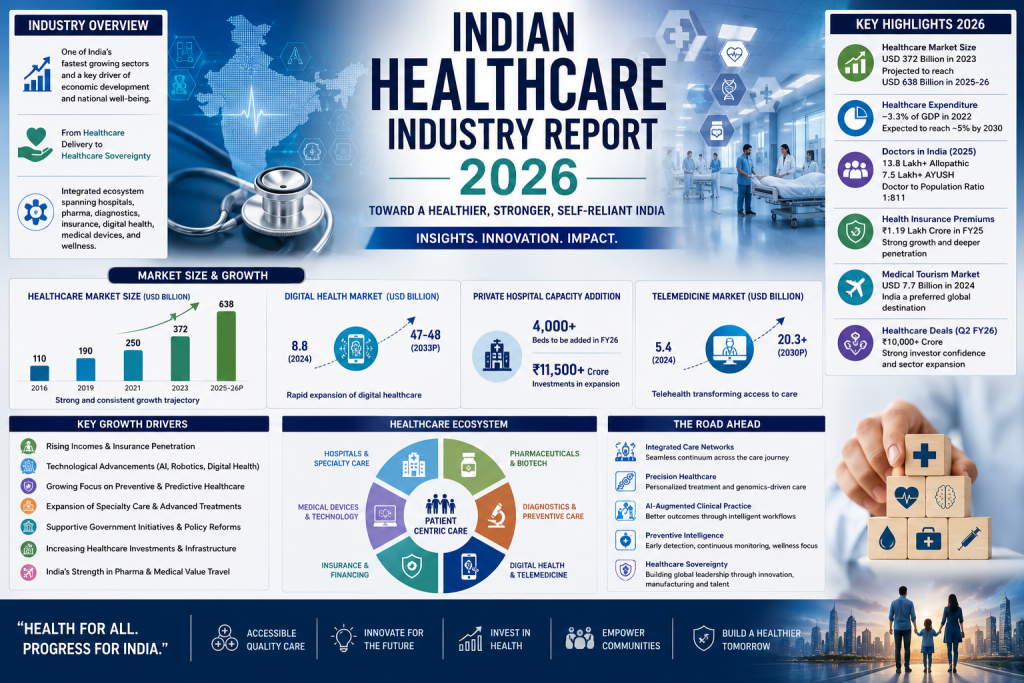
Recent industry estimates indicate that India’s healthcare sector expanded from approximately US$110 billion in 2016 to nearly US$372 billion in 2023, with projections placing the broader ecosystem near US$638 billion by 2025–26 under high-growth scenarios, making healthcare one of India’s fastest-growing strategic industries. (India Brand Equity Foundation)
Healthcare expenditure represented approximately 3.3% of GDP in 2022, with expectations of rising toward 5% by 2030 as infrastructure and access continue expanding. (India Brand Equity Foundation)
The healthcare economy increasingly derives value from six integrated engines:
- Hospitals and tertiary care
- Pharmaceutical manufacturing
- Diagnostics and preventive care
- Insurance and financing
- Digital health platforms
- Medical tourism and advanced specialty services
Unlike earlier decades where healthcare was viewed primarily as consumption expenditure, modern healthcare has become productive national capital.
Chapter 2: Structural Transformation of Indian Healthcare
Historically, India developed a dual healthcare architecture:
- Public health systems focused on access.
- Private healthcare focused on scale and specialization.
By 2026, this distinction is becoming increasingly blurred.
The new model emerging across India may be described as:
Public Policy + Private Capacity + Digital Integration
Three major forces are driving this transition:
Demographic Transition
India’s aging population, urbanization, chronic diseases, and lifestyle-related disorders are increasing demand for long-duration healthcare services.
Epidemiological Transition
Healthcare demand is shifting from infectious disease management toward:
- Oncology
- Cardiology
- Neurology
- Metabolic disorders
- Mental health
- Precision medicine
Economic Transition
Rising incomes and insurance penetration are altering healthcare consumption patterns.
The Indian healthcare consumer is increasingly demanding:
better outcomes, shorter waiting periods, specialized care, and digitally integrated experiences.
Chapter 3: Hospitals—India’s Expanding Healthcare Infrastructure
Hospitals remain the largest visible component of Indian healthcare.
Infrastructure expansion accelerated significantly.
Current projections indicate private hospitals may add more than 4,000 additional beds in FY26, supported by investments exceeding ₹11,500 crore. (India Brand Equity Foundation)
Simultaneously, large healthcare networks are moving aggressively toward specialty expansion.
Recent industry developments show continued investments into:
- oncology,
- cardiac sciences,
- neurology,
- transplant medicine,
- robotic surgery,
- integrated care platforms. (The Economic Times)
Recent reports indicate leading hospital chains are projecting strong growth driven by specialty care demand, with continued expansion in complex-care infrastructure. (Reuters)
This reflects an important shift:
Healthcare growth is no longer occupancy-driven.
It is increasingly acuity-driven.
Chapter 4: Human Capital—India’s Most Valuable Healthcare Asset
Buildings do not create healthcare systems.
People do.
India’s healthcare workforce has expanded substantially.
As of 2025:
- Registered allopathic doctors exceeded 13.8 lakh
- AYUSH practitioners exceeded 7.5 lakh
- Doctor-to-population ratio reached approximately 1:811 (India Brand Equity Foundation)
Medical education capacity is also expanding with new institutions and upgraded district-level teaching infrastructure. (India Brand Equity Foundation)
However, significant challenges remain:
- uneven specialist distribution,
- physician burnout,
- talent migration,
- rural workforce shortages.
Recent professional discussions continue highlighting physician compensation and workforce sustainability concerns. (The Times of India)
India’s next healthcare breakthrough may come not from equipment—
but from workforce redesign.
Chapter 5: The Digital Healthcare Revolution
Perhaps no force is transforming Indian healthcare more rapidly than digitalization.
Healthcare is transitioning from episodic treatment to continuous patient engagement.
India’s digital health market was estimated at approximately US$8.8 billion in 2024 and is projected to grow substantially toward US$47–48 billion by 2033. (India Brand Equity Foundation)
Key digital pillars include:
- electronic health records,
- telemedicine,
- AI diagnostics,
- remote monitoring,
- digital pharmacies,
- integrated health platforms.
Telemedicine itself is projected to become a multi-billion-dollar segment within India’s healthcare ecosystem. (India Brand Equity Foundation)
Healthcare delivery is increasingly moving from:
Hospital-Centered Care → Patient-Centered Care
Chapter 6: Artificial Intelligence and the Future Clinical Model
AI is becoming one of healthcare’s most transformative technologies.
Across India, emerging healthcare initiatives increasingly emphasize:
- predictive diagnostics,
- imaging analytics,
- robotic surgery,
- workflow automation,
- population health modeling. (The Times of India)
Industry-wide adoption is moving from pilot projects toward operational deployment.
Potential applications include:
- radiology augmentation,
- pathology automation,
- clinical decision support,
- pharmacovigilance,
- healthcare logistics.
AI will not replace clinicians.
But clinicians using AI may redefine healthcare performance.
Chapter 7: Diagnostics and Preventive Healthcare
Healthcare economics is shifting.
Future systems increasingly reward early detection rather than late intervention.
Diagnostics is becoming a strategic growth segment because of:
- genomics,
- molecular diagnostics,
- wellness testing,
- oncology screening,
- personalized medicine.
Industry assessments indicate strong growth in diagnostics supported by expansion into Tier-2 and Tier-3 markets and increasing specialty testing demand. (LinkedIn)
Preventive healthcare is becoming economically superior to curative overload.
Chapter 8: Health Insurance—Financing the Next Healthcare Cycle
Healthcare expansion depends on financial access.
India’s health insurance market continues to strengthen.
Total health insurance premiums reached approximately ₹1.19 lakh crore in FY25, showing sustained expansion over previous years. (India Brand Equity Foundation)
Recent industry updates indicate insurance providers remain optimistic about long-term growth and deeper penetration beyond metropolitan regions. (The Times of India)
Future growth drivers include:
- family coverage,
- middle-income expansion,
- digital claims,
- personalized insurance.
Insurance increasingly functions as healthcare infrastructure.
Chapter 9: Medical Tourism and India’s Global Position
India has become one of the world’s most attractive medical destinations.
Medical value travel continues expanding.
Recent estimates place India’s medical tourism market at approximately US$7.7 billion in 2024, with expectations of substantial future growth. Annual international patient inflows remain significant. (India Brand Equity Foundation)
India’s competitive strengths include:
- affordability,
- specialist expertise,
- English-language capability,
- advanced tertiary care,
- pharmaceutical access.
Future growth areas may include:
- oncology,
- fertility medicine,
- organ transplantation,
- rehabilitation.
Chapter 10: Investment, Consolidation, and Healthcare Capital
Healthcare investment activity has accelerated.
Industry reports indicate:
- healthcare deal activity crossing ₹10,000 crore in Q2 FY26,
- strong interest from private equity and strategic investors,
- continued expansion in specialty care and diagnostics. (EY)
Large healthcare operators continue pursuing:
- acquisitions,
- network expansion,
- technology integration.
Recent capital market developments also reflect investor confidence in healthcare growth. (Reuters)
Healthcare is increasingly becoming an institutional investment class.
Chapter 11: Rural Healthcare—India’s Largest Untapped Opportunity
Despite progress, India’s healthcare challenge remains uneven access.
Urban India cannot define healthcare success.
Strategic priorities must include:
- district-level strengthening,
- telehealth deployment,
- mobile diagnostics,
- workforce decentralization.
The greatest healthcare innovation of the next decade may not emerge from metropolitan centers.
It may emerge from making advanced care available where it has historically been absent.
Chapter 12: The Healthcare Industry of 2030—A Strategic Forecast
By 2030, Indian healthcare may evolve toward five defining characteristics:
Integrated Care Networks
Hospitals, diagnostics, pharmacies, and digital platforms becoming unified ecosystems.
Precision Healthcare
More personalized interventions.
Preventive Intelligence
Continuous monitoring replacing episodic treatment.
AI-Augmented Clinical Practice
Automation supporting clinical excellence.
Healthcare Sovereignty
Domestic capability across innovation, manufacturing, and delivery.
Conclusion
The Indian healthcare industry in 2026 should not be viewed simply as a collection of hospitals and medical services.
It represents one of India’s most consequential strategic sectors.
Its future will not be decided only in operating theatres—
but equally in laboratories, classrooms, digital platforms, insurance systems, regulatory institutions, and scientific ecosystems.
India now stands at a historic transition point:
from expanding healthcare access—
to defining the future architecture of global healthcare.
“The healthcare systems that will lead the future are not those that merely treat disease. They will be those that create resilience, intelligence, accessibility, and human dignity at scale.”
— Devanssh Mehta