

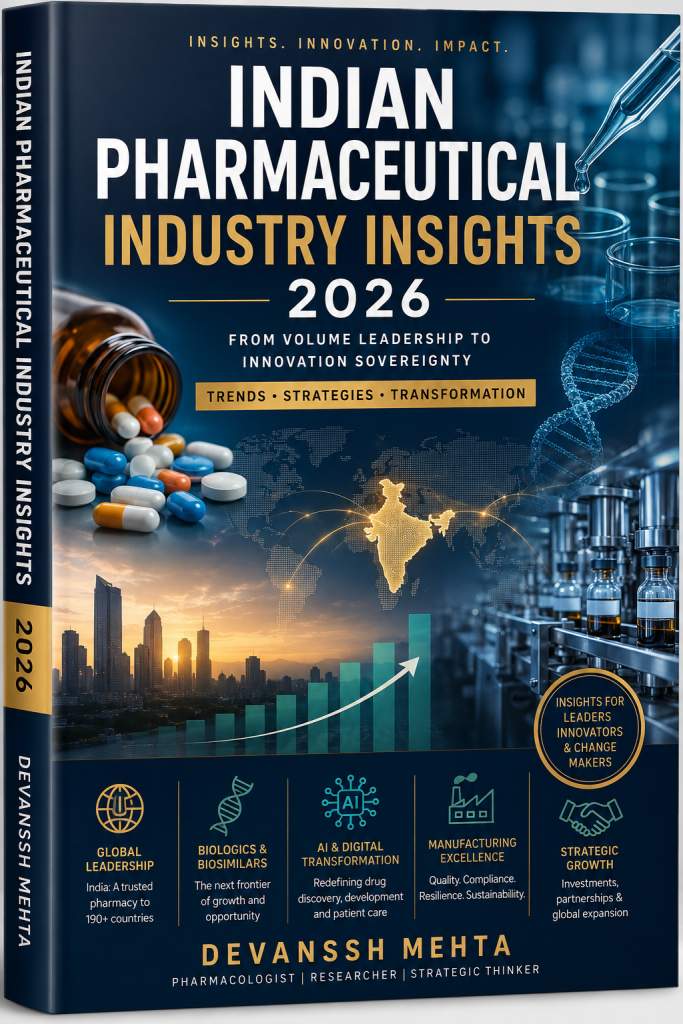
Indian Pharmaceutical Industry Insights 2026
From Volume Leadership to Innovation Sovereignty: The Strategic Transition of Indian Pharma
By Devanssh Mehta Mode (International Excellence Standard)
Introduction: A Defining Decade for Indian Pharmaceuticals
The Indian pharmaceutical industry in 2026 stands at one of the most consequential points in its modern history. For decades, India built its global reputation through affordability, manufacturing efficiency, regulatory adaptability, and unmatched strength in generic medicines. Today, however, the strategic question facing the sector is no longer whether India can manufacture medicines at scale—it is whether India can lead the next generation of pharmaceutical innovation.
India remains one of the most important pharmaceutical nations globally. It continues to be recognized as a major supplier of generic medicines, vaccines, and increasingly complex formulations to international markets. Yet 2026 is revealing a structural shift: competitiveness is moving from cost advantage toward scientific capability, regulatory maturity, biologics, digital integration, and intellectual leadership. (Press Information Bureau)
The transformation is visible across regulation, exports, manufacturing modernization, biologics, AI-enabled development, and strategic public policy.
Industry Size and Economic Position in 2026
India’s pharmaceutical industry has entered a new scale phase.
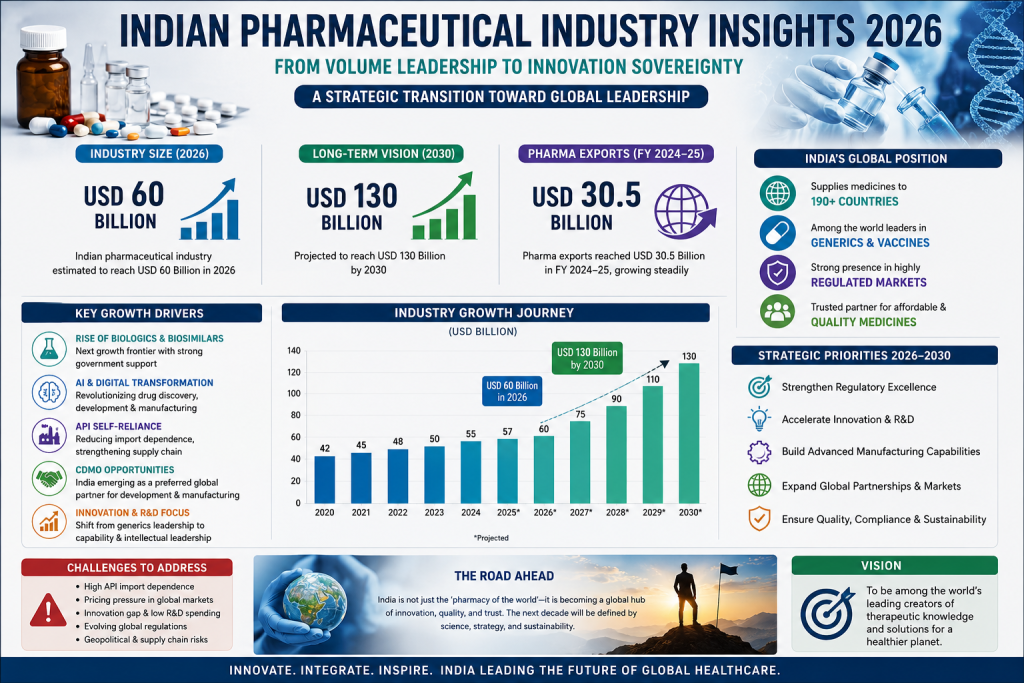
Recent estimates place the sector near USD 60 billion in 2026, with long-term projections targeting approximately USD 130 billion by 2030 under continued growth and structural expansion. Market estimates also indicate the Indian pharmaceutical market crossed approximately ₹4.7 lakh crore–₹4.8 lakh crore in turnover during FY25, reinforcing its position among the world’s most influential healthcare industries. (Mordor Intelligence)
India’s importance extends beyond domestic demand:
- Exports reach more than 190 countries
- India ranks among the leading pharmaceutical exporters globally
- Nearly half of exports serve highly regulated markets including North America and Europe
- India maintains a strong position in generics and vaccines internationally (Press Information Bureau)
The significance of these numbers lies not merely in scale but in strategic capability.
The Export Engine: Global Trust as India’s New Currency
Exports remain the principal strategic pillar.
Indian pharmaceutical exports reached approximately USD 30.5 billion during FY 2024–25, showing continued growth momentum and positioning the industry for double-digit expansion ambitions through 2026–27. (The Times of India)
Export growth is increasingly supported by:
- Generic formulations
- Complex injectables
- Biosimilar products
- Contract manufacturing
- CDMO expansion
- Specialty therapeutics
- Emerging market penetration
Historically, Indian pharmaceutical success emerged from reverse engineering and process excellence. The future model increasingly depends on regulatory excellence and differentiated products.
The next phase will likely reward organizations capable of combining:
Quality + Speed + Scientific Depth + Global Compliance.
Regulatory Transformation: The Rise of Regulatory Intelligence
One of the most important developments in 2026 is the increasing modernization of India’s regulatory ecosystem.
Recent policy announcements indicate efforts to overhaul the national regulatory architecture and strengthen drug approval systems while aligning more closely with global standards. Simultaneously, substantial public investment initiatives have been introduced to accelerate biopharmaceutical growth and innovation capability. (The Economic Times)
Regulatory modernization now extends beyond approval timelines.
Strategic priorities include:
- Digital regulatory workflows
- Data integrity
- Pharmacovigilance modernization
- GMP strengthening
- Faster investigational approvals
- Advanced manufacturing oversight
Recent changes under evolving drug rules are also simplifying test-license mechanisms for investigational products and APIs, improving development flexibility. (CliniExperts)
The future competitive advantage may increasingly belong to firms with stronger regulatory science teams rather than merely larger factories.
From Generics to Innovation: India’s Identity Shift
India’s global identity has long been tied to being the “pharmacy of the world.”
That identity remains powerful—but insufficient.
Industry discussions in 2026 increasingly emphasize transition from:
Generic Leadership → Capability Leadership
Experts suggest India will remain anchored in generics and biosimilars over the near term while gradually expanding into biologics, advanced therapies, and innovation-driven business models. (The Times of India)
This shift requires investment in:
- Novel drug discovery
- Translational pharmacology
- Clinical research
- Advanced analytics
- Platform technologies
- Molecular design
Indian pharmaceutical competitiveness must increasingly become intellectual rather than purely operational.
Biologics and Biosimilars: The Next Frontier
Perhaps the most important structural transition in Indian pharmaceuticals is the rise of biologics.
Traditional small-molecule chemistry continues to dominate revenues, but biologics are rapidly becoming the strategic growth driver.
Emerging priorities include:
- Monoclonal antibodies
- Recombinant therapeutics
- Oncology biologics
- Autoimmune therapies
- Biosimilars
- Cell-based therapeutics
Government initiatives in 2026 include major financial commitments intended to strengthen India’s biopharmaceutical ecosystem and reduce dependence on imported innovation. (The Economic Times)
This transition creates opportunities for pharmacologists, formulation scientists, biotech researchers, and translational medicine specialists.
API Sovereignty: The Supply Chain Question
India’s pharmaceutical success has historically hidden a strategic vulnerability—dependence on imported Active Pharmaceutical Ingredients (APIs).
Recent assessments indicate that more than 70% of certain API imports continue to originate from China, creating supply concentration risks. (Indian Macroeconomic Indicators)
In response, domestic manufacturing initiatives have accelerated.
Under bulk-drug production initiatives:
- dozens of manufacturing projects have been approved,
- multiple greenfield facilities have become operational,
- investment commitments have crossed thousands of crores. (LinkedIn)
The objective is not complete decoupling.
The objective is strategic resilience.
India’s pharmaceutical future depends upon:
API Independence + Advanced Intermediates + Manufacturing Depth
Artificial Intelligence and Digital Pharma
Artificial intelligence has moved from experimentation to execution.
In 2026, major trends include:
- AI-assisted drug discovery
- Clinical simulation
- Digital twins
- Predictive toxicology
- Pharmacovigilance automation
- Manufacturing analytics
- Precision medicine support (Drishti IAS)
AI may fundamentally alter pharmaceutical economics by reducing:
- discovery timelines,
- development failures,
- trial complexity,
- and manufacturing variability.
For India, AI offers an opportunity to leapfrog traditional R&D cycles.
However, technology alone cannot replace scientific judgment.
Future leadership will come from integration:
AI × Pharmacology × Clinical Science × Regulation
Manufacturing Excellence and Quality Revolution
Indian manufacturing is entering a higher-quality phase.
Global markets increasingly reward:
- audit readiness,
- serialization,
- environmental compliance,
- traceability,
- automation,
- contamination control.
The future factory will not merely produce medicines.
It will generate validated data.
Industry competitiveness is increasingly determined by:
- batch reliability,
- digital records,
- quality culture,
- and inspection preparedness.
The movement toward advanced manufacturing is expected to continue reshaping India’s global perception.
The Emerging CDMO Opportunity
Contract Development and Manufacturing Organizations (CDMOs) are becoming a strategic growth engine.
Global supply diversification and “China Plus One” strategies are creating opportunities for Indian pharmaceutical manufacturers.
Analysts suggest strong long-term growth potential in outsourced development and manufacturing services as multinational firms seek resilient and diversified supply chains. (DrugPatentWatch)
India’s strengths include:
- scientific talent,
- manufacturing scale,
- cost competitiveness,
- English-language integration,
- regulatory familiarity.
This may become one of India’s highest-value pharmaceutical opportunities.
Mergers, Consolidation, and Global Expansion
Indian pharmaceutical companies are becoming more ambitious internationally.
One of the most notable developments of 2026 is the announcement of a major overseas acquisition involving India’s leading pharmaceutical player, signaling strategic movement into specialty medicines, oncology, women’s health, obesity, and biosimilars. (Reuters)
Such developments indicate a broader transition:
From exporting products
to acquiring global platforms.
The future pharmaceutical leader may not be the company producing the largest volume.
It may be the company controlling:
- brands,
- intellectual property,
- platforms,
- and patient ecosystems.
Human Capital: India’s Hidden Pharmaceutical Advantage
India’s greatest pharmaceutical asset may not be infrastructure.
It may be people.
The country possesses:
- pharmacists,
- pharmacologists,
- clinicians,
- biostatisticians,
- regulatory scientists,
- manufacturing specialists,
- biotech researchers.
Yet a structural gap remains between education and industrial capability.
Future priorities include:
- interdisciplinary education,
- translational science,
- industry-linked research,
- digital literacy,
- innovation ecosystems.
The next generation of pharmaceutical professionals must evolve beyond technical execution toward strategic scientific leadership.
Strategic Risks That Cannot Be Ignored
Despite progress, challenges remain.
Structural Risks
- API dependency
- pricing pressure
- regulatory fragmentation
- R&D underinvestment
External Risks
- tariff uncertainty
- geopolitical disruptions
- supply chain shocks
- evolving trade rules (Reuters)
Scientific Risks
- innovation gaps
- limited breakthrough discovery
- talent migration
Addressing these weaknesses will determine whether India scales or stalls.
The Road to 2030 and Beyond
The Indian pharmaceutical industry is entering an era where scale alone is insufficient.
The future may increasingly belong to companies and institutions that master:
- biologics,
- AI,
- advanced manufacturing,
- regulatory science,
- translational medicine,
- intellectual property,
- and scientific originality.
India’s ambition should no longer be limited to becoming the world’s medicine supplier.
The larger aspiration should be:
to become one of the world’s creators of therapeutic knowledge.
Conclusion
The Indian pharmaceutical industry in 2026 should not be viewed merely as an industrial sector.
It represents a national capability.
Its future will not be decided only inside factories—but equally inside laboratories, regulatory institutions, digital platforms, universities, healthcare systems, and strategic policy frameworks.
The next decade may determine whether India remains a global supplier of medicines—
or becomes one of the principal architects of global healthcare innovation.
“The future of Indian pharma will not belong only to those who manufacture medicines. It will belong to those who manufacture trust, knowledge, and therapeutic possibility.” — Devanssh Mehta