India’s Healthcare System: Challenges and Strategic Reforms
Reimagining a Resilient, Equitable, and Innovation-Driven Health Architecture for the 21st Century
Introduction: Healthcare at the Crossroads of National Development
Healthcare systems are fundamental pillars of national development, social justice, and economic productivity. In the context of a rapidly transforming nation such as India, the healthcare system occupies a critical space where public policy, medical science, economics, and social welfare intersect. With a population exceeding 1.4 billion people, India faces the monumental task of ensuring accessible, affordable, and high-quality healthcare services for a highly diverse population.
Over the past decades, India has made remarkable progress in improving life expectancy, reducing infant mortality, and expanding medical infrastructure. Programs supported by institutions such as the World Health Organization and national initiatives like Ayushman Bharat have contributed significantly to expanding healthcare coverage and strengthening public health systems.
However, despite these achievements, India’s healthcare system continues to confront numerous structural challenges including unequal access, insufficient public health spending, workforce shortages, and the rising burden of non-communicable diseases. These complexities necessitate comprehensive strategic reforms aimed at transforming India’s healthcare architecture into a resilient and equitable system capable of addressing present and future health challenges.
This article examines the current structure, major challenges, and strategic reforms necessary for strengthening India’s healthcare system according to global health standards.
Evolution of India’s Healthcare System
Historical Foundations
The modern healthcare framework in India evolved gradually after independence in 1947. Early public health strategies were influenced by the recommendations of the Bhore Committee, which emphasized the need for a universal, government-funded healthcare system.
The decades following independence witnessed significant expansion of:
- Primary health centres (PHCs)
- District hospitals
- Medical colleges
- Public health programs targeting infectious diseases
National health initiatives addressing diseases such as tuberculosis, malaria, and leprosy significantly improved health indicators across the country.
Contemporary Healthcare Architecture
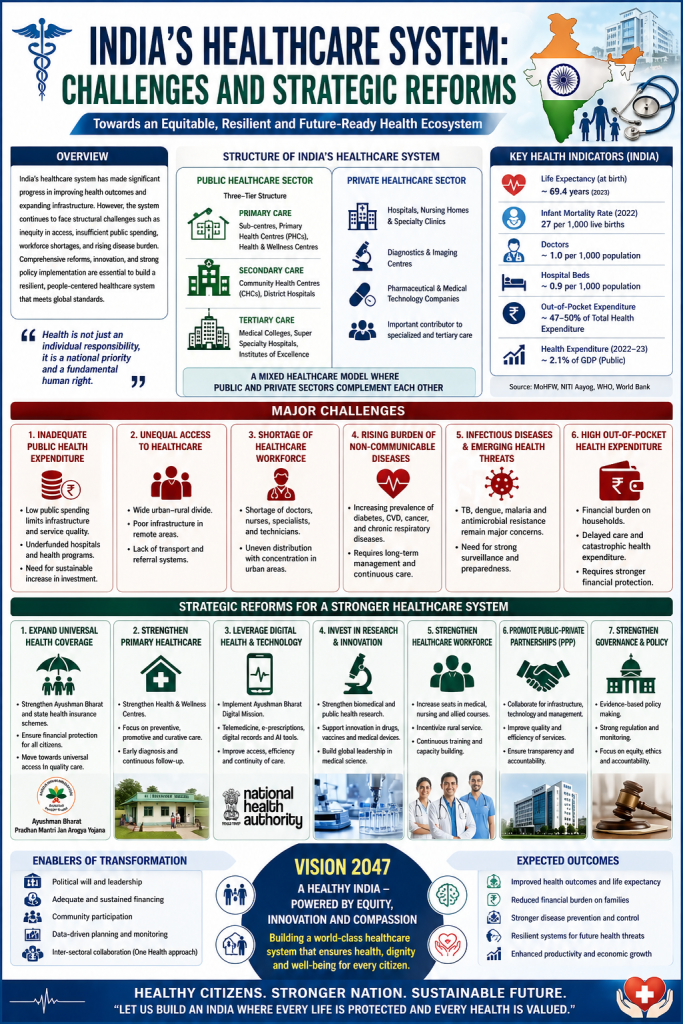
Today, India’s healthcare system consists of a mixed public-private model.
Public Healthcare Sector
The public sector provides subsidized healthcare through a three-tier structure:
- Primary healthcare – Sub-centres and Primary Health Centres
- Secondary healthcare – Community Health Centres and district hospitals
- Tertiary healthcare – Specialized medical institutions and teaching hospitals
These institutions form the backbone of India’s rural and public health services.
Private Healthcare Sector
India’s private healthcare sector has grown rapidly and now provides a large proportion of tertiary and specialized healthcare services. Private hospitals, diagnostic centres, and specialty clinics often offer advanced medical technologies and specialized treatment options.
However, heavy reliance on private healthcare also contributes to high out-of-pocket healthcare expenditure, which remains one of the most pressing challenges in the Indian healthcare landscape.
Major Challenges Facing India’s Healthcare System
Despite progress in health infrastructure and disease control, India faces several persistent challenges that limit the effectiveness and equity of healthcare delivery.
Inadequate Public Health Expenditure
Public healthcare spending in India remains relatively low compared with many developed and emerging economies.
Limited government expenditure results in:
- Underfunded hospitals
- Insufficient medical equipment
- Shortage of healthcare personnel
- Limited research investment
Increasing public healthcare investment is therefore crucial for building a stronger healthcare infrastructure.
Unequal Access to Healthcare Services
Healthcare access in India varies significantly across geographical regions.
Urban populations benefit from:
- Advanced hospitals
- Specialist physicians
- Modern diagnostic facilities
In contrast, rural areas often suffer from:
- Shortage of doctors
- Inadequate healthcare infrastructure
- Poor transportation and referral systems
This urban-rural disparity remains one of the most critical barriers to equitable healthcare delivery.
Shortage of Healthcare Workforce
Human resources represent the foundation of any healthcare system. India continues to face shortages of trained healthcare professionals including:
- Physicians
- Nurses
- Pharmacists
- Public health specialists
- Laboratory technicians
Workforce distribution is also uneven, with a higher concentration of specialists in metropolitan areas compared to rural regions.
Rising Burden of Non-Communicable Diseases
India is experiencing a rapid epidemiological transition characterized by the increasing prevalence of non-communicable diseases (NCDs) such as:
- Cardiovascular diseases
- Diabetes
- Cancer
- Chronic respiratory disorders
These diseases require long-term management, advanced diagnostics, and continuous healthcare services, placing significant pressure on the healthcare system.
Infectious Diseases and Emerging Health Threats
While non-communicable diseases are rising, infectious diseases continue to remain a significant concern.
India still faces challenges related to:
- Tuberculosis
- Dengue
- Malaria
- Antimicrobial resistance
Furthermore, global health crises such as the COVID-19 pandemic have demonstrated the importance of strong public health preparedness and surveillance systems.
High Out-of-Pocket Healthcare Expenditure
One of the most pressing issues in India’s healthcare system is the high proportion of healthcare expenses paid directly by patients.
High out-of-pocket expenditure can lead to:
- Financial hardship for families
- Delayed healthcare seeking
- Reduced adherence to treatment
Addressing this issue is essential for achieving equitable healthcare access.
Strategic Reforms for Strengthening India’s Healthcare System
Transforming India’s healthcare system requires comprehensive reforms that address structural weaknesses while embracing innovation and scientific advancement.
Expanding Universal Health Coverage
Universal health coverage is a cornerstone of modern healthcare systems.
Programs such as Ayushman Bharat represent a major step toward ensuring financial protection for millions of citizens by providing insurance coverage for hospitalization and specialized treatment.
Expanding such programs and improving their implementation can significantly reduce healthcare inequalities.
Strengthening Primary Healthcare
Primary healthcare forms the first point of contact between individuals and the healthcare system.
Strengthening primary healthcare services through:
- Health and Wellness Centres
- Community health workers
- Preventive health programs
can significantly reduce disease burden and improve early diagnosis.
Preventive healthcare strategies focusing on lifestyle modification, vaccination, and health education are essential for long-term healthcare sustainability.
Digital Health and Technological Innovation
Digital technologies are transforming healthcare delivery worldwide.
India has initiated major digital health initiatives such as the Ayushman Bharat Digital Mission, which aims to create an integrated digital health ecosystem.
Key components include:
- Electronic health records
- Telemedicine services
- Digital health identification systems
- Health data integration platforms
These innovations can improve efficiency, accessibility, and coordination of healthcare services.
Investment in Medical Research and Innovation
Scientific research plays a critical role in advancing healthcare systems.
India must strengthen investment in:
- Biomedical research
- Pharmaceutical innovation
- Vaccine development
- Clinical research infrastructure
Institutions such as the Indian Council of Medical Research play a vital role in advancing scientific research and public health innovation.
Strengthening research capacity will enable India to contribute significantly to global medical science.
Strengthening Healthcare Workforce Development
Expanding medical education and training programs is essential for addressing workforce shortages.
Strategic initiatives may include:
- Establishing new medical colleges
- Enhancing nursing and allied health training
- Incentivizing rural medical service
- Strengthening continuing medical education programs
Developing a well-trained healthcare workforce will improve both healthcare accessibility and quality.
Public-Private Partnerships in Healthcare
Collaboration between public and private sectors can help address infrastructure gaps and expand healthcare access.
Public-private partnerships can support:
- Hospital infrastructure development
- Diagnostic services
- Medical technology innovation
- Healthcare management systems
When properly regulated, these partnerships can significantly strengthen healthcare delivery systems.
Ethical and Policy Considerations
Healthcare reform is not merely a technical exercise; it is fundamentally an ethical responsibility. Healthcare systems must be guided by principles of equity, accessibility, transparency, and accountability.
Governments must ensure that healthcare policies prioritize:
- Social justice
- Public welfare
- Evidence-based decision-making
Healthcare professionals also play a crucial role in promoting ethical clinical practice, patient safety, and rational medical treatment.
Conclusion: Toward a Resilient and Inclusive Healthcare Future
India stands at a pivotal moment in the evolution of its healthcare system. Rapid demographic changes, epidemiological transitions, and technological advancements are reshaping healthcare needs across the nation.
Addressing the challenges facing India’s healthcare system requires visionary leadership, sustained investment, and coordinated action across government institutions, healthcare providers, scientific communities, and civil society.
Strategic reforms focusing on universal health coverage, primary healthcare strengthening, digital health innovation, medical research, and workforce development can transform India’s healthcare system into a globally competitive and socially equitable model.
A resilient healthcare system is not only essential for improving population health but also for strengthening national productivity, economic stability, and social progress.
Ultimately, the future of India’s healthcare system will depend on the nation’s collective commitment to building a healthcare architecture that ensures health, dignity, and well-being for every citizen.