Meerut: The Strategic Gateway of Western Uttar Pradesh’s Economic Future
Introduction: A City at the Crossroads of History and Economic Transformation
Cities often evolve through the convergence of geography, infrastructure, industry, and human aspiration. In northern India, Meerut stands as a compelling example of such transformation. Historically known as the birthplace of the 1857 uprising, Meerut today is emerging as a strategic economic gateway of Western Uttar Pradesh, linking the National Capital Region (NCR) with the expanding economic landscape of northern India.
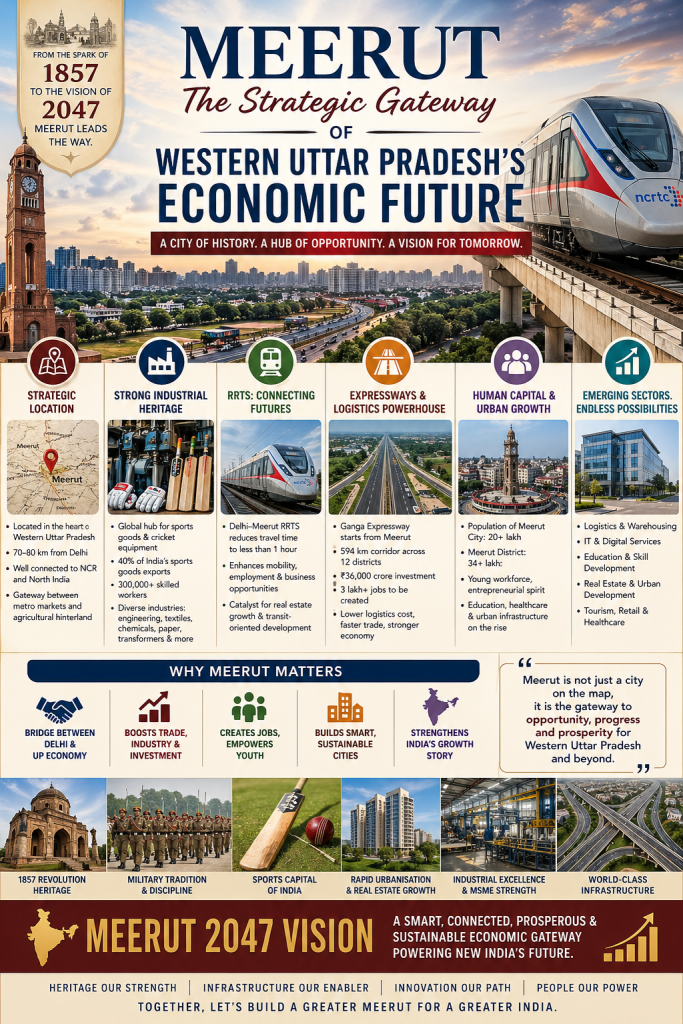
Located approximately 70–80 kilometers from Delhi, Meerut occupies a geostrategic position within India’s most dynamic economic corridor. Its proximity to the national capital, combined with modern infrastructure projects such as the Delhi–Meerut Regional Rapid Transit System (RRTS), expressways, and expanding industrial clusters, has begun to reshape the city’s economic profile. (Wikipedia)
The transformation of Meerut from a historical cantonment town into a modern urban growth engine reflects broader structural changes in India’s regional development model. As the country transitions toward integrated economic corridors, Meerut is increasingly positioned as a logistics hub, manufacturing center, and urban growth pole for Western Uttar Pradesh.
This article explores the evolving role of Meerut as a strategic gateway by examining its geographical advantages, industrial foundations, infrastructure expansion, and long-term economic prospects.
1. Geographic Advantage: The Strategic Location of Meerut
Geography often determines economic destiny. Meerut’s location within the National Capital Region (NCR) gives it a natural advantage in terms of connectivity, labor mobility, and market access.
Situated in the fertile Upper Ganga–Yamuna Doab, Meerut is surrounded by some of India’s most productive agricultural districts. This region has historically served as a commercial and trading center, linking rural agricultural markets with urban consumption centers.
Several factors reinforce Meerut’s geographic significance:
- Proximity to Delhi, India’s political and financial capital.
- Position along major national highways and freight corridors.
- Access to a large rural hinterland providing labor and agricultural output.
- Integration into the NCR economic ecosystem, which includes Noida, Ghaziabad, Gurugram, and Faridabad.
This strategic positioning enables Meerut to function as a regional connector between metropolitan economic activity and rural production networks.
Moreover, Western Uttar Pradesh itself represents one of India’s most economically productive regions due to its agriculture, manufacturing clusters, and proximity to Delhi’s consumption markets. In this context, Meerut operates as a gateway city through which economic activity flows between metropolitan Delhi and the wider region.
2. Industrial Foundations: A Manufacturing Tradition
Meerut’s economic structure is built upon a strong tradition of small and medium-scale manufacturing industries. Over decades, the city has developed clusters in sports equipment, engineering goods, textiles, chemicals, and metal products. (Meerut District)
One of the most distinctive aspects of Meerut’s industrial ecosystem is the sports goods manufacturing cluster. The city is widely recognized as one of the world’s major centers for cricket equipment and other sports goods.
Research indicates that:
- Meerut accounts for around 40% of India’s sports goods exports. (ETGovernment.com)
- The sector includes thousands of manufacturing units employing over 300,000 workers. (ETGovernment.com)
- Numerous international athletes have used cricket bats manufactured in Meerut. (Wikipedia)
Beyond sports equipment, the city hosts a diverse industrial base including:
- engineering components
- textile production
- chemical manufacturing
- paper industries
- transformer manufacturing
- publishing and printing industries (Meerut District)
The presence of such clusters demonstrates the entrepreneurial culture of the region, where small manufacturers and family-owned enterprises have played a major role in industrial development.
These industries collectively form the economic backbone of Meerut, contributing to employment generation and regional trade.
3. Infrastructure Revolution: The Delhi–Meerut RRTS Corridor
Infrastructure is often the most powerful catalyst for economic transformation. In recent years, Meerut has witnessed unprecedented infrastructure development, the most significant being the Delhi–Meerut Regional Rapid Transit System (RRTS).
The RRTS corridor is India’s first high-speed regional rail system, connecting Delhi to Meerut through an 82-kilometer route. Once fully operational, it reduces travel time between the two cities from several hours to less than one hour, fundamentally reshaping regional mobility. (Housivity)
This project has several transformative implications:
- Labor mobility
Residents of Meerut can now commute easily to Delhi for employment. - Real estate expansion
Property values along the corridor have increased significantly due to improved connectivity. (Housivity) - Transit-oriented development (TOD)
Large zones around stations are being developed for mixed residential and commercial use. - Regional economic integration
Businesses can operate across multiple cities within the NCR.
By reducing travel time and improving accessibility, the RRTS has effectively expanded the economic radius of Delhi, bringing Meerut into the core urban network of northern India.
4. Expressways and Logistic Corridors
Complementing the RRTS are several major expressway projects that are transforming regional connectivity.
One of the most important is the Ganga Expressway, which begins in Meerut and extends across Uttar Pradesh to Prayagraj. The project spans nearly 594 kilometers and is expected to generate extensive economic activity across the state. (The Times of India)
The expressway is projected to:
- connect 12 districts across Uttar Pradesh
- create around 300,000 jobs
- reduce logistics costs significantly
- stimulate industrial corridors along its route (The Times of India)
Such large-scale infrastructure developments transform cities like Meerut into transportation and logistics hubs, capable of supporting manufacturing, warehousing, and trade networks.
Combined with national highways and freight corridors, these projects position Meerut as a critical node in northern India’s transportation network.
5. Demographic Strength and Urban Expansion
Economic growth requires human capital. Meerut’s demographic profile provides a strong foundation for future development.
The city’s population is estimated to exceed two million residents, reflecting rapid urban expansion over recent decades. (Census 2011 India)
This growing population offers several economic advantages:
- a large workforce
- expanding consumer markets
- increasing demand for housing and services
- opportunities for entrepreneurship
The district itself has a population exceeding 3.4 million, with both urban and rural communities contributing to the regional economy. (Meerut District)
Urbanization trends indicate that Meerut is evolving from a traditional city into a metropolitan economic zone integrated with the NCR.
6. Emerging Economic Sectors and Future Opportunities
While traditional industries remain important, Meerut’s economic future increasingly lies in emerging sectors.
Several areas show strong potential:
Logistics and Warehousing
The city’s strategic location near Delhi and major expressways makes it ideal for logistics operations.
Information Technology and Services
As connectivity improves, IT and service industries are expected to expand in the region.
Education and Skill Development
Universities and educational institutions in Meerut can supply the skilled workforce needed for modern industries.
Real Estate and Urban Development
Improved infrastructure is driving large-scale housing and commercial projects across the city.
Together, these sectors indicate a transition toward a diversified urban economy.
7. Challenges to Sustainable Development
Despite its promising trajectory, Meerut faces several structural challenges that must be addressed to sustain long-term growth.
These include:
- urban infrastructure pressures
- environmental concerns
- traffic congestion
- uneven industrial modernization
- skill gaps in the workforce
Effective policy planning and governance will be essential to ensure that growth remains inclusive, sustainable, and environmentally responsible.
Conclusion: Meerut’s Economic Destiny in the 21st Century
Meerut today stands at a pivotal moment in its historical evolution. Once known primarily for its military cantonment and role in the First War of Independence, the city is now emerging as a strategic economic gateway of Western Uttar Pradesh.
Several factors are driving this transformation:
- integration with the National Capital Region
- major infrastructure investments
- a strong industrial base
- a large and dynamic population
- expanding urban connectivity
Projects such as the Delhi–Meerut RRTS, expressways, and industrial corridors are redefining the economic geography of northern India. In this emerging landscape, Meerut is increasingly positioned as a regional growth engine linking metropolitan Delhi with the broader economy of Uttar Pradesh.
The future of Meerut will ultimately depend on its ability to combine historical legacy with modern innovation. If managed effectively, the city has the potential to become not only a gateway to Western Uttar Pradesh but also a symbol of India’s evolving urban and economic transformation.