The Delhi–Meerut RRTS Revolution: Transforming a Historic City into a Modern Economic Hub
Infrastructure, Connectivity, and the Reimagination of Regional Development in North India
Introduction
Infrastructure has always been a powerful catalyst of economic transformation. Throughout modern history, major cities have emerged as centers of prosperity when they achieved strong connectivity with surrounding regions. High-speed railways, highways, and modern urban transport systems have repeatedly demonstrated their ability to reshape regional economies and urban geography.
In this context, the Delhi–Meerut Regional Rapid Transit System (RRTS) represents one of the most transformative infrastructure projects in northern India. Designed as India’s first semi-high-speed regional rail network, the corridor connects the national capital with key urban centers in western Uttar Pradesh, particularly the historic city of Meerut.
More than a transport project, the Delhi–Meerut RRTS represents a structural shift in regional planning. It reflects a broader strategy to integrate satellite cities into the economic ecosystem of the National Capital Region (NCR), thereby decentralizing growth and enabling sustainable urban expansion.
This article explores the strategic importance of the Delhi–Meerut RRTS corridor, its technological and infrastructural features, and its transformative potential in turning Meerut from a historically significant city into a modern economic hub.
Historical Context: From Heritage City to Emerging Urban Centre
Meerut occupies a distinctive place in the historical imagination of India. The city is widely recognized as the birthplace of the uprising that ignited the Indian Rebellion of 1857, marking the beginning of India’s long struggle against colonial rule.
However, in the decades following independence, Meerut’s development trajectory remained relatively modest compared to metropolitan centers such as Delhi, Mumbai, or Bengaluru. Although the city evolved into an important manufacturing hub—particularly for sports goods, musical instruments, and small-scale industries—it struggled with several structural limitations:
• limited high-speed connectivity
• heavy reliance on road transport
• urban congestion and travel inefficiencies
• limited integration with the Delhi metropolitan economy
For decades, the distance between Delhi and Meerut—approximately 80 kilometers—represented not only a geographical separation but also an economic divide. Commuting between the two cities often required two to three hours due to traffic congestion and infrastructure limitations.
The Delhi–Meerut RRTS project was conceived to bridge this gap and create a seamless regional transport network capable of transforming the urban dynamics of the region.
Concept and Vision of the Delhi–Meerut RRTS
The RRTS initiative emerged from the National Capital Region Transport Plan, which envisioned high-speed regional rail corridors linking major urban clusters around Delhi.
The project is implemented by the National Capital Region Transport Corporation (NCRTC), a joint venture of the Government of India and several state governments. (Wikipedia)
The Delhi–Meerut corridor became the first priority project under this vision.
Key objectives include:
• reducing travel time between Delhi and Meerut
• promoting sustainable urban mobility
• decongesting highways and roads
• encouraging balanced regional development
By connecting Delhi, Ghaziabad, and Meerut through a high-speed rail system, the project aims to create a new model of integrated metropolitan development.
Technical and Infrastructure Features of the Corridor
The Delhi–Meerut RRTS corridor represents one of the most technologically advanced transport systems currently operating in India.
Corridor Length and Route
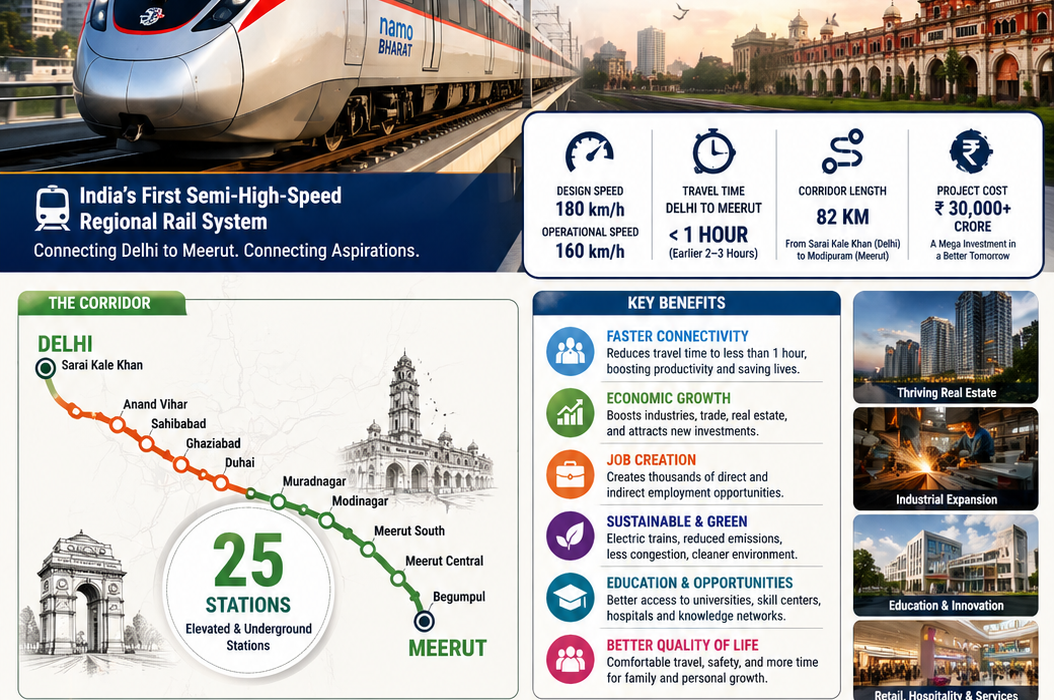
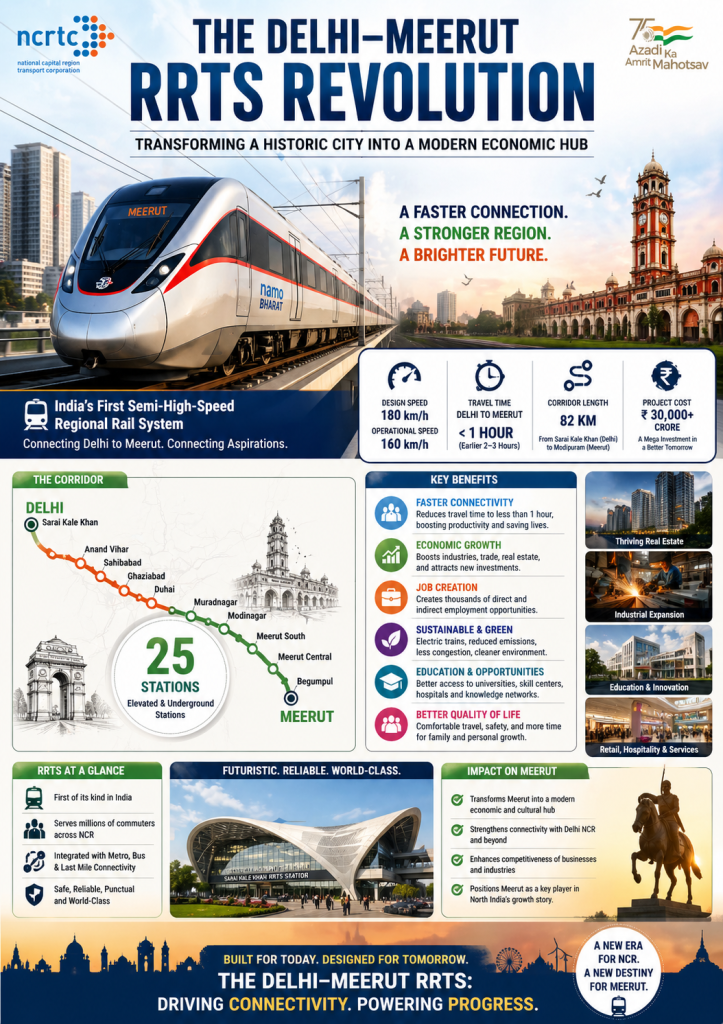
The corridor extends approximately 82 kilometers, linking Delhi with Meerut through Ghaziabad. (Wikipedia)
It begins at Sarai Kale Khan in Delhi and terminates at Modipuram in Meerut, passing through several urban and suburban clusters along the way. (Wikipedia)
Stations and Infrastructure
The network includes around 25 stations, including RRTS stations and the integrated Meerut Metro section. (Wikipedia)
Key stations include:
• Sarai Kale Khan
• Anand Vihar
• Sahibabad
• Duhai
• Muradnagar
• Modinagar
• Meerut South
• Meerut Central
• Begumpul
• Modipuram
The corridor combines elevated and underground sections, reflecting modern urban transport engineering.
Speed and Efficiency
The RRTS trains operate at a design speed of up to 180 km/h, with operational speeds reaching around 160 km/h. (Rail Analysis India)
This makes the system one of the fastest regional transit networks in India.
As a result, travel time between Delhi and Meerut will be reduced to less than one hour, compared to two or three hours previously required by road transport. (Rail Analysis India)
Investment and Financial Scale
The project represents a massive infrastructure investment estimated at over ₹30,000 crore. (Press Information Bureau)
Funding has been supported by multiple sources, including:
• Government of India
• Government of Uttar Pradesh
• international development institutions
Such financial scale underscores the strategic importance of the corridor within India’s infrastructure development agenda.
The Economic Transformation of Meerut
The most profound impact of the RRTS will be economic.
Improved connectivity dramatically alters the geography of opportunity. Cities that were previously peripheral can rapidly become integrated into metropolitan economic systems.
For Meerut, the implications are transformative.
1. Emergence as a Commuter City
With travel time reduced to under an hour, professionals working in Delhi will be able to reside in Meerut while commuting daily to the capital.
This dynamic can stimulate:
• housing demand
• real estate development
• urban infrastructure expansion
Cities around the world—from Tokyo to Paris—have experienced similar transformations through high-speed suburban rail networks.
2. Industrial Expansion
Meerut already hosts a robust manufacturing base, particularly in sports equipment and small industries.
Improved connectivity will allow manufacturers to access:
• larger markets
• faster logistics networks
• improved supply chains
This could significantly enhance export potential and attract new industrial investment.
3. Growth of Educational and Knowledge Institutions
The improved connectivity between Delhi and Meerut will benefit universities and research institutions.
Students and scholars will gain easier access to:
• academic collaborations
• research facilities
• professional networks
Institutions such as Chaudhary Charan Singh University could become more integrated with the broader knowledge ecosystem of the NCR.
4. Rise of Service Economy
Transport connectivity often stimulates growth in sectors such as:
• hospitality
• retail
• technology services
• healthcare
As Meerut becomes more accessible, the city may attract startups, service firms, and new professional communities.
Urban Transformation and Real Estate Development
Infrastructure corridors often create new urban growth zones.
The RRTS stations themselves are expected to become economic micro-clusters, generating commercial activity and employment.
Transit-oriented development around stations can include:
• business parks
• residential complexes
• retail hubs
• hospitality centers
This model has been widely successful in cities such as Hong Kong and Singapore, where rail infrastructure forms the backbone of urban planning.
Environmental and Social Benefits
Beyond economic growth, the RRTS corridor also contributes to environmental sustainability.
Reduction in Road Congestion
Thousands of commuters traveling daily between Delhi and Meerut currently rely on private vehicles and buses.
By shifting commuters to rail transport, the system can significantly reduce:
• traffic congestion
• fuel consumption
• road accidents
Lower Carbon Emissions
Electric rail transport is considerably more energy-efficient than road vehicles.
The RRTS system therefore contributes to India’s broader climate and sustainability goals.
Improved Quality of Life
Shorter travel times translate directly into improved quality of life.
Commuters can spend less time in traffic and more time with their families, workplaces, or educational pursuits.
Challenges and Strategic Considerations
While the potential benefits of the RRTS are immense, several challenges must be addressed to maximize its impact.
Urban Planning Coordination
Rapid development around RRTS stations must be carefully managed to avoid:
• unplanned urban sprawl
• congestion near stations
• infrastructure overload
Integration with Local Transport
The success of the RRTS will depend on strong last-mile connectivity, including:
• buses
• metro systems
• shared mobility services
Equitable Development
Economic growth should benefit not only large investors but also local communities and small businesses.
Inclusive planning will be essential to ensure that development is socially balanced.
A New Vision for Regional Development
The Delhi–Meerut RRTS corridor represents a new paradigm in Indian infrastructure development.
Rather than concentrating economic activity solely in metropolitan capitals, modern transport networks allow surrounding cities to participate in shared prosperity.
Meerut’s transformation illustrates the power of connectivity.
Once primarily known for its historical legacy, the city now stands on the threshold of a new identity—one defined by innovation, mobility, and economic dynamism.
Conclusion
The Delhi–Meerut RRTS is more than a railway project; it is a symbol of India’s evolving approach to urban and regional planning.
By connecting the historic city of Meerut with the economic powerhouse of Delhi through high-speed transport, the corridor creates opportunities for industrial growth, educational collaboration, urban development, and improved quality of life.
The project reflects a broader national vision—one in which infrastructure serves not merely as physical construction but as a foundation for social progress and economic transformation.
As India continues its journey toward becoming a major global economy, projects like the Delhi–Meerut RRTS demonstrate how strategic investments in connectivity can reshape cities, empower regions, and redefine the geography of opportunity.
For Meerut, the revolution has already begun.