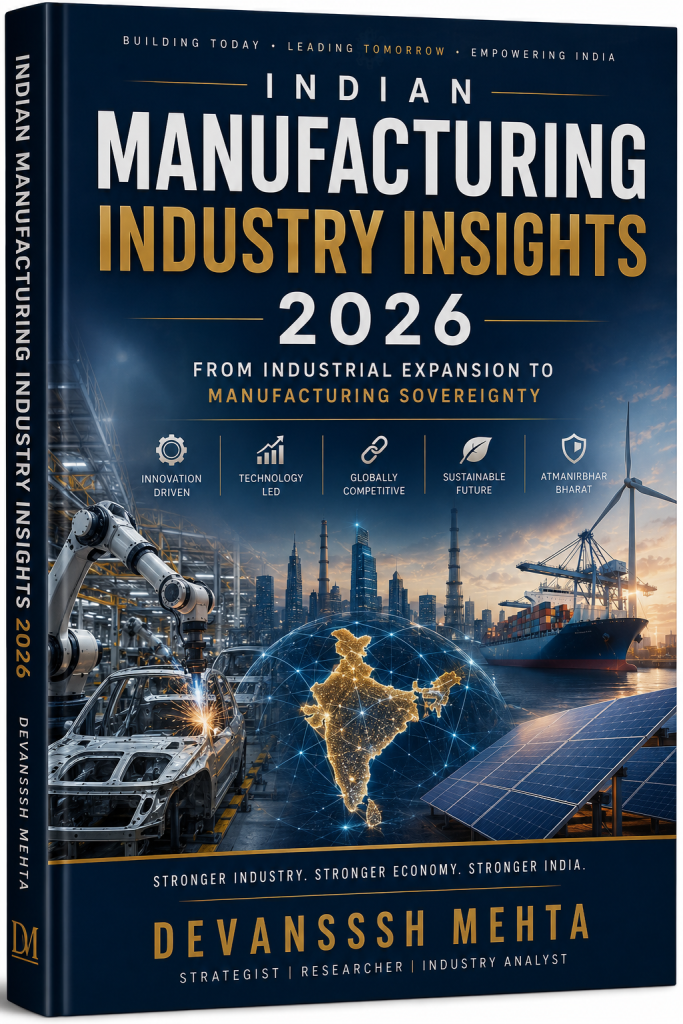
Indian Manufacturing Industry Insights 2026
From Industrial Expansion to Manufacturing Sovereignty: Reimagining India’s Productive Future
A Detailed Strategic Industry Article in the Style of Devanssh Mehta
Introduction: Manufacturing at the Center of India’s Economic Transformation
The history of nations repeatedly demonstrates that enduring economic power is rarely built on consumption alone. It emerges from the ability to design, engineer, manufacture, distribute, and continuously innovate. Manufacturing therefore occupies a unique position among all sectors of an economy because it transforms ideas into products, labor into productivity, technology into commercial capability, and national ambition into measurable economic outcomes.
India in 2026 stands at one of the most consequential industrial moments since economic liberalization.
For decades, India’s economic growth story was dominated by services, information technology, and domestic consumption. Manufacturing remained strategically important but often underrepresented relative to its potential. The nation succeeded in developing globally competitive sectors—including pharmaceuticals, automobiles, chemicals, engineering goods, and textiles—yet the broader aspiration of becoming one of the world’s premier manufacturing powers remained incomplete.
Today, however, the industrial environment has fundamentally changed.
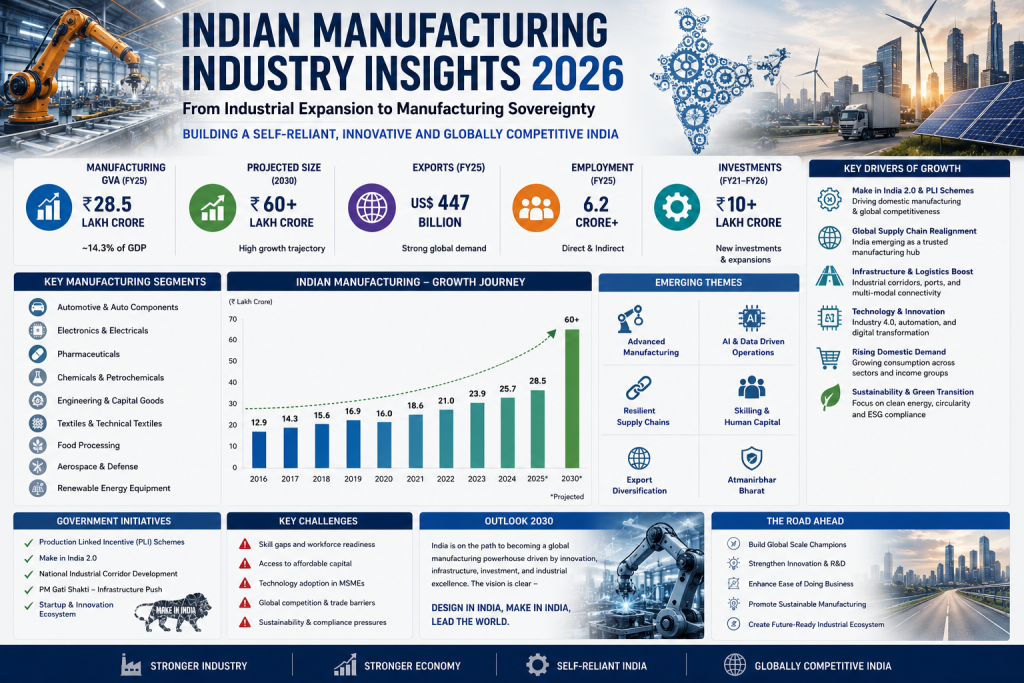
Global supply chain realignment, digital manufacturing, industrial automation, sustainability imperatives, geopolitical restructuring, infrastructure modernization, and increasing domestic demand have collectively altered India’s industrial trajectory.
Manufacturing in 2026 is no longer merely about producing goods.
It is increasingly becoming the foundation upon which India may construct technological sovereignty, strategic resilience, employment generation, export competitiveness, and long-term economic leadership.
The central question facing Indian industry is therefore profound:
Can India evolve from being a major manufacturing location into becoming one of the defining industrial powers of the twenty-first century?
This report examines the structural transformation underway across Indian manufacturing and explores the opportunities, risks, technologies, and strategic choices that may define the next decade.
Manufacturing as a Strategic National Capability
Manufacturing differs from most sectors because of its multiplier effect.
When manufacturing expands, it stimulates demand across logistics, transportation, energy, engineering, finance, technology, education, and infrastructure.
Every industrial plant influences multiple surrounding ecosystems.
Factories generate employment directly.
Supply chains generate indirect employment.
Innovation generates future competitiveness.
This interconnected nature makes manufacturing one of the most strategically valuable sectors in any economy.
Historically, industrial development occurred through multiple stages:
Agricultural economy → Industrial economy → Knowledge economy → Intelligent economy.
India today is increasingly entering a hybrid stage where manufacturing and knowledge creation are becoming inseparable.
The future industrial leader will not necessarily be the nation with the lowest labor cost.
It may increasingly become the nation that combines:
- Scale
- Technology
- Infrastructure
- Talent
- Innovation
- Sustainability
- Institutional capability
India’s opportunity lies precisely at this intersection.
The New Industrial Architecture of India
Modern manufacturing is dramatically different from traditional industrial models.
Conventional manufacturing emphasized:
- large production volumes,
- labor intensity,
- cost minimization.
The emerging industrial model emphasizes:
- productivity,
- precision,
- digital integration,
- sustainability,
- resilience.
India’s manufacturing architecture increasingly consists of multiple interconnected industrial pillars.
Automotive Manufacturing
India has emerged among the world’s largest automotive markets.
The industry today extends beyond vehicle assembly.
It includes:
- components,
- electronics,
- software,
- battery technologies,
- mobility platforms.
Vehicle manufacturing is transforming into mobility engineering.
Pharmaceutical Manufacturing
India’s pharmaceutical industry remains one of the strongest global manufacturing success stories.
Its capabilities increasingly extend into:
- APIs,
- biologics,
- formulations,
- advanced therapies.
Pharmaceutical manufacturing demonstrates how industrial competitiveness evolves from production toward scientific capability.
Electronics Manufacturing
Electronics has become one of India’s most strategically important industrial sectors.
Electronics today influences nearly every domain:
- healthcare,
- communications,
- defense,
- mobility,
- AI.
The challenge is no longer manufacturing devices.
It is building industrial depth.
Chemicals and Specialty Materials
Chemical manufacturing increasingly supports:
- agriculture,
- pharmaceuticals,
- semiconductors,
- advanced materials.
Future manufacturing competitiveness may depend heavily on materials science.
Industrial Infrastructure: Building Economic Geometry
Industrial competitiveness begins with infrastructure.
Factories cannot outperform infrastructure.
India’s industrial expansion increasingly relies on creating integrated industrial ecosystems rather than isolated facilities.
Modern industrial infrastructure includes:
- industrial corridors,
- multimodal logistics,
- ports,
- rail connectivity,
- warehouses,
- digital networks,
- renewable energy systems.
Infrastructure has shifted from being a support function to becoming a strategic advantage.
Industrial delays, energy instability, and logistics inefficiencies can eliminate competitiveness even before production begins.
The emerging industrial ecosystem seeks to reduce friction at every stage:
Raw materials → Manufacturing → Distribution → Export.
Infrastructure excellence increasingly determines industrial speed.
Global Supply Chain Realignment and India’s Opportunity
The international manufacturing environment is undergoing structural transformation.
Recent disruptions exposed vulnerabilities associated with concentrated production ecosystems.
As businesses seek diversification and resilience, India has gained increasing strategic attention.
This presents opportunities across:
- engineering products,
- pharmaceuticals,
- electronics,
- industrial equipment,
- automotive systems.
However, relocation alone does not guarantee industrial leadership.
Countries competing for industrial investment increasingly offer:
- incentives,
- infrastructure,
- regulatory predictability,
- workforce readiness.
India’s differentiator cannot rely solely on cost.
Long-term leadership requires capability.
The future manufacturing equation increasingly becomes:
Competitiveness = Quality × Reliability × Innovation × Speed
Technology and the Rise of Industry 4.0
Manufacturing is entering a computational era.
Industry 4.0 represents the convergence of:
- artificial intelligence,
- industrial IoT,
- robotics,
- cloud systems,
- advanced analytics,
- digital twins.
Factories increasingly operate as intelligent systems.
Traditional factories converted inputs into products.
Modern factories convert inputs into products and operational intelligence.
Sensors collect performance information.
Algorithms optimize production.
Machines anticipate maintenance.
Supply chains become visible in real time.
Manufacturing decisions become predictive rather than reactive.
The implications are enormous.
Industrial intelligence can improve:
- efficiency,
- quality,
- resource utilization,
- profitability.
This technological transformation may redefine industrial competitiveness globally.
Human Capital: The Core of Industrial Excellence
Despite rapid technological advancement, people remain the decisive factor.
Industrial success ultimately depends upon:
- engineers,
- operators,
- managers,
- scientists,
- entrepreneurs.
India’s workforce remains one of its strongest strategic assets.
Yet industrial transformation requires workforce evolution.
Future manufacturing professionals must possess:
- engineering literacy,
- data capability,
- digital fluency,
- systems thinking.
Industrial education must move beyond specialization.
The future industrial leader may be multidisciplinary.
Sustainability and Green Industrial Transformation
Industrial growth is increasingly evaluated through environmental performance.
Modern manufacturing must deliver:
economic growth
without ecological instability.
Industrial sustainability now includes:
- energy efficiency,
- water stewardship,
- circular manufacturing,
- carbon management.
Industrial ecosystems increasingly integrate:
reuse → recycling → regeneration.
The future industrial economy may reward companies capable of producing more value with fewer resources.
Environmental responsibility is increasingly becoming industrial strategy.
MSMEs: India’s Distributed Industrial Engine
Micro, Small, and Medium Enterprises remain among India’s most influential productive assets.
MSMEs contribute across:
- manufacturing,
- exports,
- employment,
- innovation.
Yet challenges remain:
- financing,
- modernization,
- digital adoption,
- productivity.
Future industrial success may depend upon integrating MSMEs into larger industrial value chains.
The strongest industrial systems are rarely centralized.
They are networked.
Manufacturing and Export Competitiveness
Manufacturing expansion ultimately requires global participation.
Export success increasingly depends upon:
- quality,
- branding,
- technological sophistication,
- consistency.
Global buyers increasingly value:
- reliability,
- compliance,
- sustainability.
India’s industrial transition may therefore follow four stages:
Make in India
→ Design in India
→ Invent in India
→ Lead from India
This evolution represents industrial maturity.
Industrial Risks and Strategic Challenges
Every industrial transformation carries risk.
India’s manufacturing growth trajectory must navigate:
Internal Challenges
- Infrastructure disparities
- Skill gaps
- Technology adoption barriers
- Productivity variation
External Challenges
- Trade disruptions
- Commodity volatility
- Global competition
Structural Challenges
- Innovation deficits
- Supply chain dependencies
- Energy uncertainty
Industrial resilience therefore becomes a permanent strategic requirement.
Manufacturing 2035: India’s Long-Term Industrial Vision
The next decade may witness the emergence of a fundamentally different industrial landscape.
Future manufacturing systems may become:
Intelligent
Factories operating through predictive systems.
Connected
Integrated supply chains.
Sustainable
Resource-efficient production.
Innovation-Led
Higher value creation.
Sovereign
Reduced dependence in strategic sectors.
Industrial leadership will increasingly belong to countries capable of integrating technology with execution.
Conclusion
Manufacturing Beyond Production
The Indian manufacturing industry in 2026 should not be viewed merely as an economic sector.
It represents one of India’s most powerful national instruments for shaping prosperity, innovation, employment, competitiveness, and strategic influence.
Its future will not be decided only inside factories—
but equally inside research laboratories, universities, industrial corridors, design studios, technology platforms, and entrepreneurial ecosystems.
The next decade may determine whether India remains a major manufacturing economy—
or becomes one of the defining industrial civilizations of the modern era.
Industrial greatness is not measured by the number of factories a nation builds.
It is measured by the amount of capability, confidence, and transformative value those factories create.
“The future of manufacturing belongs not to those who merely produce at scale—but to those who industrialize intelligence, innovation, and national ambition.”
— Devanssh Mehta