
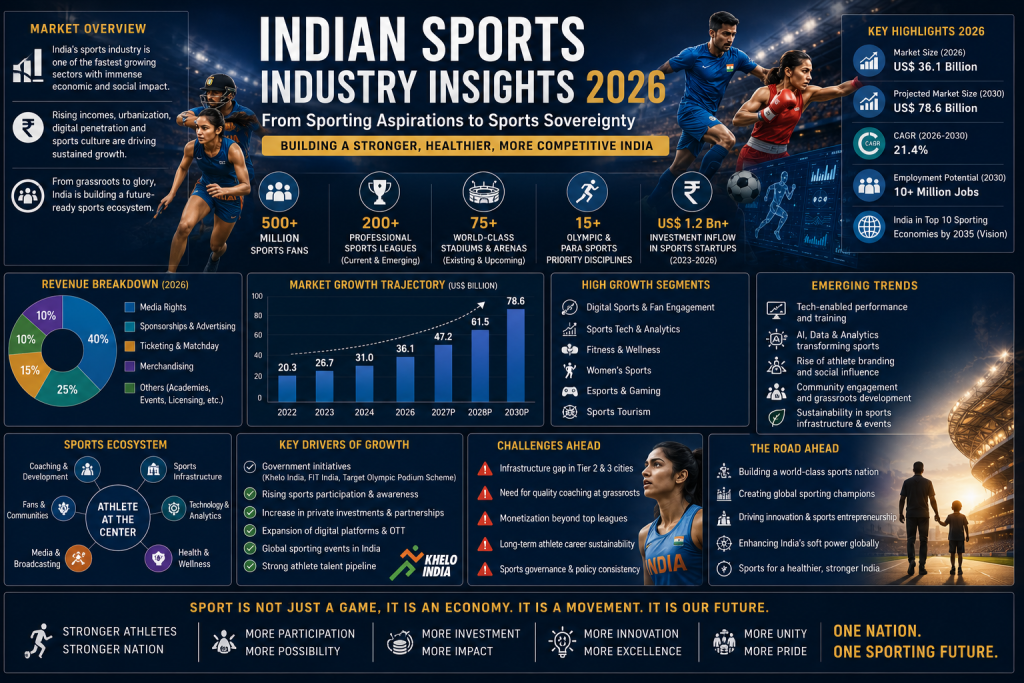
Indian Sports Industry Insights 2026
From Sporting Aspirations to Sports Sovereignty: The Rise of India’s New Performance Economy
A World-Class Strategic Industry Article in the Style of Devanssh Mehta
Introduction: Sports as an Economic, Cultural, and Strategic Industry
For much of modern history, sport was viewed primarily as competition, recreation, entertainment, and national identity. Stadiums represented celebration. Athletes represented excellence. Sporting victories represented moments of collective emotion.
However, the global landscape has fundamentally changed.
In the twenty-first century, sport has evolved into a multidimensional economic system that integrates media, technology, infrastructure, healthcare, education, data science, consumer engagement, tourism, investment, urban development, and international influence.
India in 2026 stands at a historic turning point within this transformation.
The Indian sports industry is no longer defined only by athletic achievement.
It is increasingly becoming a strategic growth engine.
Modern sport in India now represents an interconnected ecosystem composed of:
- professional leagues,
- athlete development,
- sports technology,
- digital broadcasting,
- sports medicine,
- sponsorship,
- infrastructure,
- analytics,
- grassroots participation,
- gaming and fan engagement.
The central question confronting India in 2026 is not whether India can produce world-class athletes.
The larger question is:
Can India become one of the world’s most influential sporting economies while simultaneously building sustainable athletic excellence?
This article explores the strategic evolution, structural opportunities, economic architecture, technological disruption, and long-term future of India’s sports industry.

Sports as an Industry: Beyond Competition
Sport today functions as an economic multiplier.
Unlike traditional entertainment sectors, sports influence multiple economic domains simultaneously.
Every sporting event activates:
- broadcasting,
- hospitality,
- travel,
- retail,
- merchandising,
- healthcare,
- advertising,
- digital platforms.
Every elite athlete supports an ecosystem of:
- coaches,
- nutrition experts,
- physiotherapists,
- psychologists,
- performance scientists,
- analysts,
- sponsors.
This interconnected structure transforms sports into a modern economic sector.
India’s sports economy increasingly reflects this evolution.
The future sports ecosystem is becoming:
Athlete + Technology + Audience + Commerce + Infrastructure
The Economic Architecture of Indian Sports
The Indian sports industry is becoming progressively diversified.
Historically, Indian sports economics remained concentrated.
Today, multiple revenue engines are emerging.
Media Rights
Broadcasting and streaming continue redefining industry economics.
Media is increasingly becoming the largest value creator.
Sports content now competes with:
- cinema,
- gaming,
- social media,
- digital entertainment.
Consumer attention itself has become a tradable asset.
Sponsorship Economy
Corporate participation in sports continues expanding.
Brands increasingly invest not merely for visibility but for:
- emotional association,
- audience access,
- identity building.
Sponsorship now extends beyond team branding into:
- grassroots programs,
- athlete partnerships,
- community initiatives.
Sports Infrastructure
Infrastructure has become a strategic asset.
The modern sports ecosystem requires:
- stadiums,
- training centers,
- rehabilitation facilities,
- performance labs,
- analytics centers.
Infrastructure increasingly determines athlete outcomes.
Merchandise and Fan Economy
Fan engagement is becoming commercial infrastructure.
Revenue increasingly originates from:
- memberships,
- apparel,
- collectibles,
- digital experiences.
Sport is increasingly becoming an experience economy.
Professionalization of Indian Sport
Indian sport historically relied heavily on institutional systems.
The modern era increasingly favors professional ecosystems.
Professionalization includes:
- structured contracts,
- athlete management,
- performance analytics,
- league governance.
The sporting ecosystem increasingly resembles corporate governance.
This transformation affects:
- athlete careers,
- financial sustainability,
- long-term competitiveness.
Sport is becoming a profession rather than an uncertain pursuit.
League Expansion and Sports Commercialization
One of the most influential developments in Indian sports has been the emergence of professional leagues.
League models create industrial effects.
They accelerate:
- audience growth,
- investment,
- media rights,
- athlete visibility.
Professional league structures increasingly support:
- year-round engagement,
- commercial predictability,
- athlete development.
Future opportunities extend across:
- football,
- kabaddi,
- badminton,
- volleyball,
- athletics.
Diversification remains essential for sustainable growth.
Grassroots Sports: The Foundation of Sporting Nations
Elite athletes do not emerge accidentally.
They emerge from systems.
Grassroots sport remains India’s largest long-term opportunity.
Sustainable sporting success requires:
- school sports,
- district development,
- talent identification,
- youth coaching.
Countries that dominate sports generally invest heavily in early-stage development.
India’s long-term sporting transformation may depend less on elite academies—
and more on broad participation.
Sports participation itself is becoming developmental infrastructure.
Sports Technology and Performance Science
Modern sport increasingly resembles applied science.
Athletic performance today depends upon:
- biomechanics,
- physiology,
- data analytics,
- recovery science,
- nutrition.
Technology increasingly shapes:
training → execution → recovery.
Modern performance systems include:
- wearable devices,
- motion tracking,
- AI-assisted analysis,
- digital coaching.
Athletic development increasingly becomes measurable.
Future champions may increasingly emerge from scientific ecosystems rather than intuition alone.
Sports Medicine and Athlete Health
One of the most significant transformations in global sports has been the rise of sports medicine.
Athletes increasingly depend upon integrated support systems.
Modern athlete care includes:
- injury prevention,
- rehabilitation,
- physiotherapy,
- nutrition,
- mental performance.
Sports medicine increasingly intersects with:
- orthopedics,
- pharmacology,
- neuroscience,
- digital monitoring.
Performance sustainability may become as important as peak performance.
Women’s Sports: India’s Emerging Sporting Transformation
One of the most promising developments in Indian sport is the increasing visibility of women athletes.
Women’s sports increasingly represent:
- participation growth,
- sponsorship opportunity,
- audience expansion.
Structural improvements continue across:
- infrastructure,
- coaching,
- media visibility.
Women’s sport should not be viewed merely as inclusion.
It increasingly represents industry expansion.
Digital Transformation and Fan Intelligence
Technology has fundamentally changed sports consumption.
Fans no longer passively watch.
They interact.
Digital transformation includes:
- streaming,
- personalized content,
- mobile engagement,
- virtual experiences.
Sports organizations increasingly operate as media companies.
Audience engagement is becoming:
continuous rather than episodic.
The future fan experience may become individualized.
Data Analytics and Competitive Intelligence
Competitive advantage increasingly depends upon information.
Sports analytics now influences:
- player evaluation,
- injury prediction,
- tactical optimization.
Data ecosystems increasingly support:
- decision-making,
- resource allocation,
- performance forecasting.
Future sporting success may depend increasingly upon intelligence systems.
Education and Sports Careers
India’s sports ecosystem is creating new career pathways.
Modern sports now support:
- sports management,
- analytics,
- journalism,
- rehabilitation,
- event operations.
Future growth requires stronger integration between:
education and sports industry requirements.
The future sports professional may combine:
athletics + technology + management.
Sports Infrastructure and Urban Development
Sports infrastructure increasingly influences cities.
Modern sports facilities create:
- tourism,
- employment,
- community engagement.
Future infrastructure must move beyond large stadiums.
The next generation requires:
- neighborhood facilities,
- regional training ecosystems.
Sports infrastructure increasingly becomes public infrastructure.
Investment and the Sports Economy
Sports investment continues becoming more sophisticated.
Investors increasingly evaluate:
- media economics,
- audience growth,
- digital monetization.
Capital deployment increasingly supports:
- athlete ecosystems,
- sports startups,
- technology platforms.
Future sports growth may increasingly resemble venture ecosystems.
Challenges That May Shape the Industry
Despite momentum, major challenges remain.
Structural Challenges
- Infrastructure disparity
- Uneven athlete access
- Funding concentration
Economic Challenges
- Commercial sustainability
- Monetization limitations
Development Challenges
- Talent identification
- Coaching depth
Technological Challenges
- Digital integration gaps
Long-term success requires systemic thinking.
India Sports 2035: The Future Landscape
By 2035, India’s sports industry may increasingly become:
Athlete-Centric
Integrated support ecosystems.
Technology-Led
Data-enhanced performance.
Commercially Sustainable
Diversified revenue streams.
Globally Competitive
Stronger international positioning.
Socially Inclusive
Broader participation.
Sport may increasingly become part of national development strategy.
Strategic Outlook: Sports as National Capability
The Indian sports industry in 2026 should not be viewed merely as entertainment.
It represents:
economic value,
human development,
international positioning,
social cohesion,
and national confidence.
Its future will not be determined only on playing fields—
but equally in laboratories, classrooms, digital platforms, training systems, governance structures, and innovation ecosystems.
The next decade may determine whether India remains a nation passionate about sport—
or becomes one of the nations that define the future of global sport.
Conclusion
India’s sports transformation has already begun.
The future will not belong solely to countries with the largest stadiums.
It will belong to countries capable of building:
better athletes,
better systems,
better science,
better governance,
and better opportunities.
Sport is becoming more than competition.
It is becoming infrastructure for human potential.
“The future of Indian sport will not be measured only in medals and trophies. It will be measured in how effectively the nation transforms athletic talent into human capability, economic value, and global influence.”
— Devanssh Mehta