
Indian Defence Ecosystem Market Report 2026
Full Strategic Industry Report with Deep Market Insights, SWOT Analysis, and PESTLE Analysis
Author Devanssh Mehta Mode
Executive Summary
India’s defence ecosystem in 2026 has entered a new industrial phase where national security, industrial capability, technological sovereignty, manufacturing competitiveness, and export ambition are increasingly integrated into one strategic framework.
Historically, Indian defence was viewed primarily through military readiness and procurement. The 2026 landscape is fundamentally different. Defence now operates as a strategic economic multiplier influencing aerospace, electronics, shipbuilding, advanced materials, cyber systems, artificial intelligence, semiconductors, manufacturing employment, innovation ecosystems, and geopolitical positioning.
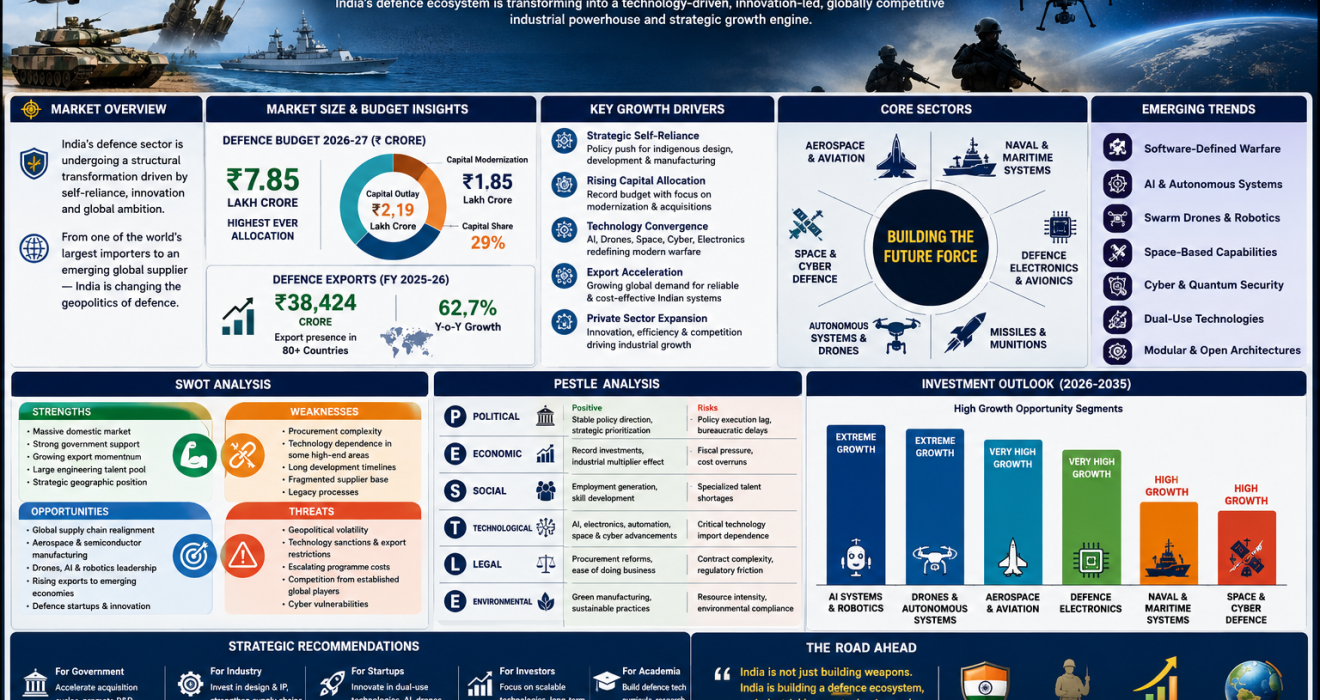
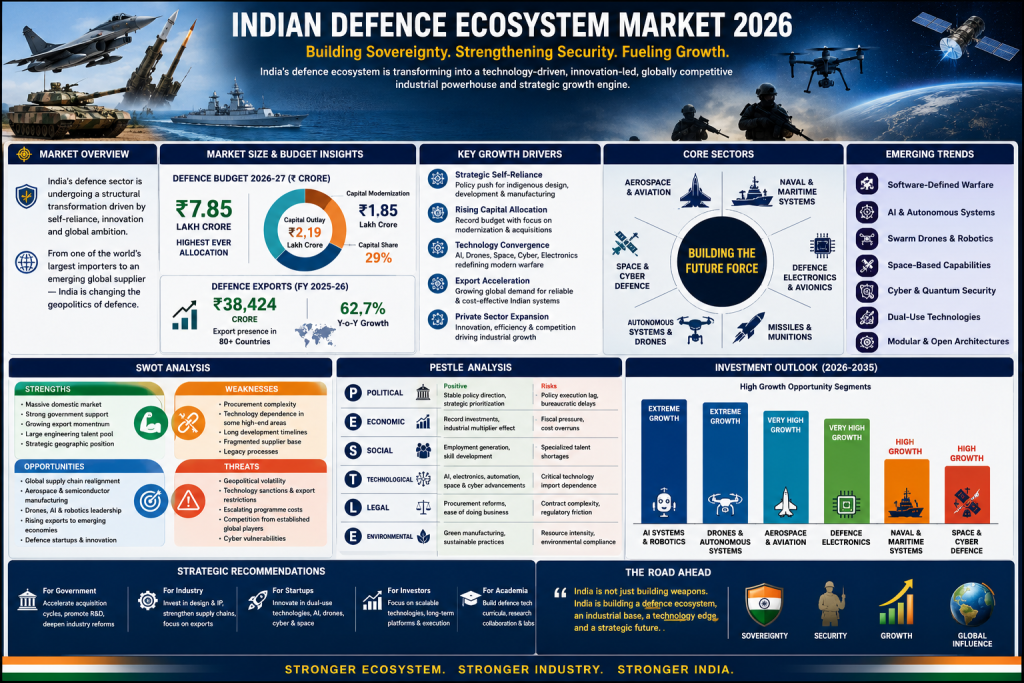
The Union Budget 2026–27 allocated approximately ₹7.85 lakh crore to defence, the highest ever allocation, with capital modernization crossing ₹2.19 lakh crore and approximately ₹1.85 lakh crore dedicated to acquisitions and modernization, signalling accelerated capability building and domestic industrial expansion. (Press Information Bureau)
Simultaneously, India recorded ₹38,424 crore in defence exports in FY 2025–26, representing approximately 62.7% year-on-year growth, demonstrating that India is increasingly transitioning from a defence-importing nation toward a defence-producing and exporting power. (The Times of India)
This report evaluates the structure, economics, industrial dynamics, opportunities, threats, and future outlook of India’s defence ecosystem.
Part I — Strategic Context: The Reinvention of Indian Defence
Modern defence ecosystems globally are no longer military institutions alone.
They have evolved into integrated national capability systems consisting of:
- Industrial manufacturing
- Advanced engineering
- Scientific research
- Strategic logistics
- Export capability
- Innovation ecosystems
- Talent development
- Technology ownership
India’s defence transformation is being driven by five simultaneous transitions:
| Historical Model | Emerging 2026 Model |
|---|---|
| Import dependence | Indigenous production |
| Platform purchase | Platform ownership |
| Public-sector concentration | Mixed public–private ecosystem |
| Security spending | Strategic investment |
| Procurement-led | Innovation-led |
The Indian defence ecosystem increasingly resembles a strategic industrial architecture rather than a conventional ministry-driven procurement model.
Part II — Market Architecture of the Indian Defence Ecosystem
1. Defence Budget and Capital Formation
The Ministry of Defence remains India’s largest central expenditure segment.
Key structural indicators:
- Total defence allocation approximately ₹7.85 lakh crore.
- Capital outlay approximately ₹2.19 lakh crore.
- Capital modernization increase approximately 22%.
- Defence share approximately 14.7% of central expenditure.
- Capital allocation approaching 29% of total defence spending. (MP-IDSA)
This budget composition signals a shift from sustaining forces toward creating future combat capability.
2. Defence Industrial Segments
Aerospace and Aviation
India increasingly prioritizes:
- Combat aircraft
- Transport systems
- Engines
- Aerospace integration
- Avionics
Aircraft and aero-engine allocation exceeded ₹63,000 crore in Budget 2026, reflecting long-term air power modernization priorities. (The Economic Times)
Naval and Maritime Systems
Growth areas:
- Indigenous shipbuilding
- Maritime surveillance
- Undersea capabilities
- Strategic sea-lane protection
Naval fleet modernization continues to receive dedicated capital expansion. (The Economic Times)
Defence Electronics
Electronics increasingly define battlefield superiority.
Strategic areas:
- Electronic warfare
- Radar
- Secure communications
- Sensors
- Embedded systems
- Battlefield networking
Electronics may become India’s largest defence value segment over the next decade.
Autonomous Systems and Drones
India’s emerging battlefield doctrine increasingly emphasizes:
- Precision strike
- Autonomous surveillance
- Swarm intelligence
- Tactical AI
Drone systems are becoming one of the fastest-growing subsegments.
Space and Cyber Defence
Strategic competition increasingly extends beyond geography.
Emerging domains:
- Space monitoring
- Satellite resilience
- Cyber defence
- Data dominance
- Quantum security
Part III — Market Growth Drivers
Driver 1: Strategic Self-Reliance
Domestic procurement and local production increasingly dominate acquisition policy.
Industrial self-reliance is becoming synonymous with national resilience.
Driver 2: Export Acceleration
Defence exports reached record levels and are increasingly supported by both public and private manufacturing ecosystems. Government ambitions target approximately ₹50,000 crore exports by 2029. (Press Information Bureau)
Driver 3: Technology Convergence
Defence increasingly overlaps with:
- AI
- Robotics
- Materials science
- Semiconductor systems
- Space technologies
Driver 4: Private Sector Expansion
Private participation is improving:
- Manufacturing velocity
- Cost competitiveness
- Innovation cycles
Driver 5: Infrastructure-Led Industrial Growth
Record national infrastructure spending indirectly strengthens defence logistics and manufacturing ecosystems. (Reuters)
Part IV — Defence Value Chain Analysis
Upstream Layer
Inputs:
- Metals
- Electronics
- Sensors
- Components
- Propulsion
Midstream Layer
Transformation:
- Manufacturing
- Systems integration
- Testing
Downstream Layer
Outputs:
- Platforms
- Services
- Maintenance
- Exports
Strategic Support Layer
- Academia
- R&D
- Policy
- Financing
- Workforce
The future competitive advantage lies not in platform assembly but in controlling intellectual property and systems integration.
Part V — Emerging Trends Defining Indian Defence 2026–2035
Trend 1 — Software-Defined Warfare
Future defence value shifts toward:
- Algorithms
- Battlefield intelligence
- Data systems
Trend 2 — Defence-as-Manufacturing
Defence increasingly behaves like advanced manufacturing.
Trend 3 — Export Diplomacy
Exports increasingly influence geopolitical relationships.
Trend 4 — Modular Platforms
Flexibility becomes more valuable than platform size.
Trend 5 — Dual-Use Technology Growth
Commercial technologies increasingly enter defence applications.
Part VI — SWOT Analysis of Indian Defence Ecosystem (2026)
Strengths
Massive Domestic Market
One of the world’s largest modernization pipelines.
Government Commitment
Record budget allocation supports execution. (Press Information Bureau)
Export Momentum
Record export growth validates industrial capability. (The Times of India)
Large Engineering Talent Base
Strategic Geography
Weaknesses
Procurement Complexity
Limited Indigenous Capability in Select High-End Technologies
Long Development Timelines
Fragmented Supplier Networks
Legacy Institutional Structures
Opportunities
Global Supply Chain Realignment
Aerospace Manufacturing Leadership
Drone and AI Platforms
Semiconductor Integration
Defence Technology Startups
Export Market Expansion
Threats
Regional Geopolitical Volatility
Technology Restrictions
Escalating Program Costs
Global Competitive Pressure
Cyber Vulnerabilities
SWOT Strategic Interpretation
India’s greatest strategic challenge is no longer capability creation.
It is execution speed, scale discipline, and technology depth.
Part VII — PESTLE Analysis of Indian Defence Market
Political Factors
Positive:
- Stable strategic direction
- Long-term defence prioritization
Risks:
- Policy execution lag
Impact:
High
Economic Factors
Positive:
- Record public investment
- Industrial multiplier effect
Risks:
- Fiscal pressure
Impact:
Very High
Social Factors
Positive:
- Employment generation
- Skill development
Risks:
- Specialized talent shortages
Impact:
Medium–High
Technological Factors
Positive:
- AI
- Automation
- Electronics
Risks:
- Critical technology imports
Impact:
Extreme
Legal Factors
Positive:
- Procurement reform
Risks:
- Contract complexity
Impact:
Medium
Environmental Factors
Positive:
- Sustainable manufacturing
Risks:
- Resource intensity
Impact:
Moderate
Part VIII — Competitive Landscape Outlook
Future competitive advantage will likely emerge from companies and institutions capable of controlling:
- Design
- Electronics
- Software
- Integration
- Export ecosystems
Winning characteristics:
✓ Faster innovation
✓ Indigenous IP
✓ Export readiness
✓ Modular engineering
✓ Capital efficiency
Part IX — Investment Outlook (2026–2035)
High-opportunity segments:
| Segment | Outlook |
|---|---|
| Defence Electronics | Extreme Growth |
| Aerospace | Very High |
| AI Systems | Extreme Growth |
| Drones | Extreme Growth |
| Space Defence | High |
| Cybersecurity | Extreme Growth |
| Naval Systems | High |
Part X — Strategic Recommendations
Government
- Accelerate procurement cycles
- Expand advanced R&D
Industry
- Build platform ownership
- Invest in deep engineering
Academia
- Create defence innovation clusters
Investors
- Focus on scalable technologies
Startups
- Target dual-use technologies
Final Conclusion
The Indian defence ecosystem of 2026 represents far more than military modernization.
It is becoming a national industrial transformation project.
Its future success will not be determined merely by budget size or procurement volumes—but by how effectively India converts expenditure into sovereign technology, converts technology into manufacturing strength, and converts manufacturing strength into global influence.
If execution remains disciplined and innovation intensity continues, India’s defence industry may become one of the defining strategic growth stories of the coming decade.