How to Become a Professional Actor in India: A Complete Journey from Aspiration to Artistic Mastery
Introduction: Beyond Fame—Understanding the Real Meaning of Acting
For millions of Indians, becoming an actor appears glamorous from the outside.
Cinema screens glow with applause, interviews celebrate success, social media amplifies celebrity, and award ceremonies create the illusion that acting is built upon visibility.
But professional acting is not fame.
Professional acting is disciplined emotional engineering.
It is one of the few professions where the human body becomes the instrument, emotions become material, observation becomes research, and life itself becomes education.
The actor studies people.
The actor studies silence.
The actor studies truth.
India today possesses one of the largest entertainment ecosystems in the world, spanning films, OTT platforms, television, theatre, advertisements, digital content, documentaries, voice acting, animation, gaming, live performance, and global productions.
The modern Indian actor no longer competes only inside cinema.
They compete in an attention economy.
This means opportunities are expanding—but expectations are rising.
This article explores how to become a professional actor in India in a structured, realistic, and long-term manner.
Understanding What Acting Actually Means
Before entering this profession, one must redefine acting.
Acting is not pretending.
Acting is creating believable human behavior under imaginary circumstances.
Professional actors transform:
- Observation into performance
- Emotion into expression
- Script into experience
- Character into reality
Acting requires:
- Psychology
- Communication
- Physical intelligence
- Emotional control
- Storytelling
An actor becomes a bridge between imagination and audience experience.
Why India Has Become One of the Most Dynamic Acting Markets
India’s entertainment landscape has evolved dramatically.
Earlier opportunities were concentrated in cinema.
Today the ecosystem includes:
Films
+
Television
+
OTT platforms
+
Regional cinema
+
Advertising
+
Digital creators
+
Short films
+
Corporate films
+
International collaborations
Professional actors now emerge from multiple backgrounds.
The industry increasingly values capability over traditional pathways.
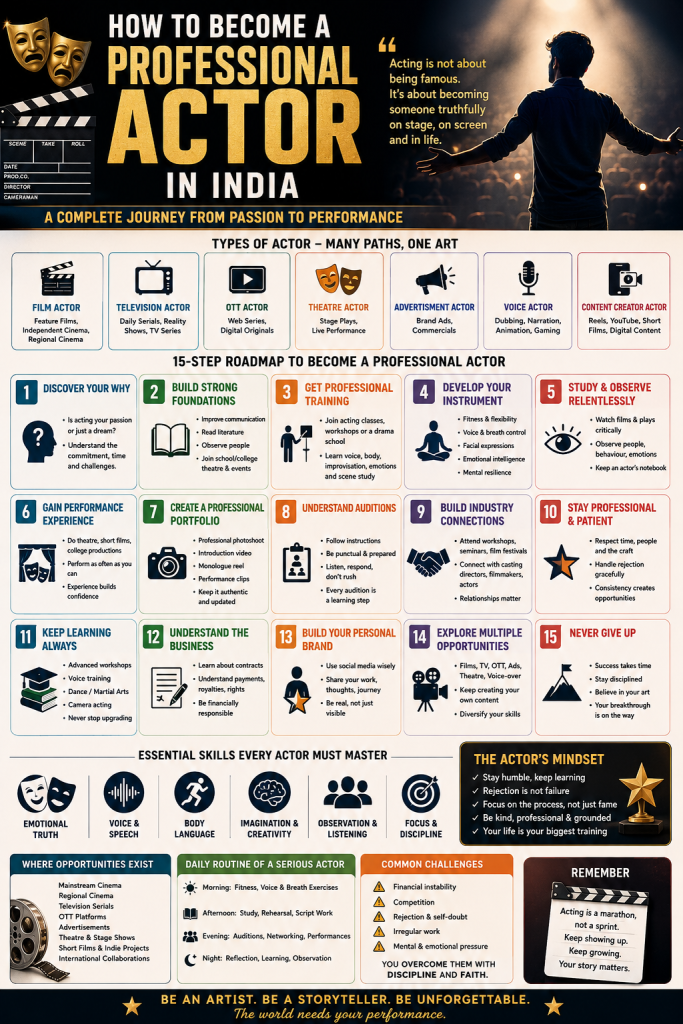
Step One: Understand Which Type of Actor You Want to Become
Many beginners make a critical mistake.
They say:
“I want to become an actor.”
But acting itself contains numerous career directions.
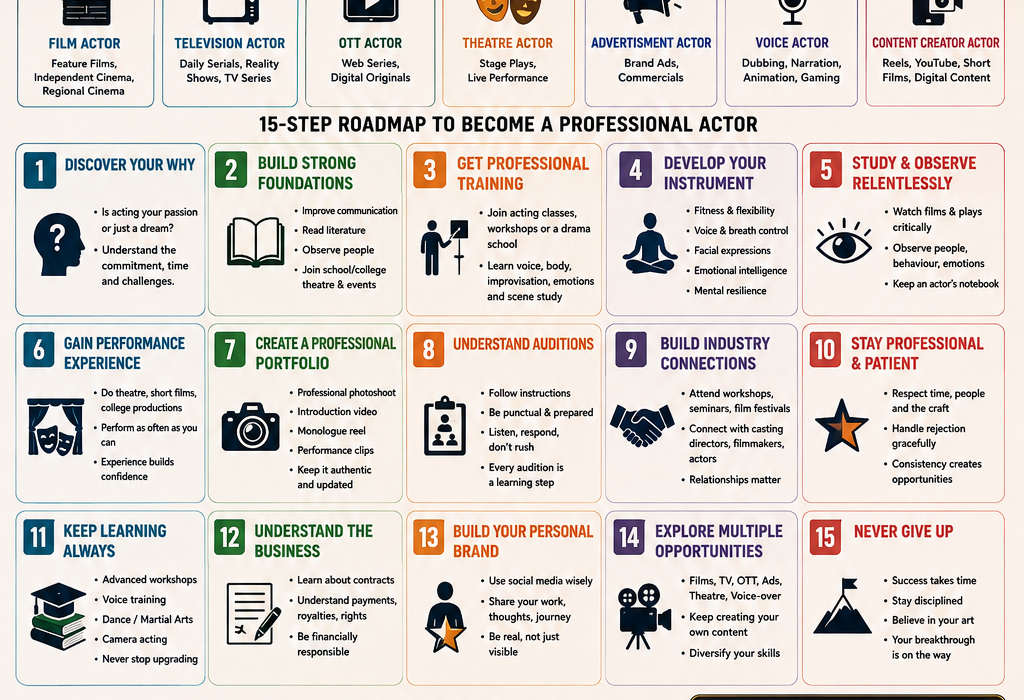
Film Actor
Works in:
- Feature films
- Independent cinema
- Regional cinema
Requires:
- Camera performance
- Screen presence
Television Actor
Focuses on:
- Daily serials
- Episodic content
- Long schedules
Requires:
- Speed
- Consistency
OTT Actor
Growing field.
Requires:
- Naturalistic acting
- Character depth
Theatre Actor
Strong foundation.
Develops:
- Voice
- Presence
- Discipline
Advertisement Actor
Commercial performance.
Requires:
- Expressiveness
- Adaptability
Voice Actor
Works in:
- Dubbing
- Narration
- Animation
Content Creator Actor
Builds:
- Personal audience
- Independent brand
Step Two: Decide Whether Acting Is Passion or Profession
Before investing years, ask yourself:
Do I enjoy performing?
Can I tolerate rejection?
Can I train continuously?
Can I remain emotionally stable?
Can I work without immediate success?
Acting rewards those who love the process—not only outcomes.
Step Three: Build Foundational Skills During School and College
Contrary to popular belief, acting preparation can begin early.
Develop:
Communication
Practice speaking.
Literature
Read stories.
Observation
Watch people.
Public Performance
Participate in:
- Theatre
- Debates
- Presentations
Confidence
Build comfort with visibility.
Step Four: Train Like a Professional
Raw talent is rarely enough.
Professional actors train.
Core Acting Skills
Voice
Control tone.
Body Language
Movement becomes communication.
Emotional Access
Create authenticity.
Improvisation
Adapt naturally.
Scene Analysis
Understand character.
Character Development
Build identity.
Formal Education Options
A degree is not mandatory.
Training matters.
Useful backgrounds:
- Performing arts
- Theatre
- Literature
- Communication
- Psychology
- Media
However, actors emerge from every academic field.
Step Five: Build an Actor’s Instrument—Your Mind and Body
Your instrument is not equipment.
Your instrument is you.
Develop:
Physical Fitness
Build mobility.
Facial Expression
Increase emotional range.
Voice Training
Enhance control.
Breath Training
Improve endurance.
Sleep and Recovery
Protect performance.
Step Six: Learn the Science of Observation
Great actors are researchers.
Observe:
- Walking styles
- Emotional reactions
- Speech rhythm
- Silence
- Confidence
- Fear
Characters emerge from observation.
Step Seven: Study Cinema Intelligently
Do not watch films as entertainment alone.
Study:
Character
↓
Conflict
↓
Dialogue
↓
Performance
Ask:
Why did the scene work?
Create an Actor’s Notebook
Record:
- Characters
- Emotions
- Behaviors
- Accent patterns
- Stories
This becomes your performance laboratory.
Step Eight: Begin Performing Before Seeking Opportunities
Do not wait.
Perform now.
Methods:
- Theatre
- Reels
- Short films
- Monologues
- College productions
Performance creates growth.
Step Nine: Build a Professional Portfolio
Every actor needs professional assets.
Headshots
Simple.
Authentic.
Introduction Video
Short and confident.
Monologue Reel
Show emotional range.
Performance Clips
Demonstrate capability.
Digital Presence
Professional profiles.
Step Ten: Understand Auditions
Auditions are not examinations.
Auditions are matching exercises.
Casting teams evaluate:
- Fit
- Energy
- Interpretation
- Reliability
Audition Structure
Introduction
↓
Scene
↓
Direction
↓
Variation
↓
Callback
How to Perform Better in Auditions
Prepare.
Arrive calm.
Listen carefully.
Do not imitate others.
Leave emotionally detached.
Understanding Rejection in Acting
Rejection is not failure.
A role may depend on:
- Height
- Chemistry
- Appearance
- Language
- Age
- Timing
Professional actors normalize rejection.
Step Eleven: Learn Camera Acting
Stage and screen are different.
Camera magnifies.
Learn:
- Eye focus
- Continuity
- Framing
- Subtle expression
Less often becomes more.
Step Twelve: Build Industry Relationships Professionally
Entertainment is collaborative.
Network through:
- Workshops
- Film communities
- Production environments
- Creative circles
Relationships should be genuine.
Step Thirteen: Understand Contracts and Professionalism
Read carefully:
- Payment terms
- Exclusivity
- Usage rights
- Credits
- Duration
Professional behavior creates longevity.
The Financial Reality of Becoming an Actor
Acting careers often begin unpredictably.
Plan for:
- Training
- Travel
- Portfolio
- Living expenses
Build financial discipline.
Multiple Income Models for Actors
Professional actors may earn through:
Films
Television
Brand campaigns
Voice work
Teaching
Content creation
Corporate projects
Creative diversification increases sustainability.
Building Your Personal Brand as an Actor
Today actors are also brands.
Build:
Identity
+
Consistency
+
Visibility
+
Authenticity
Publish:
- Work
- Learning
- Creativity
Avoid performative attention.
Social Media and the Modern Actor
Use platforms strategically.
Show:
- Process
- Discipline
- Growth
Avoid:
- Artificial positioning
- Constant comparison
Audience trust compounds slowly.
Step Fourteen: Master Emotional Intelligence
Actors work with emotions.
Develop:
- Self-awareness
- Empathy
- Recovery ability
- Boundaries
Professional emotional control matters.
Daily Routine of a Serious Actor
Morning:
Movement
Voice
Reading
Midday:
Practice
Recording
Evening:
Performance
Night:
Reflection
Training should continue even without assignments.
Challenges Every Actor Encounters
Comparison
Avoid measuring journeys.
Self-Doubt
Normal.
Delayed Success
Expected.
Burnout
Recover intentionally.
Public Judgment
Develop resilience.
Mistakes That Stop Acting Careers
Waiting for discovery.
Ignoring training.
Overacting.
Seeking fame.
Lack of professionalism.
No portfolio.
No patience.
Becoming an Actor Without Industry Connections
Possible.
Requirements increase:
Skill
Consistency
Visibility
Networking
Persistence
Professional conduct
Theatre: The Hidden University of Actors
Theatre teaches:
Discipline
Voice
Presence
Listening
Many great performers developed through stage work.
Understanding Character Creation
Professional actors ask:
What does this character want?
What do they fear?
What are they hiding?
Character is psychology.
The Future of Acting in India Beyond 2026
Emerging opportunities:
- Streaming platforms
- Virtual production
- Performance capture
- International co-productions
- AI-assisted filmmaking
- Interactive storytelling
The future actor becomes multi-skilled.
The Actor as an Entrepreneur
Modern actors increasingly manage:
Content
Brand
Audience
Career strategy
The actor is becoming a creative enterprise.
Long-Term Growth Roadmap
Years 1–2:
Training
Years 3–5:
Portfolio
Years 5–8:
Professional opportunities
Years 8–15:
Recognition
Years 15+:
Legacy
Growth is nonlinear.
Skills That Separate Great Actors from Average Actors
Observation
Discipline
Emotional truth
Voice
Presence
Consistency
Professionalism
Adaptability
Final Conclusion: Becoming an Artist Who Endures
To become a professional actor in India is to choose uncertainty in exchange for expression.
It requires courage to appear.
Discipline to improve.
Humility to learn.
Patience to continue.
The audience eventually remembers performances—
but the actor remembers practice.
Do not pursue acting to become visible.
Pursue acting to become capable.
Because careers in acting are not built by applause.
They are built by preparation repeated long after the applause disappears.
And that is where professional acting truly begins.