
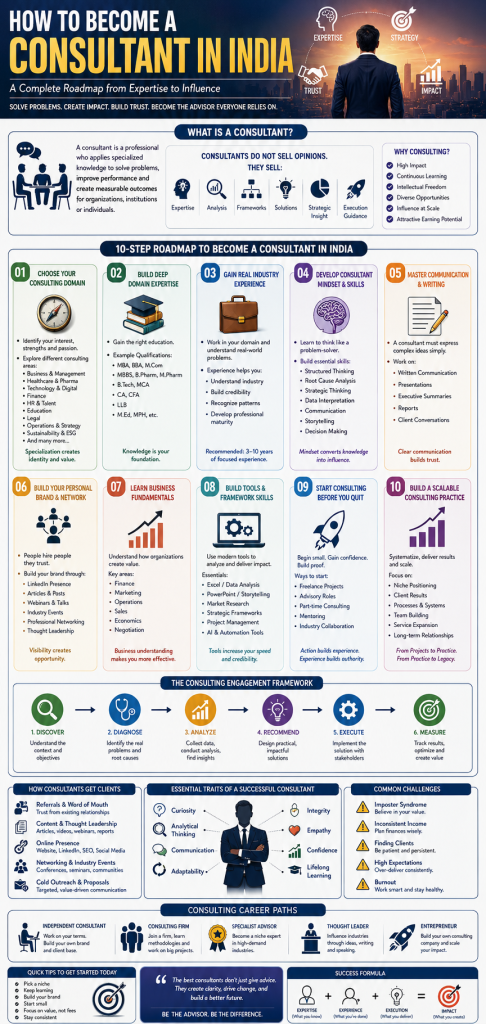
How to Become a Consultant in India: A Complete Professional Journey from Expertise to Influence
Introduction: The Age of the Consultant
Across India’s rapidly transforming economy, one professional identity has emerged as one of the most influential, intellectually rewarding, and strategically powerful careers—the consultant.
Consultants shape industries without necessarily owning factories, hospitals, banks, startups, or governments. They diagnose problems, design solutions, influence decisions, improve systems, accelerate growth, and create measurable outcomes.
In modern India, consultants are everywhere.
A pharmaceutical consultant guides drug companies.
A healthcare consultant redesigns hospitals.
A business consultant helps organizations scale.
A management consultant transforms operations.
A legal consultant interprets regulation.
An education consultant builds institutions.
A digital consultant drives technological change.
A strategy consultant influences national competitiveness.
Yet despite the visibility of consulting, most people misunderstand the profession.
Consulting is not giving advice.
Consulting is structured problem solving combined with credibility.
This article explores how to become a consultant in India—not merely by obtaining a title, but by developing expertise, authority, and long-term professional impact.
Understanding What a Consultant Really Is
Before discussing qualifications and career routes, one must understand the meaning of consulting.
A consultant is a professional who applies specialized knowledge to help individuals, organizations, institutions, governments, or businesses solve problems and achieve outcomes.
Consultants do not sell opinions.
They sell:
- Expertise
- Analysis
- Frameworks
- Execution guidance
- Strategic insight
- Decision support
The consultant becomes valuable because they reduce uncertainty.
Organizations pay consultants not for information—but for clarity.
Why Consulting Has Become One of India’s Most Powerful Careers
India in 2026 is undergoing structural transformation.
Major growth drivers include:
- Digitalization
- Healthcare expansion
- Manufacturing growth
- Startup ecosystems
- AI adoption
- Global outsourcing
- Infrastructure development
- Pharmaceutical innovation
Each transformation creates complexity.
Complexity creates demand for experts.
Experts become consultants.
The consulting economy in India today extends far beyond multinational firms.
Independent consulting is growing rapidly.
Step One: Understand Which Type of Consultant You Want to Become
The biggest mistake beginners make is saying:
“I want to become a consultant.”
Consulting is not one profession.
It is hundreds of specialized professions.
Business Consultant
Helps organizations improve:
- Revenue
- Operations
- Growth
- Market entry
Clients:
Startups, SMEs, corporations.
Management Consultant
Focus areas:
- Organizational transformation
- Efficiency
- Strategic planning
Ideal for:
MBA graduates.
Healthcare Consultant
Works on:
- Hospital systems
- Clinical operations
- Healthcare strategy
- Public health
Suitable for:
- Doctors
- Pharmacists
- Healthcare managers
Pharmaceutical Consultant
Supports:
- Drug development
- Market access
- Regulatory affairs
- Medical writing
- Commercial strategy
Suitable for:
- B.Pharm
- M.Pharm
- Pharmacologists
Education Consultant
Helps:
- Students
- Institutions
- Curriculum design
Technology Consultant
Focus:
- AI
- Software
- Cybersecurity
- Cloud transformation
Financial Consultant
Specialization:
- Investments
- Wealth
- Financial planning
HR Consultant
Works in:
- Recruitment
- Leadership
- Organizational development
Step Two: Build Deep Domain Expertise
Consulting begins with competence.
Without expertise there is no consulting.
Ask:
What problem can I solve repeatedly?
The answer defines your consulting identity.
Build Educational Credibility
Examples:
Healthcare:
MBBS, B.Pharm, M.Pharm, MPH
Business:
BBA, MBA
Technology:
BTech, MCA
Finance:
CA, CFA
Law:
LLB
Education:
M.Ed.
Degrees alone do not create consultants.
But they accelerate credibility.
Step Three: Gain Real Industry Experience
Experience converts knowledge into authority.
Most successful consultants spend years in execution before consulting.
Experience creates:
- Pattern recognition
- Decision-making
- Professional language
- Industry understanding
Suggested Experience Timeline
Entry:
0–3 years
Build skills.
Mid:
4–8 years
Lead projects.
Senior:
8–15 years
Transition to consulting.
Step Four: Develop Consultant Thinking
Consultants think differently.
Employees ask:
“What should I do?”
Consultants ask:
“What problem actually exists?”
Develop:
Structured thinking
Systems thinking
Strategic analysis
Root-cause diagnosis
Communication clarity
The Consultant Problem-Solving Framework
Every consulting engagement follows a sequence.
Discovery
Understand context.
Diagnosis
Identify causes.
Analysis
Quantify issues.
Recommendation
Design solutions.
Execution
Implement.
Measurement
Track outcomes.
Step Five: Build Communication Excellence
Consulting is communication multiplied by expertise.
A consultant must:
- Speak clearly
- Write persuasively
- Present confidently
- Simplify complexity
Develop Writing Ability
Practice:
- Reports
- White papers
- Case studies
- Research articles
- Industry analysis
Writing creates authority.
Step Six: Build Your Personal Brand
Modern consulting is reputation-driven.
People hire names.
Create:
Professional website
Portfolio
Articles
Public speaking
Professional networking
Build Thought Leadership
Publish:
- Research
- Market analysis
- Insights
- Case discussions
Visibility multiplies trust.
Step Seven: Learn Business Fundamentals
Even technical consultants require business understanding.
Learn:
Economics
Marketing
Sales
Operations
Finance
Negotiation
Step Eight: Learn Consulting Tools
Modern consultants use:
Analytics
Data interpretation.
Presentation Design
Executive communication.
Market Research
Evidence generation.
Strategic Frameworks
Decision architecture.
AI Tools
Productivity enhancement.
Step Nine: Start Consulting Before Becoming a Consultant
Do not wait for permission.
Begin with:
- Freelance assignments
- Advisory work
- Small projects
- Industry mentoring
Experience compounds.
Creating Your First Consulting Offer
Most beginners fail because services are vague.
Bad:
“I provide consulting.”
Better:
“I help small pharmaceutical businesses improve product positioning.”
Specificity wins.
Step Ten: Build a Consulting Portfolio
Your portfolio should demonstrate:
Problem
→ Action
→ Outcome
Include:
- Projects
- Publications
- Reports
- Results
Pricing Your Consulting Services
Early career:
Hourly.
Mid career:
Project-based.
Advanced:
Outcome-based.
Elite:
Retainer model.
How Consultants Get Clients in India
Channels include:
Referrals
Highest trust.
Publishing
Authority generation.
Digital Presence
Visibility.
Professional Networks
Relationship leverage.
Industry Events
Opportunity creation.
Building Credibility Without Famous Clients
Start by publishing:
- Articles
- Reports
- Frameworks
- Case insights
People trust demonstrated thinking.
The Consulting Mindset Shift
Employees trade time.
Consultants trade judgment.
This changes everything.
You become responsible for:
- Results
- Client expectations
- Professional reputation
Ethics in Consulting
Consultants influence decisions.
Therefore:
Avoid:
- False claims
- Data manipulation
- Conflicts of interest
Protect:
- Confidentiality
- Transparency
- Integrity
Trust compounds.
Challenges Consultants Face
Imposter Syndrome
Normal.
Revenue Volatility
Manage reserves.
Competition
Differentiate.
Burnout
Protect energy.
Difficult Clients
Create boundaries.
The Indian Consulting Opportunity Landscape Beyond 2026
High-growth sectors include:
- Healthcare
- Pharmaceuticals
- Manufacturing
- Defence
- Digital transformation
- Education
- Sustainability
- Biotechnology
- AI governance
Opportunity increasingly belongs to specialists.
How to Become an Independent Consultant
Stage 1:
Acquire expertise.
Stage 2:
Build network.
Stage 3:
Publish insights.
Stage 4:
Get initial clients.
Stage 5:
Standardize services.
Stage 6:
Scale.
How to Build a Consulting Firm
Evolution model:
Individual
↓
Expert Brand
↓
Small Team
↓
Consultancy Firm
↓
Specialized Advisory Organization
Consultant Skills That Matter Most
Technical expertise
+
Writing ability
+
Strategic thinking
+
Negotiation
+
Emotional intelligence
+
Decision-making
The Consultant’s Daily Routine
Morning:
Research
Midday:
Client discussions
Afternoon:
Analysis
Evening:
Reporting
Night:
Learning
Consulting rewards intellectual endurance.
Mistakes That Prevent People from Becoming Consultants
- Waiting too long
- Not specializing
- Weak communication
- No portfolio
- No online presence
- Selling hours instead of outcomes
Consultant Income: The Reality
Income varies dramatically.
Determinants:
- Domain
- Reputation
- Network
- Experience
- Positioning
- Results
Consulting rewards credibility more than seniority.
Becoming a Consultant in Healthcare and Pharmaceuticals (Special Perspective)
For professionals with backgrounds in pharmacy, pharmacology, medicine, and healthcare, consulting offers extraordinary opportunities.
Possible areas:
- Medical writing
- Healthcare analytics
- Regulatory affairs
- Market access
- Pharmacovigilance
- Clinical strategy
- Training
- Scientific communication
Domain expertise combined with communication becomes a powerful advantage.
Building Long-Term Consultant Authority
The highest-performing consultants eventually become:
- Authors
- Educators
- Speakers
- Advisors
- Industry thinkers
Their influence extends beyond projects.
Final Conclusion: Becoming the Person People Trust
Consulting is not achieved through business cards.
It is earned through repeated demonstration of insight.
To become a consultant in India:
Learn deeply.
Work seriously.
Write consistently.
Communicate clearly.
Build trust.
Create outcomes.
The consultant of the future will not be the person with the most information.
It will be the person who can transform complexity into direction.
And that journey begins not when someone calls you a consultant—
but when people begin trusting your judgment enough to act on it.