Analysis of the Batteries Market in India (2026 Edition)
The Strategic Engine Powering India’s Mobility, Energy Transition, Electronics, and Industrial Future
The Indian battery industry is undergoing one of the most significant industrial transformations in modern economic history. Batteries are no longer merely energy storage devices powering automobiles and electronic equipment; they have become strategic assets shaping national competitiveness, energy security, decarbonization pathways, industrial policy, and technological sovereignty.
India’s battery market is entering a phase where electrification, renewable integration, domestic manufacturing, energy storage systems, and advanced chemistry innovation are converging into a unified growth ecosystem.
The next decade will determine whether India remains predominantly an importer of battery technologies or evolves into a globally competitive battery manufacturing and energy-storage powerhouse.
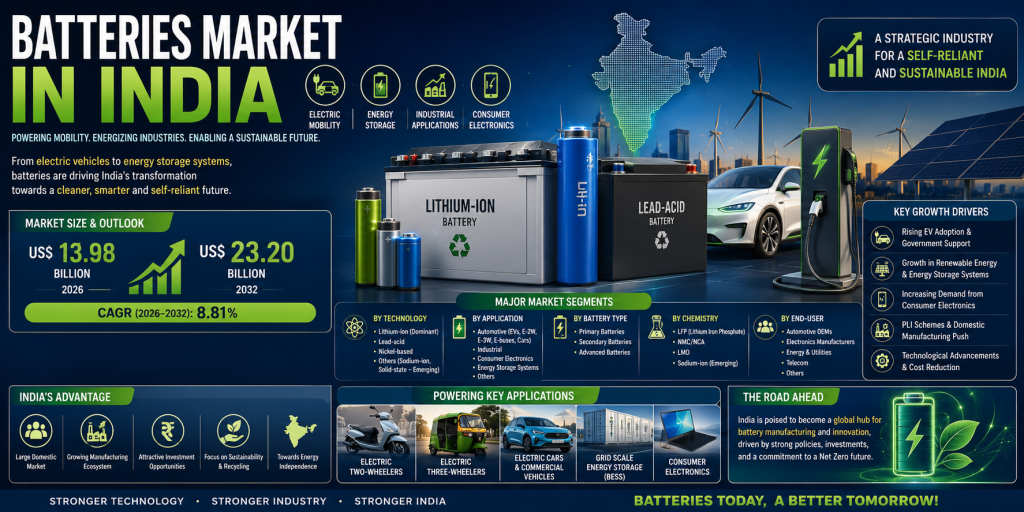
Current industry estimates place India’s overall battery market at approximately US$13.98 billion in 2026, with projections reaching approximately US$23.20 billion by 2032, reflecting sustained expansion across mobility, industrial, consumer, and storage applications. (MarkNtel Advisors)
1. Introduction: Why Batteries Have Become Strategic Infrastructure
Historically, batteries occupied a supporting role in economic systems.
Today, batteries sit at the center of:
- Electric mobility
- Consumer electronics
- Renewable energy storage
- Telecom infrastructure
- Grid modernization
- Data center resilience
- Industrial automation
- National energy independence
Battery technology now influences:
- geopolitical positioning,
- manufacturing competitiveness,
- carbon reduction strategies,
- and industrial innovation.
India’s growing power requirements, rising electrification, and renewable ambitions have elevated batteries from industrial products into strategic national infrastructure. (The Indian Express)
2. Market Size and Economic Outlook
India’s battery ecosystem is broad and includes:
Primary Batteries
- Disposable cells
- Consumer batteries
Secondary Batteries
- Rechargeable batteries
- Automotive batteries
- Industrial storage
Advanced Battery Technologies
- Lithium-ion
- Lithium iron phosphate (LFP)
- Sodium-ion
- Solid-state (emerging)
Energy Storage Systems
- Grid-scale batteries
- Commercial backup systems
- Renewable integration systems
Industry estimates suggest:
| Segment | Current Outlook |
|---|---|
| India Battery Market (2026) | ~US$13.98 Billion |
| Forecast (2032) | ~US$23.20 Billion |
| Expected CAGR | ~8.81% |
Lithium-ion technologies now account for the dominant technological share of growth in India’s battery economy. (MarkNtel Advisors)
3. Market Evolution: From Lead-Acid Dominance to Advanced Chemistry
For decades, India’s battery market was dominated by:
- Lead-acid batteries
- Automotive starter batteries
- UPS systems
- Industrial backup applications
The market has now entered a chemistry transition.
Evolution Timeline
Phase I (Pre-2015):
Lead-acid industrial expansion.
Phase II (2015–2023):
Consumer electronics and EV acceleration.
Phase III (2024–2030):
Lithium-ion industrialization.
Phase IV (Beyond 2030):
Advanced chemistries and circular manufacturing.
4. India’s Lithium-Ion Revolution
Among all battery technologies, lithium-ion represents the fastest growth trajectory.
Multiple market assessments estimate India’s lithium-ion battery market at US$6.73 billion in 2026, potentially expanding to approximately US$15.17 billion by 2031 at nearly 17.65% CAGR. (Mordor Intelligence)
Alternative industry projections indicate expansion toward approximately US$10.03 billion by 2033, growing around 23.7% CAGR from 2026 onward. (Grand View Research)
Key growth drivers include:
- EV penetration
- Mobile electronics
- Renewable storage
- Industrial electrification
- Localization policies
5. Electric Vehicles: The Primary Demand Engine
No sector has transformed India’s battery market more profoundly than electric mobility.
Battery demand is increasingly generated by:
- Electric two-wheelers
- Electric three-wheelers
- Passenger EVs
- Electric buses
- Commercial fleets
India remains among the world’s leading electric mobility markets and retained the position of the world’s second-largest electric two-wheeler market, while also ranking strongly in electric buses and electric three-wheelers. (The Times of India)
Battery pack demand is forecast to accelerate sharply.
Industry estimates indicate India’s EV battery pack market may rise from approximately US$53.76 million in 2026 to US$254.59 million by 2031, reflecting exceptionally high growth. (Mordor Intelligence)
6. Battery Manufacturing Ecosystem in India
India is transitioning from battery assembly toward integrated manufacturing.
Critical manufacturing stages include:
Upstream
- Mineral sourcing
- Cathode production
- Electrolyte processing
Midstream
- Cell manufacturing
- Module assembly
- Battery pack integration
Downstream
- Recycling
- Second-life deployment
- Service ecosystems
Recent investments indicate accelerating localization.
Examples include:
- expansion of advanced battery facilities,
- cathode manufacturing investment,
- localization of cell technologies. (The Times of India)
7. Government Policy as a Market Catalyst
India’s battery expansion has been supported through industrial intervention.
Major policy pillars include:
Production Linked Incentive (PLI)
Focused on:
- Advanced Chemistry Cells (ACC)
- Domestic manufacturing
Make in India
Encouraging:
- Localization
- Supply chain resilience
EV Support Frameworks
Driving:
- vehicle adoption,
- battery manufacturing,
- charging ecosystem expansion.
Policy support has materially accelerated battery industrialization. (Mordor Intelligence)
8. Energy Storage Systems (BESS): The Next Mega Opportunity
Battery demand is increasingly moving beyond vehicles.
Grid-scale energy storage is emerging rapidly.
India’s Battery Energy Storage System (BESS) market was estimated at approximately:
- US$2.05 billion (2026)
- Potentially US$8.59 billion by 2031
- Growth rate of approximately 33.2% CAGR (Mordor Intelligence)
Other projections suggest growth toward US$20.37 billion by 2035, indicating long-term strategic expansion potential. (Cervicorn Consulting)
Drivers include:
- solar integration,
- renewable balancing,
- grid modernization,
- industrial reliability.
9. Consumer Electronics and Portable Battery Demand
India’s digital economy creates substantial battery demand.
Key consuming segments:
- Smartphones
- Tablets
- Laptops
- Wearables
- Portable medical devices
Consumer electronics continue expanding battery utilization intensity across households and enterprises. (Market Research Future)
10. Emerging Technologies Reshaping the Industry
Lithium Iron Phosphate (LFP)
Advantages:
- thermal stability
- long lifecycle
- lower cost
LFP currently represents one of India’s strongest growth chemistries. (Grand View Research)
Sodium-Ion Batteries
Emerging opportunities:
- lower material cost
- improved safety
- grid applications
Sodium-ion may become increasingly relevant for stationary energy storage. (Live Science)
Solid-State Batteries
Potential future benefits:
- higher energy density
- faster charging
- improved safety
Commercial maturity remains under development.
11. Supply Chain and Strategic Challenges
Despite progress, India faces structural constraints.
Import Dependence
Large portions of:
- lithium,
- nickel,
- graphite,
- cobalt
remain externally sourced.
Some industry assessments estimate dependence on imports for major battery materials remains extremely high. (Knowledge Sourcing)
Cost Volatility
Industry economics remain sensitive to:
- commodity prices,
- exchange rates,
- logistics costs.
Technology Gaps
India must accelerate:
- chemistry innovation,
- cell design,
- battery management systems.
12. Circular Economy and Battery Recycling
Battery growth creates end-of-life responsibility.
India’s emerging battery ecosystem increasingly emphasizes:
- material recovery,
- reuse,
- remanufacturing.
Recent industry partnerships show growing momentum toward circular battery systems and recycling infrastructure. (The Economic Times)
13. Competitive Structure of India’s Battery Industry
The ecosystem includes:
- Cell manufacturers
- Pack integrators
- Automotive suppliers
- Electronics manufacturers
- Energy storage firms
Competitive advantage increasingly depends upon:
- localization,
- chemistry innovation,
- manufacturing efficiency,
- lifecycle economics.
New investments continue entering India’s battery ecosystem to capture accelerating domestic demand. (The Times of India)
14. SWOT Analysis
Strengths
- Massive domestic demand
- Government support
- Renewable expansion
- Large mobility opportunity
Weaknesses
- Raw material dependence
- Technology imports
- Limited integrated supply chains
Opportunities
- Export growth
- Battery recycling
- Energy storage leadership
- Advanced chemistry innovation
Threats
- Global pricing pressure
- Mineral supply disruptions
- Rapid technology shifts
15. PESTLE Analysis
Political
Industrial incentives encourage manufacturing.
Economic
Electrification increases investment.
Social
Consumers increasingly accept electric mobility.
Technological
Rapid chemistry innovation drives competition.
Legal
Environmental and recycling compliance rise.
Environmental
Batteries enable lower-emission energy systems.
16. Future Outlook: 2026–2035
India’s battery industry is entering an industrial acceleration cycle.
Market indicators collectively point toward:
- large-scale lithium-ion expansion,
- explosive energy-storage growth,
- deeper EV penetration,
- stronger domestic manufacturing,
- rising recycling ecosystems.
Global battery deployment has expanded dramatically over recent years and continues accelerating due to EVs and energy storage systems. (IEA)
By 2035, leadership may no longer belong simply to companies that manufacture batteries—but to those that control:
- chemistry,
- manufacturing,
- software,
- lifecycle services,
- and circular resource recovery.
Conclusion
The Indian battery market is becoming one of the defining industrial stories of the decade.
What began as a fragmented lead-acid industry is evolving into an integrated ecosystem of advanced chemistry, electric mobility, renewable storage, domestic manufacturing, and strategic industrial capability.
Batteries are no longer passive components.
They are becoming the energy architecture of modern India—and one of the strongest indicators of the nation’s transition from consumption-led growth to technology-led industrial leadership.