Lessons Written by Life
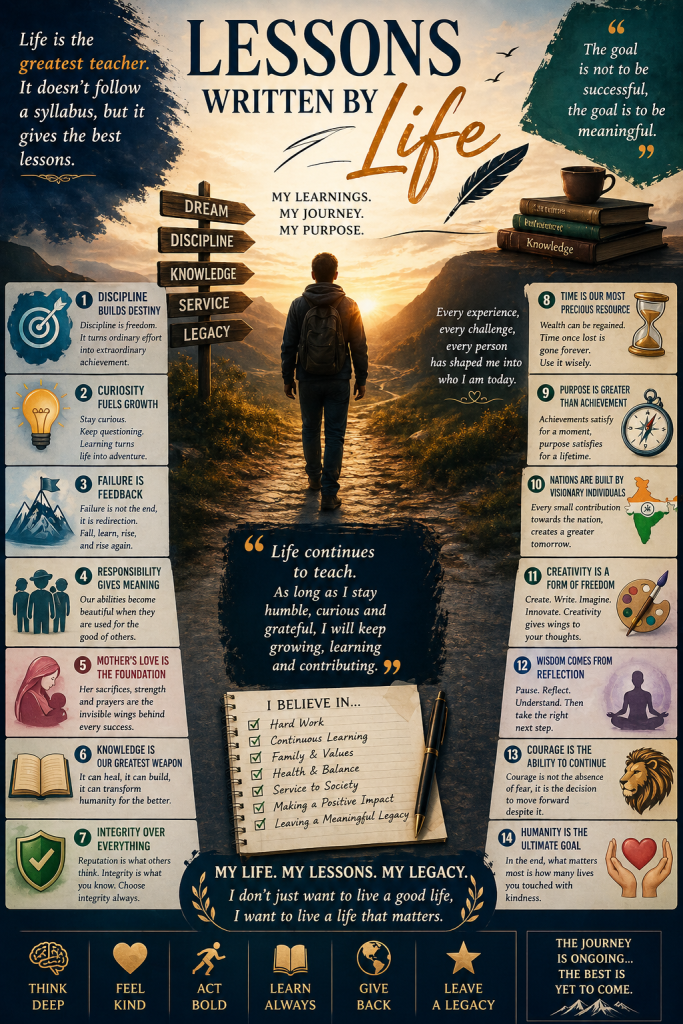
A Personal Journey Through Struggle, Knowledge, Responsibility, and Meaning
Introduction — Life as the Greatest University
Human beings spend years attending schools and universities in pursuit of knowledge. Degrees are earned, certificates are framed, and titles are attached to names. Yet, the most profound lessons rarely emerge from classrooms. They emerge from life itself.
Life is perhaps the most demanding teacher. It does not follow a syllabus. It does not announce examinations in advance. And its results cannot be predicted through memorization or theoretical preparation.
Instead, life teaches through experience — through failure and perseverance, through loss and love, through ambition and humility. The lessons it offers are often disguised in moments of uncertainty, hardship, and introspection.
Looking back at my own journey, I have come to recognize that my education was never limited to academic institutions. My true education came from observing people, confronting adversity, embracing intellectual curiosity, and learning to transform personal struggles into purposeful action.
Every phase of life carries its own lessons. Childhood teaches curiosity. Youth teaches ambition. Adversity teaches resilience. Responsibility teaches maturity.
And if one observes carefully, life gradually reveals a deeper truth — success is not merely the accumulation of achievements but the evolution of character.
This blog reflects upon the lessons life has taught me so far. These lessons are not philosophical abstractions. They are practical realizations born from experience.
They are lessons about discipline, courage, knowledge, purpose, and humanity.
Lesson One — Discipline is the Architecture of Character
One of the earliest lessons life taught me was the value of discipline.
Discipline is often misunderstood as restriction. In reality, discipline is freedom.
It is the invisible architecture that supports human potential.
A disciplined mind is capable of focusing on long-term goals despite temporary distractions. It enables a person to pursue excellence consistently rather than occasionally.
In many ways, discipline is the difference between aspiration and achievement.
People often admire successful individuals and attribute their accomplishments to talent or luck. Yet the deeper truth is that sustained success almost always arises from disciplined habits.
Daily routines, intellectual commitment, and perseverance in the face of obstacles create momentum over time.
Discipline transforms ordinary effort into extraordinary outcomes.
It is not glamorous, but it is powerful.
Lesson Two — Curiosity is the Engine of Intellectual Growth
Another profound lesson life has taught me is the power of curiosity.
Curiosity is the force that drives human discovery. It motivates scientists to explore the unknown, writers to question society, and thinkers to challenge established assumptions.
Without curiosity, knowledge stagnates.
Curiosity is what compels us to ask deeper questions:
Why does a disease occur?
How does society evolve?
What motivates human behavior?
How can science improve human life?
These questions transform learning from passive reception into active exploration.
Curiosity also protects the mind from intellectual complacency.
In a rapidly changing world, continuous learning is no longer optional. It is essential.
Those who remain curious remain intellectually alive.
Lesson Three — Failure is Not the Opposite of Success
Society often portrays success as a smooth trajectory of achievements.
Reality tells a different story.
Behind every meaningful accomplishment lies a series of setbacks, disappointments, and unexpected challenges.
Failure, when interpreted correctly, is not a defeat. It is feedback.
It reveals weaknesses that must be addressed and strategies that must be reconsidered.
More importantly, failure tests one’s commitment to a goal.
If a person abandons an ambition at the first sign of difficulty, the ambition was never truly meaningful.
Resilience is born from the willingness to continue despite temporary setbacks.
Life repeatedly demonstrates that persistence often matters more than initial talent.
Lesson Four — Responsibility Gives Meaning to Strength
Strength without responsibility becomes arrogance.
Knowledge without responsibility becomes manipulation.
Power without responsibility becomes oppression.
One of the most important realizations of adulthood is that responsibility gives purpose to our abilities.
Human beings are not isolated individuals. They exist within families, communities, and nations.
Our actions influence others.
Responsibility begins within the family but eventually extends outward toward society.
Helping others, supporting loved ones, and contributing to the well-being of the community transforms individual success into collective progress.
Responsibility is therefore not a burden. It is a privilege.
Lesson Five — The Quiet Strength of Mothers
One of the most powerful lessons life teaches is the silent courage of mothers.
Throughout history, societies have celebrated warriors, kings, and political leaders. Yet the sacrifices made by mothers often remain unnoticed.
A mother’s strength lies not in public recognition but in unwavering devotion.
Whether facing illness, hardship, or uncertainty, mothers demonstrate a remarkable resilience that often inspires entire families.
Their courage is quiet but profound.
It reminds us that true strength does not always manifest in dramatic actions. Sometimes it appears in daily acts of love, patience, and determination.
Lesson Six — Knowledge is Humanity’s Most Powerful Weapon
Human civilization has progressed through the accumulation of knowledge.
Knowledge builds bridges, cures diseases, and expands the boundaries of human possibility.
At the same time, knowledge carries responsibility.
Scientific discoveries must serve humanity rather than harm it.
Throughout history, knowledge has been used both to heal and to destroy.
The ethical use of knowledge therefore becomes one of the most important responsibilities of intellectuals, scientists, and leaders.
Knowledge without ethics becomes dangerous.
But knowledge guided by compassion becomes transformative.
Lesson Seven — Integrity is More Valuable Than Reputation
Reputation is what others think about you.
Integrity is what you know about yourself.
While reputation can fluctuate based on public opinion, integrity remains a constant internal compass.
Life eventually reveals that maintaining integrity is far more valuable than chasing external validation.
Opportunities may arise that promise short-term advantages but require compromising one’s principles.
In such moments, integrity becomes the guiding force that determines the path forward.
A person who preserves integrity may face temporary difficulties but ultimately earns lasting respect.
Lesson Eight — Time is the Most Precious Resource
Human beings often pursue wealth, recognition, and status.
Yet the most valuable resource is time.
Time cannot be stored, borrowed, or recovered.
Every moment spent contributes to the story of our lives.
This realization encourages a more thoughtful approach to daily choices.
Time invested in learning, creating, and helping others yields meaningful returns.
Time wasted in negativity or distraction cannot be reclaimed.
Recognizing the value of time transforms ordinary days into opportunities for purposeful living.
Lesson Nine — Purpose is Greater Than Achievement
Achievements provide satisfaction, but purpose provides direction.
Without a clear sense of purpose, achievements may feel empty.
Purpose answers a deeper question:
Why am I doing what I am doing?
For some individuals, purpose lies in scientific discovery. For others, it lies in service, creativity, leadership, or mentorship.
Purpose transforms effort into meaning.
It motivates perseverance during difficult times and provides clarity during moments of uncertainty.
A life guided by purpose transcends individual ambition.
It becomes part of a larger narrative.
Lesson Ten — Nations Are Built by Individuals with Vision
Every nation’s progress depends upon individuals who believe in something larger than themselves.
Teachers, scientists, soldiers, doctors, entrepreneurs, and writers all contribute to the evolution of society.
Each profession plays a role in strengthening the foundations of civilization.
When individuals align their personal ambitions with national progress, collective transformation becomes possible.
History repeatedly demonstrates that visionary individuals shape the destiny of nations.
Lesson Eleven — Creativity is a Form of Freedom
Creativity allows human beings to express thoughts that cannot always be communicated through conventional language.
Writing, art, science, and innovation are all forms of creativity.
Creativity liberates the mind from rigid boundaries and encourages exploration.
Through creativity, individuals contribute ideas that challenge existing assumptions and inspire new possibilities.
Creative thinking therefore becomes a catalyst for progress.
Lesson Twelve — Wisdom Emerges from Reflection
Experience alone does not guarantee wisdom.
Wisdom emerges when experiences are carefully examined and understood.
Reflection transforms events into insights.
It allows individuals to identify patterns in their lives and make more informed decisions in the future.
In a world that often prioritizes speed, reflection reminds us to pause and evaluate our direction.
Without reflection, experiences may be forgotten.
With reflection, experiences become lessons.
Lesson Thirteen — Courage is the Ability to Continue
Courage is often portrayed as heroic acts on battlefields.
Yet in everyday life, courage appears in quieter forms.
It appears when individuals continue pursuing their goals despite obstacles.
It appears when people defend their values in difficult circumstances.
It appears when individuals choose hope over despair.
Courage is therefore not the absence of fear.
It is the determination to move forward despite fear.
Lesson Fourteen — Humanity Must Remain the Ultimate Goal
In the pursuit of progress, societies sometimes risk forgetting the importance of compassion.
Technological advancements, economic growth, and scientific achievements must ultimately serve humanity.
If progress neglects human well-being, it loses its purpose.
Compassion therefore becomes the guiding principle that ensures progress remains meaningful.
Conclusion — Life Continues to Teach
Life does not stop teaching once we reach adulthood.
Every stage of life reveals new perspectives.
Challenges become teachers.
Relationships become mirrors.
Experiences become chapters in an ongoing story.
Looking back, one realizes that life’s lessons rarely arrive as clear instructions.
They appear gradually, through reflection and understanding.
And perhaps the most important realization is this:
The journey of learning never truly ends.
As long as curiosity remains alive, life continues to offer wisdom.
Every day becomes another page in the book of experience.
And every challenge becomes an opportunity to grow.