
Trichosanthes dioica and the Therapeutic Promise of Trichosanthes Species: Exploring Their Advantages for Human Health
.
Introduction
Across the history of human civilization, plants have served not merely as food sources but as reservoirs of therapeutic compounds that shape traditional and modern medicine. Among these plants, the genus Trichosanthes, belonging to the Cucurbitaceae family, occupies a unique place in both ethnomedicine and nutritional science. Species within this genus—particularly Trichosanthes dioica, commonly known as pointed gourd or “parwal”—have long been valued in the Indian subcontinent for their medicinal, nutritional, and pharmacological properties.
In Ayurvedic literature, Trichosanthes dioica is known as Patola, and it has been traditionally employed to treat numerous conditions ranging from digestive disorders to inflammatory diseases. Ancient herbal texts describe the plant as cooling, detoxifying, and restorative. Modern pharmacological research has increasingly begun to validate many of these traditional claims by identifying bioactive compounds responsible for diverse therapeutic effects.
The genus Trichosanthes comprises more than one hundred species distributed across tropical and subtropical regions of Asia, Australia, and the Pacific islands. These species contain a wide range of phytochemicals—including flavonoids, saponins, alkaloids, triterpenes, and ribosome-inactivating proteins such as trichosanthin—that contribute to their medicinal value. These compounds exhibit antioxidant, anti-inflammatory, antimicrobial, antidiabetic, and cardioprotective properties. (Wisdom Library)
The present article explores in depth the advantages of Trichosanthes dioica and other Trichosanthes species for human health, examining their botanical characteristics, nutritional composition, pharmacological activities, and therapeutic potential. The discussion also reflects on their significance in modern medicine and their potential role in the future of herbal therapeutics.
Botanical Overview of Trichosanthes Species
Taxonomy and Distribution
The genus Trichosanthes belongs to the Cucurbitaceae family, which includes many economically important plants such as cucumbers, melons, and gourds. These plants are typically climbing vines characterized by tendrils, lobed leaves, and elongated fruits.
The most widely recognized medicinal species include:
- Trichosanthes dioica (pointed gourd / parwal)
- Trichosanthes cucumerina (snake gourd)
- Trichosanthes tricuspidata
- Trichosanthes kirilowii
- Trichosanthes bracteata
These species are predominantly found in India, China, Bangladesh, Sri Lanka, Southeast Asia, and parts of Australia, where they are used both as food and medicine.
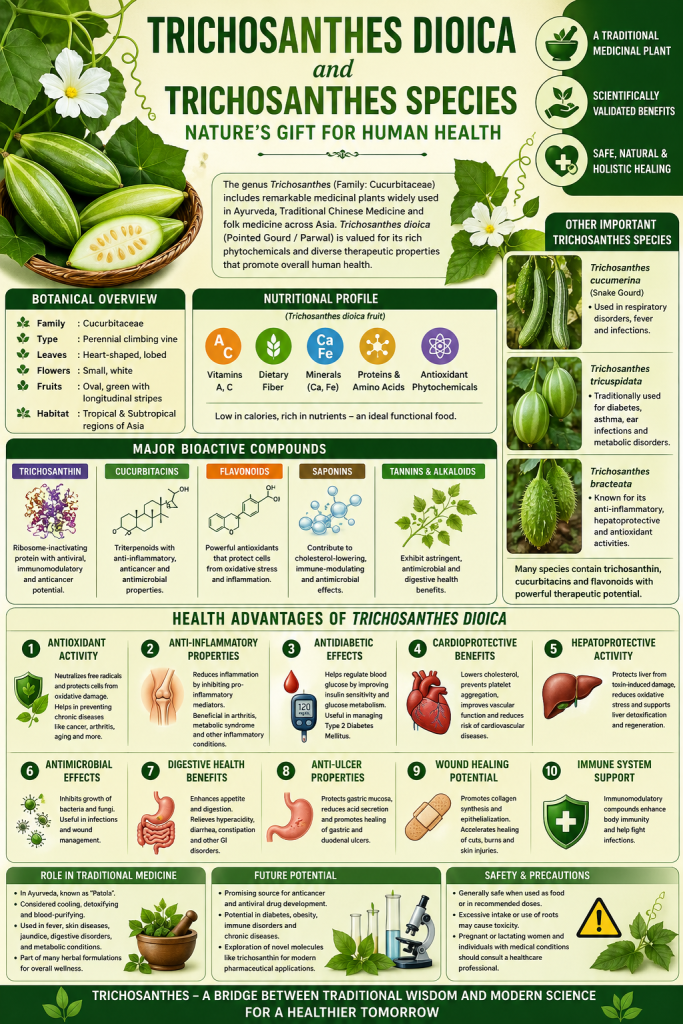
Trichosanthes dioica, in particular, is extensively cultivated in eastern India and neighboring countries due to its edible fruit and therapeutic benefits. The plant is a perennial climbing vine with slender stems, heart-shaped leaves, and small white flowers. Its fruits are oval-shaped and green with longitudinal stripes.
Nutritional Composition of Trichosanthes dioica
The nutritional profile of Trichosanthes dioica contributes significantly to its health-promoting properties. The fruit contains:
- Vitamins A and C
- Dietary fiber
- Minerals such as calcium and iron
- Proteins and essential amino acids
- Antioxidant phytochemicals
The presence of these nutrients makes pointed gourd not only a vegetable but also a functional food with therapeutic potential.
Phytochemical investigations have revealed that Trichosanthes species contain bioactive compounds such as flavonoids, tannins, saponins, cucurbitacins, alkaloids, and triterpenoids. These compounds play a critical role in mediating the plant’s pharmacological effects. (Wisdom Library)
Major Bioactive Compounds in Trichosanthes Species
Understanding the medicinal advantages of Trichosanthes requires an examination of its bioactive molecules. Several compounds identified in these plants are responsible for their therapeutic properties.
1. Trichosanthin
Trichosanthin is a ribosome-inactivating protein that has attracted significant scientific interest due to its antiviral and anticancer properties. It has been investigated for its ability to inhibit viral replication and induce apoptosis in cancer cells.
2. Cucurbitacins
Cucurbitacins are highly oxygenated triterpenoids found in cucurbit plants. These compounds exhibit:
- Anti-inflammatory activity
- Anticancer potential
- Antimicrobial properties
3. Flavonoids
Flavonoids act as powerful antioxidants that protect cells from oxidative stress and inflammation.
4. Saponins and Tannins
These compounds contribute to antimicrobial, anti-inflammatory, and cholesterol-lowering effects.
The synergistic action of these phytochemicals provides the foundation for the wide therapeutic potential of Trichosanthes plants.
Advantages of Trichosanthes dioica for Human Health
1. Antioxidant Activity
One of the most significant health advantages of Trichosanthes dioica is its strong antioxidant activity.
Oxidative stress caused by free radicals is associated with numerous chronic diseases including cancer, cardiovascular disorders, diabetes, and neurodegenerative conditions.
Extracts from Trichosanthes plants contain antioxidant compounds that neutralize reactive oxygen species, thereby protecting cells from oxidative damage.
Scientific studies have confirmed that Trichosanthes dioica possesses potent antioxidant activity, which contributes to its protective effects against various diseases. (PubMed)
2. Anti-Inflammatory Properties
Inflammation is a biological response that plays a central role in many diseases such as arthritis, metabolic syndrome, and cardiovascular disorders.
Compounds present in Trichosanthes species inhibit inflammatory mediators and cytokines, thereby reducing inflammation.
Traditional medicine has long used pointed gourd extracts to treat swelling, fever, and inflammatory conditions.
Modern pharmacological research supports these traditional uses by demonstrating the anti-inflammatory effects of plant extracts.
3. Antidiabetic Effects
Diabetes mellitus is one of the most serious global health challenges.
Research indicates that Trichosanthes dioica extracts may help regulate blood glucose levels by enhancing insulin sensitivity and improving glucose metabolism.
Animal studies have demonstrated that extracts from this plant significantly reduce blood sugar levels in diabetic models. (Wisdom Library)
These findings suggest that the plant could serve as a valuable complementary therapy for diabetes management.
4. Cardioprotective Benefits
Cardiovascular diseases remain a leading cause of mortality worldwide.
Bioactive compounds in Trichosanthes plants have shown cardioprotective properties through mechanisms such as:
- Reducing cholesterol levels
- Preventing platelet aggregation
- Improving vascular function
These effects collectively contribute to improved cardiovascular health.
5. Hepatoprotective Activity
The liver plays a critical role in detoxification and metabolism.
Studies have shown that extracts from Trichosanthes dioica protect the liver from damage caused by toxins and oxidative stress.
Traditional medicine also uses the plant to treat conditions such as jaundice and liver enlargement. (Drugs.com)
6. Antimicrobial Effects
Many Trichosanthes species possess antimicrobial properties that inhibit the growth of bacteria and fungi.
These properties make them useful in treating infections and preventing microbial growth in wounds.
7. Digestive Health Benefits
The fruits of Trichosanthes dioica are easily digestible and promote gastrointestinal health.
Traditional medicine describes the plant as a stomachic agent that improves appetite and digestion.
It is also used to treat hyperacidity, diarrhea, and gastrointestinal discomfort. (ScienceDirect)
8. Anti-Ulcer Properties
Peptic ulcers occur due to excessive acid secretion and damage to the stomach lining.
Extracts from Trichosanthes dioica have shown anti-ulcer activity by protecting the gastric mucosa and reducing inflammation.
9. Wound Healing Potential
Topical application of extracts from Trichosanthes plants accelerates wound healing.
Studies demonstrate that plant extracts increase collagen synthesis and epithelialization, thereby promoting tissue regeneration. (ScienceDirect)
10. Immune System Support
The immunomodulatory properties of Trichosanthes species help strengthen the body’s immune defense.
Certain compounds stimulate immune cells and enhance resistance against infections.
Advantages of Other Trichosanthes Species
Trichosanthes cucumerina
Commonly known as snake gourd, this species is widely used in traditional medicine for treating respiratory disorders and fever.
Trichosanthes tricuspidata
This species is used in folk medicine to treat asthma, ear infections, and metabolic disorders.
Studies indicate that extracts from this plant possess antidiabetic and lipid-lowering effects. (AJPT Online)
Trichosanthes bracteata
This species is known for its anti-inflammatory and hepatoprotective properties.
Its flavonoid-rich extracts exhibit strong antioxidant activity.
Role of Trichosanthes in Traditional Medicine
For centuries, Trichosanthes species have been integral to traditional medical systems such as Ayurveda, Chinese medicine, and folk healing traditions.
In Ayurveda, Trichosanthes dioica is considered:
- Cooling and detoxifying
- Beneficial for skin disorders
- Effective in treating fever and digestive problems
Various herbal formulations containing Trichosanthes are used to treat viral infections, skin diseases, and metabolic disorders.
Future Potential in Pharmaceutical Research
The increasing interest in plant-derived drugs has renewed attention toward medicinal plants such as Trichosanthes.
Several bioactive compounds from these plants are currently being studied for their therapeutic potential in:
- Cancer therapy
- Antiviral drug development
- Immunomodulatory treatments
- Metabolic disease management
The discovery of novel molecules from Trichosanthes species could contribute significantly to the development of new pharmaceuticals.
Safety and Toxicological Considerations
Although Trichosanthes species offer numerous health benefits, certain precautions are necessary.
Some parts of the plant—particularly the roots—may exhibit toxicity at high doses.
Therefore, medicinal use should always follow proper dosage guidelines and professional supervision.
Conclusion
The genus Trichosanthes, particularly Trichosanthes dioica, represents a remarkable example of how traditional knowledge and modern scientific research can converge to reveal the therapeutic potential of medicinal plants.
Rich in bioactive phytochemicals and essential nutrients, these plants offer numerous health advantages, including antioxidant, anti-inflammatory, antidiabetic, cardioprotective, and hepatoprotective effects. Their role in traditional medicine across Asia underscores their longstanding importance in human health.
As modern science continues to explore plant-based medicines, Trichosanthes species stand out as promising candidates for future pharmaceutical development.
The integration of traditional botanical wisdom with modern pharmacological research may ultimately unlock new therapeutic strategies derived from these remarkable plants—offering safer, natural alternatives for the prevention and treatment of human diseases.