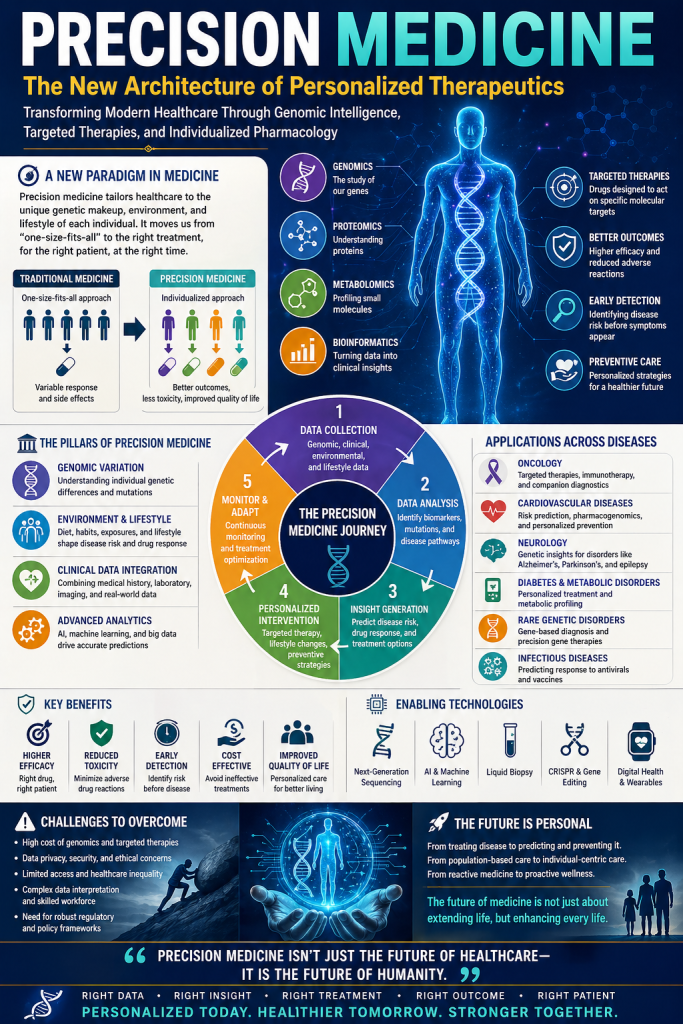
Precision Medicine: The New Architecture of Personalized Therapeutics
Transforming Modern Healthcare Through Genomic Intelligence, Targeted Therapies, and Individualized Pharmacology
Introduction: The Dawn of a New Medical Paradigm
For centuries, medicine has largely operated under a generalized treatment paradigm in which patients with the same disease diagnosis receive identical therapeutic interventions. While this approach has produced remarkable advances in public health, it has also revealed an inherent limitation: patients are biologically unique, and therefore their responses to drugs are often highly variable.
The recognition of this variability has catalyzed one of the most transformative movements in modern biomedical science—precision medicine. Precision medicine represents a shift from the traditional “one-size-fits-all” model toward a more refined therapeutic strategy that tailors medical interventions according to an individual’s genetic makeup, molecular characteristics, lifestyle, and environmental exposures.
This paradigm integrates disciplines such as genomics, pharmacogenomics, molecular biology, bioinformatics, artificial intelligence, and clinical pharmacology to create highly targeted diagnostic and therapeutic strategies.
Precision medicine is not merely a technological innovation; it is a philosophical transformation in healthcare, redefining how diseases are understood, diagnosed, prevented, and treated.
Conceptual Foundations of Precision Medicine
Definition and Scope
Precision medicine can be defined as an approach to healthcare in which medical decisions, treatments, and preventive strategies are customized based on the individual variability in genes, environment, and lifestyle of each patient.
This approach relies heavily on the integration of molecular-level information with clinical data. By identifying the specific biological mechanisms driving disease in an individual, clinicians can select therapies that directly target those mechanisms.
Precision medicine therefore represents the convergence of several scientific domains:
- Genomic medicine
- Pharmacogenomics
- Proteomics
- Metabolomics
- Systems biology
- Computational medicine
Together, these disciplines create a framework in which disease is understood not merely as a clinical entity but as a complex molecular network.
Historical Evolution of Precision Medicine
The conceptual roots of precision medicine can be traced to early observations in pharmacology and genetics, where researchers recognized that individuals often exhibited markedly different responses to the same drug.
For example, variations in drug-metabolizing enzymes such as:
- Cytochrome P450 enzymes
- Thiopurine methyltransferase
- N-acetyltransferase
demonstrated that genetic polymorphisms could significantly alter drug efficacy and toxicity.
The completion of the Human Genome Project in 2003 represented a watershed moment in biomedical science. For the first time, researchers gained comprehensive insight into the genetic blueprint of human biology.
Subsequent technological advances in next-generation sequencing, bioinformatics, and molecular diagnostics made it possible to analyze genetic variations rapidly and cost-effectively.
These innovations laid the foundation for modern precision medicine.
Molecular Basis of Precision Medicine
Precision medicine relies on the identification of biomarkers—measurable biological indicators that provide insight into disease mechanisms and therapeutic responses.
Biomarkers may include:
- Genetic mutations
- Protein expression patterns
- Metabolic signatures
- Cellular signaling pathways
By identifying these biomarkers, clinicians can classify diseases at the molecular level rather than relying solely on clinical symptoms.
This approach has fundamentally transformed the understanding of many diseases, particularly cancer, neurological disorders, cardiovascular diseases, and autoimmune conditions.
Pharmacogenomics: The Heart of Precision Therapeutics
Pharmacogenomics represents one of the central pillars of precision medicine.
It studies how genetic variations influence an individual’s response to drugs, affecting pharmacokinetics and pharmacodynamics.
Variations in genes encoding:
- drug-metabolizing enzymes,
- drug transporters,
- receptor targets,
can significantly alter therapeutic outcomes.
For example, genetic polymorphisms may cause:
- rapid drug metabolism, reducing efficacy
- slow drug metabolism, increasing toxicity
- altered receptor binding, affecting therapeutic response
By integrating pharmacogenomic testing into clinical practice, physicians can select optimal drug types and dosages for each patient.
This approach enhances therapeutic efficacy while minimizing adverse drug reactions.
Precision Medicine in Oncology
Oncology represents the most advanced field in precision medicine implementation.
Cancer is fundamentally a genetic disease driven by mutations in oncogenes and tumor suppressor genes.
Traditional chemotherapy often targets rapidly dividing cells indiscriminately, causing significant toxicity.
Precision oncology, however, focuses on molecularly targeted therapies that specifically inhibit cancer-driving mutations.
Examples include therapies targeting:
- HER2 receptors
- EGFR mutations
- BRAF mutations
- ALK rearrangements
These therapies selectively disrupt tumor growth pathways while sparing healthy tissues, dramatically improving treatment outcomes.
Additionally, immunotherapies such as checkpoint inhibitors utilize molecular biomarkers to identify patients most likely to benefit from treatment.
Precision Medicine in Cardiovascular and Metabolic Diseases
Although oncology has led the precision medicine revolution, its applications are expanding rapidly into other therapeutic areas.
In cardiovascular medicine, genetic screening can identify individuals at high risk for conditions such as:
- familial hypercholesterolemia
- hypertrophic cardiomyopathy
- inherited arrhythmias
Early identification enables preventive strategies and targeted therapies.
Similarly, precision medicine approaches are transforming the management of diabetes and metabolic disorders through personalized lifestyle interventions and tailored pharmacotherapy.
Role of Artificial Intelligence and Big Data
Precision medicine generates enormous volumes of biological data.
Genomic sequencing alone produces millions of data points for each patient.
Analyzing this data requires advanced computational tools, including:
- machine learning
- artificial intelligence
- predictive analytics
AI-driven algorithms can identify complex patterns within biological datasets, enabling researchers to discover new disease mechanisms and therapeutic targets.
Digital health platforms further enhance precision medicine by integrating:
- electronic health records
- wearable device data
- environmental exposure data
This integration creates a comprehensive picture of patient health.
Ethical and Societal Considerations
While precision medicine offers immense promise, it also raises significant ethical questions.
Genomic data is highly sensitive and must be protected to ensure patient privacy.
Key ethical considerations include:
- data security
- informed consent
- equitable access to advanced therapies
- potential genetic discrimination
Ensuring that precision medicine benefits all populations requires robust regulatory frameworks and inclusive healthcare policies.
Challenges in Implementing Precision Medicine
Despite its transformative potential, several barriers hinder the widespread adoption of precision medicine.
1. High Cost of Genomic Technologies
Although sequencing costs have declined dramatically, advanced diagnostics and targeted therapies remain expensive.
2. Limited Infrastructure
Many healthcare systems lack the necessary infrastructure for genomic testing and data analysis.
3. Knowledge Gaps Among Clinicians
Effective implementation requires clinicians to understand complex genomic data and integrate it into therapeutic decision-making.
4. Regulatory Complexity
The development of personalized therapies often challenges traditional regulatory frameworks designed for conventional drugs.
The Future Landscape of Precision Medicine
The future of precision medicine will likely involve deeper integration of multiple biological data layers.
Emerging technologies include:
- single-cell genomics
- gene editing technologies
- RNA therapeutics
- digital biomarkers
- advanced molecular imaging
Gene-editing tools such as CRISPR are already opening new possibilities for correcting genetic disorders at their source.
In the coming decades, medicine may shift from treating disease to predicting and preventing it at the molecular level.
Implications for Pharmaceutical Research and Drug Development
Precision medicine is reshaping pharmaceutical innovation.
Drug development strategies are increasingly focusing on:
- targeted molecular pathways
- biomarker-driven clinical trials
- adaptive regulatory frameworks
- smaller but more specialized patient populations
This transformation requires pharmaceutical companies to integrate genomic science, data analytics, and translational medicine into their research pipelines.
For pharmacologists and drug developers, precision medicine represents a new frontier in therapeutic design.
Conclusion: Toward an Era of Individualized Healthcare
Precision medicine represents one of the most profound revolutions in the history of medical science.
By integrating genomic intelligence, molecular diagnostics, and advanced computational technologies, healthcare is transitioning toward a truly individualized therapeutic model.
This paradigm promises to enhance treatment efficacy, reduce adverse drug reactions, and improve disease prevention strategies.
However, realizing the full potential of precision medicine will require sustained collaboration among scientists, clinicians, policymakers, pharmaceutical innovators, and bioethicists.
Ultimately, precision medicine reflects a deeper philosophical shift in healthcare—from treating diseases in populations to caring for the biological uniqueness of every individual.
And in this recognition of human individuality lies the future of medicine itself. 🧬💊