Nanotechnology in Drug Delivery: Precision Targeting and Controlled Therapeutics
Abstract
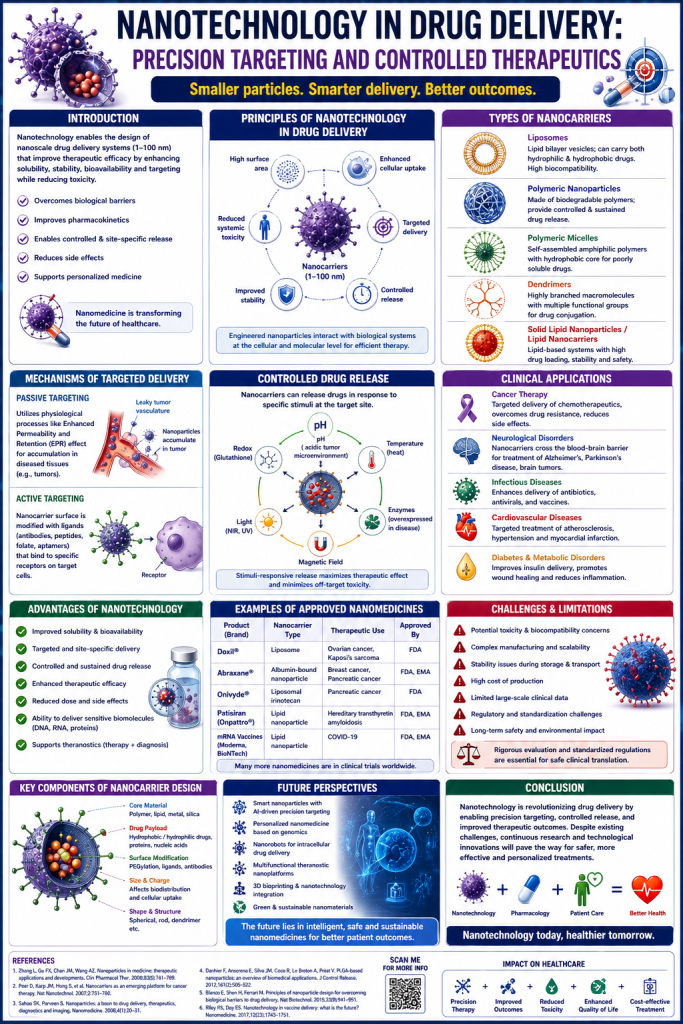
Nanotechnology has emerged as a transformative paradigm in modern pharmaceutical sciences, particularly in the design of advanced drug delivery systems capable of precise targeting and controlled therapeutic release. Traditional drug delivery approaches often suffer from limitations such as poor bioavailability, systemic toxicity, rapid drug degradation, and non-specific distribution in biological tissues. Nanotechnology-based drug delivery systems employ nanoscale materials—typically ranging from 1 to 100 nanometers—to encapsulate, transport, and release therapeutic agents in a controlled and site-specific manner. These nanosystems include liposomes, polymeric nanoparticles, dendrimers, micelles, and lipid nanoparticles, each possessing unique physicochemical properties that enhance drug solubility, stability, and therapeutic efficacy. Furthermore, nanocarriers can overcome biological barriers, improve intracellular drug delivery, and enable targeted treatment of diseases such as cancer, neurological disorders, and infectious diseases. This review provides a comprehensive overview of nanotechnology in drug delivery, including its underlying mechanisms, types of nanocarriers, clinical applications, and emerging innovations. Additionally, the article discusses the challenges associated with nanomedicine, including toxicity concerns, regulatory complexities, and large-scale manufacturing limitations. The continued advancement of nanotechnology is expected to significantly reshape pharmaceutical therapeutics by enabling highly precise and personalized drug delivery systems.
Keywords: Nanotechnology, nanoparticle drug delivery, nanocarriers, targeted therapeutics, nanomedicine, controlled drug release
1. Introduction
Drug delivery systems play a critical role in determining the pharmacokinetics, pharmacodynamics, and therapeutic efficacy of pharmaceutical compounds. Conventional drug delivery methods often face significant challenges such as poor solubility, rapid drug clearance, non-specific biodistribution, and dose-related toxicity.
Nanotechnology has emerged as a powerful tool for addressing these limitations by enabling the design of nanoscale drug carriers that can deliver therapeutic molecules with greater precision and efficiency. Nanoparticles can be engineered to carry drugs directly to diseased tissues while minimizing exposure to healthy cells.
Nanotechnology in medicine, commonly referred to as nanomedicine, has significantly expanded the possibilities of targeted therapy and personalized treatment strategies. Nanocarriers are capable of transporting drugs across biological barriers, improving cellular uptake, and controlling the rate of drug release within the body. (Jopir)
These capabilities have made nanotechnology one of the most promising fields in pharmaceutical innovation.
2. Principles of Nanotechnology-Based Drug Delivery
Nanotechnology-based drug delivery relies on nanoscale materials designed to improve the transport and therapeutic action of pharmaceutical agents. Nanocarriers typically measure between 1 and 100 nanometers, enabling them to interact efficiently with biological systems at the molecular and cellular levels. (Jopir)
The effectiveness of nanocarrier systems arises from several unique physicochemical properties:
- high surface-to-volume ratio
- enhanced cellular penetration
- controllable drug release mechanisms
- tunable surface properties for targeting specific tissues
These properties allow nanoparticles to encapsulate therapeutic molecules and protect them from degradation while delivering them to specific biological targets.
Nanotechnology-based systems also improve the pharmacokinetic profile of drugs by enhancing absorption, prolonging circulation time, and increasing bioavailability. (DrugBank Blog)
3. Types of Nanocarriers Used in Drug Delivery
Several types of nanoscale carriers have been developed to transport therapeutic agents within the body.
3.1 Liposomes
Liposomes are spherical vesicles composed of lipid bilayers that can encapsulate both hydrophilic and hydrophobic drugs. Liposomal drug delivery systems are widely used in cancer therapy due to their ability to improve drug targeting and reduce systemic toxicity. (MDPI)
Their biocompatibility and structural similarity to biological membranes make them highly effective drug delivery vehicles.
3.2 Polymeric Nanoparticles
Polymeric nanoparticles are composed of biodegradable polymers that can encapsulate drugs within their matrix or adsorb them onto their surface. These carriers provide controlled and sustained drug release and can be engineered with specific surface modifications to target particular tissues.
Their tunable size, shape, and surface charge make polymeric nanoparticles versatile tools for drug delivery applications. (American Chemical Society Publications)
3.3 Polymeric Micelles
Polymeric micelles are nanoscale structures formed by amphiphilic block copolymers that self-assemble in aqueous environments. These micelles contain a hydrophobic core capable of encapsulating poorly soluble drugs, particularly anticancer agents.
Their small size and long circulation time allow them to accumulate preferentially in tumor tissues. (PMC)
3.4 Dendrimers
Dendrimers are highly branched synthetic macromolecules with well-defined three-dimensional structures. These molecules possess multiple surface functional groups that can be used to attach drugs, targeting ligands, or imaging agents.
Their precise structural control makes them promising candidates for targeted drug delivery and diagnostic applications.
3.5 Solid Lipid Nanoparticles and Lipid Nanocarriers
Solid lipid nanoparticles and lipid-based nanocarriers are widely used in modern pharmaceutical formulations, including vaccines and anticancer drugs. These carriers offer high drug loading capacity and improved stability compared with conventional formulations.
Lipid nanoparticles have gained global recognition for their role in delivering mRNA-based vaccines and other advanced therapeutics. (PMC)
4. Mechanisms of Targeted Drug Delivery
Nanotechnology enables two primary mechanisms of targeted drug delivery:
4.1 Passive Targeting
Passive targeting occurs through physiological processes such as the enhanced permeability and retention (EPR) effect, which allows nanoparticles to accumulate in tumor tissues due to their leaky vasculature.
This mechanism is particularly useful in cancer therapy, where nanoparticles can concentrate therapeutic drugs within tumor microenvironments.
4.2 Active Targeting
Active targeting involves modifying the surface of nanoparticles with ligands, antibodies, or peptides that bind specifically to receptors expressed on target cells.
This strategy allows nanoparticles to selectively bind to diseased cells, improving therapeutic precision while reducing damage to healthy tissues.
Surface-modified nanocarriers have demonstrated improved cellular uptake and enhanced therapeutic efficacy in several experimental studies. (MDPI)
5. Controlled Drug Release Systems
One of the most important advantages of nanotechnology in drug delivery is its ability to enable controlled drug release.
Nanocarriers can be engineered to release drugs in response to specific physiological stimuli, such as:
- pH changes
- temperature variations
- enzymatic activity
- magnetic or light signals
Stimuli-responsive nanoparticles enable drugs to be released only at the disease site, thereby maximizing therapeutic effects while minimizing systemic toxicity.
Controlled drug release systems also prolong drug circulation time and reduce the frequency of drug administration.
6. Clinical Applications of Nanotechnology in Drug Delivery
Nanotechnology-based drug delivery systems have demonstrated significant potential in several medical fields.
6.1 Cancer Therapy
Cancer treatment is one of the most advanced applications of nanomedicine. Nanoparticles can deliver chemotherapeutic agents directly to tumor cells, improving treatment efficacy and reducing side effects.
Targeted nanocarriers can also overcome drug resistance mechanisms in cancer cells. (PMC)
6.2 Neurological Disorders
Nanoparticles have shown promise in delivering drugs across the blood-brain barrier, which represents a major challenge in treating neurological diseases.
Nanocarriers may enable effective treatment of conditions such as Alzheimer’s disease, Parkinson’s disease, and brain tumors.
6.3 Infectious Diseases
Nanotechnology-based delivery systems can enhance the therapeutic effectiveness of antimicrobial agents by improving drug stability and targeted delivery to infected tissues.
6.4 Cardiovascular and Metabolic Diseases
Nanocarriers are also being investigated for targeted treatment of cardiovascular diseases, diabetes, and inflammatory disorders.
7. Challenges and Limitations
Despite their significant potential, nanotechnology-based drug delivery systems face several challenges.
7.1 Toxicity and Biocompatibility
Some nanomaterials may exhibit toxicity or trigger immune responses within the body. Ensuring biocompatibility remains a critical aspect of nanomedicine development.
7.2 Manufacturing and Scalability
Large-scale manufacturing of nanomedicines presents technical challenges related to reproducibility, stability, and cost.
7.3 Regulatory and Safety Concerns
Regulatory frameworks for nanomedicines are still evolving, and standardized evaluation methods are needed to ensure safety and quality.
8. Future Perspectives
The future of nanotechnology in drug delivery is closely linked to advances in biotechnology, artificial intelligence, and precision medicine.
Emerging innovations include:
- smart nanoparticles responsive to biological signals
- multifunctional nanocarriers combining therapy and diagnostics (theranostics)
- nanorobotic drug delivery systems
- personalized nanomedicine guided by genomic data
These technologies may enable highly precise therapeutic interventions tailored to individual patient needs.
9. Conclusion
Nanotechnology represents a revolutionary advancement in drug delivery science, offering unprecedented opportunities for precision targeting and controlled therapeutic release. By improving drug stability, enhancing bioavailability, and enabling targeted delivery to diseased tissues, nanocarrier systems have the potential to significantly improve treatment outcomes for numerous diseases.
Although challenges remain in terms of safety, regulatory approval, and large-scale production, continued advances in nanomedicine are expected to transform pharmaceutical therapeutics and usher in a new era of personalized medicine.
References
- Yusuf A., et al. (2023). Nanoparticles as drug delivery systems: A review. Polymers. (PMC)
- Malik S., et al. (2023). Emerging applications of nanotechnology in healthcare and drug delivery. Nanomedicine Review. (PMC)
- Zhang Y., et al. (2014). Polymeric micelles for targeted drug delivery. International Journal of Nanomedicine. (PMC)
- Cheng Z., et al. (2025). Liposomes and lipid nanoparticles in cancer therapy. Biomedical Reports. (PMC)
- Yao Y., et al. (2020). Nanoparticle-based drug delivery in cancer therapy. Frontiers in Pharmacology. (PMC)
- Islam S., et al. (2025). Advances in nanoparticles for targeted drug delivery. Journal of Nanomedicine. (ScienceDirect)
- Egwu C.O., et al. (2024). Nanomaterials in drug delivery systems. Molecules. (MDPI)
- Hong L., et al. (2023). Nanocarriers for targeted cancer therapy. RSC Advances. (RSC Publishing)