Achieving Pharmaceutical Self-Reliance: Strategies for India’s Active Pharmaceutical Ingredient Sovereignty
Abstract
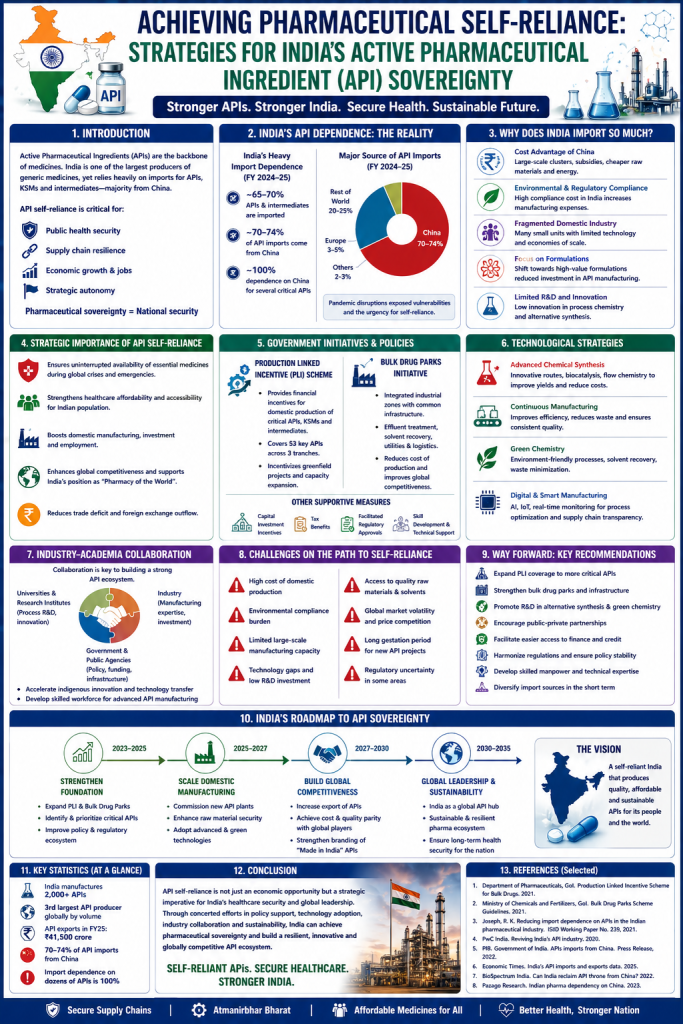
Active pharmaceutical ingredients (APIs) form the chemical backbone of modern drug formulations and are essential for sustaining national pharmaceutical production. India has emerged as one of the world’s largest manufacturers of generic medicines and APIs; however, the country remains heavily dependent on imports of key starting materials (KSMs), intermediates, and APIs from foreign suppliers. This structural dependence became particularly evident during the COVID-19 pandemic, when global supply disruptions exposed vulnerabilities in pharmaceutical supply chains. Approximately 65–70% of India’s APIs and intermediates are imported, with China accounting for the majority of these imports, raising concerns about supply security and strategic autonomy. (ACTIZA Industry)
In response, the Government of India has launched multiple initiatives—including the Production Linked Incentive (PLI) scheme for bulk drugs and the establishment of bulk drug parks—to promote domestic API manufacturing and reduce import dependency. These policies aim to rebuild indigenous production capacity, strengthen pharmaceutical supply chain resilience, and enhance India’s position as a global pharmaceutical leader. This review examines the current landscape of API manufacturing in India, analyzes structural challenges affecting domestic production, and evaluates policy strategies aimed at achieving pharmaceutical self-reliance. The article also explores technological innovations, regulatory reforms, and industry collaboration required to strengthen India’s pharmaceutical sovereignty in the coming decades.
Keywords: Active pharmaceutical ingredients, pharmaceutical sovereignty, API manufacturing, pharmaceutical policy, supply chain resilience, India
1. Introduction
The pharmaceutical industry represents a critical component of global healthcare systems, ensuring the availability of medicines required for disease prevention, diagnosis, and treatment. India occupies a unique position within this ecosystem as one of the largest producers of generic medicines and a major exporter of affordable pharmaceuticals worldwide. The country manufactures more than 2,000 APIs and is considered the third-largest API producer globally by volume. (GCCPL)
Despite this manufacturing strength, India’s pharmaceutical sector remains structurally dependent on imported APIs and intermediates. Over the past three decades, the share of API imports from China has increased dramatically due to cost advantages and economies of scale in Chinese chemical manufacturing. (PwC)
The COVID-19 pandemic highlighted the risks associated with such dependence. Disruptions in global supply chains threatened the availability of essential medicines and underscored the strategic importance of domestic pharmaceutical manufacturing capacity.
In response, policymakers have begun emphasizing pharmaceutical self-reliance, often framed within the broader national initiative of Atmanirbhar Bharat (self-reliant India). Achieving API sovereignty is therefore not only an industrial objective but also a matter of national health security.
2. Global Pharmaceutical Supply Chains and India’s Position
Modern pharmaceutical supply chains are highly globalized, involving multiple stages of production and distribution. These stages include raw material procurement, synthesis of key starting materials, API manufacturing, formulation development, and final drug distribution.
India’s pharmaceutical industry has historically focused on formulation manufacturing, where finished medicines are produced using APIs sourced from global suppliers. While this strategy enabled India to become a global leader in generic drug manufacturing, it also reduced domestic API production capacity.
Currently, a significant proportion of India’s pharmaceutical raw materials are imported. In fiscal year 2024–2025, India imported APIs and drug intermediates worth billions of dollars, with China accounting for approximately 70–74% of these imports. (ETPharma.com)
In several cases, India depends entirely on imports for certain APIs. Studies indicate that for dozens of APIs, import dependence on China can reach 100%, highlighting the vulnerability of domestic pharmaceutical supply chains. (ResearchGate)
3. Drivers of India’s API Import Dependence
Multiple factors contributed to India’s growing reliance on imported APIs over the past three decades.
3.1 Cost Competitiveness
Chinese chemical manufacturers achieved significant cost advantages through large-scale industrial clusters, government subsidies, and advanced manufacturing infrastructure. As a result, Chinese APIs often became significantly cheaper than domestically produced alternatives.
3.2 Environmental and Regulatory Constraints
API manufacturing involves complex chemical synthesis processes that generate industrial waste. Stricter environmental regulations in India increased compliance costs, leading some domestic manufacturers to shift production overseas.
3.3 Fragmented Domestic Manufacturing
India’s API manufacturing sector historically consisted of numerous small and medium-scale enterprises with limited technological capabilities and economies of scale.
3.4 Focus on Formulation Manufacturing
Indian pharmaceutical companies increasingly focused on high-value formulation manufacturing and global generic drug exports, reducing investment in upstream API production.
4. Strategic Importance of API Self-Reliance
API sovereignty is increasingly recognized as a strategic priority for national healthcare security. Several key factors underscore the importance of strengthening domestic API manufacturing.
4.1 Public Health Security
Dependence on external suppliers for essential pharmaceutical ingredients poses risks during global crises, including pandemics, geopolitical conflicts, and supply chain disruptions.
4.2 Economic and Industrial Development
Expanding domestic API manufacturing can stimulate investment, technological innovation, and employment within the pharmaceutical sector.
4.3 Supply Chain Resilience
Diversifying API manufacturing capacity within India can reduce supply chain vulnerabilities and ensure uninterrupted production of essential medicines.
4.4 Global Pharmaceutical Leadership
Strengthening API manufacturing capabilities can enhance India’s competitiveness in global pharmaceutical markets and support the country’s role as the “pharmacy of the world.”
5. Government Initiatives for API Self-Reliance
Recognizing the strategic importance of API sovereignty, the Government of India has introduced several initiatives aimed at strengthening domestic manufacturing capacity.
5.1 Production Linked Incentive (PLI) Scheme
The PLI scheme for bulk drugs was launched to promote domestic production of critical APIs, KSMs, and drug intermediates. The scheme provides financial incentives to pharmaceutical companies that invest in domestic API manufacturing and increase production volumes. (makeinindia.com)
The program covers dozens of priority APIs and supports greenfield manufacturing projects through fiscal incentives.
5.2 Bulk Drug Parks Initiative
Another major policy initiative is the establishment of dedicated bulk drug parks, which provide common infrastructure facilities such as solvent recovery systems, waste treatment plants, and logistics networks.
These parks aim to reduce manufacturing costs and improve competitiveness of domestic API producers. (Pharma Lab Magazine)
5.3 Infrastructure and Investment Incentives
Complementary policies include financial incentives for capital investment, tax benefits, and regulatory support to encourage pharmaceutical companies to establish domestic manufacturing facilities.
6. Technological Strategies for API Sovereignty
Achieving pharmaceutical self-reliance requires not only policy support but also technological innovation.
6.1 Advanced Chemical Synthesis
Innovative synthetic chemistry techniques can improve efficiency and reduce the cost of API production.
6.2 Continuous Manufacturing
Continuous manufacturing technologies offer significant advantages over traditional batch manufacturing, including improved process efficiency, reduced waste, and enhanced product consistency.
6.3 Green Chemistry
Adopting environmentally sustainable manufacturing practices can reduce environmental impact and regulatory barriers.
6.4 Digital Manufacturing
Artificial intelligence and digital process monitoring technologies can optimize manufacturing processes and improve supply chain transparency.
7. Industry–Academia Collaboration
Collaboration between pharmaceutical companies, research institutions, and government agencies is essential for strengthening India’s API manufacturing ecosystem.
Universities and research institutions can contribute through:
- advanced process chemistry research
- development of innovative synthesis routes
- training of skilled pharmaceutical scientists
Public-private partnerships can accelerate translation of research innovations into commercial manufacturing.
8. Challenges in Achieving API Sovereignty
Despite significant progress, several challenges remain.
8.1 Cost Competitiveness
Domestic API manufacturers must compete with established global suppliers that benefit from large-scale production capabilities.
8.2 Environmental Compliance
Chemical manufacturing facilities must comply with stringent environmental regulations, increasing operational costs.
8.3 Skilled Workforce
Advanced pharmaceutical manufacturing requires highly trained chemical engineers and pharmaceutical scientists.
8.4 Global Market Dynamics
Global pharmaceutical supply chains remain highly interconnected, making complete self-sufficiency difficult to achieve.
9. Future Outlook
India’s long-term strategy for pharmaceutical self-reliance will likely involve a balanced approach that combines domestic manufacturing expansion with global supply chain diversification.
Future policy directions may include:
- expansion of PLI incentives for critical APIs
- strengthening API research and innovation ecosystems
- investment in green pharmaceutical manufacturing
- integration of digital technologies in supply chain management
These measures could position India as a global leader not only in generic drug manufacturing but also in advanced pharmaceutical ingredient production.
10. Conclusion
Achieving pharmaceutical self-reliance represents a strategic imperative for India’s healthcare security and industrial development. While the country remains a global leader in pharmaceutical formulations, dependence on imported APIs poses significant risks to supply chain stability.
Government initiatives such as the PLI scheme and bulk drug parks represent important steps toward rebuilding domestic API manufacturing capacity. However, long-term success will require sustained investment in technological innovation, industrial infrastructure, regulatory reforms, and workforce development.
By strengthening its upstream pharmaceutical manufacturing capabilities, India can enhance supply chain resilience, improve global competitiveness, and ensure reliable access to essential medicines for both domestic and international populations.
References
- Joseph R.K. (2021). Reducing import dependence on APIs in the Indian pharmaceutical industry. Institute for Studies in Industrial Development. (ISID)
- Government of India. APIs imports from China statistics. (Press Information Bureau)
- Economic Times. India’s API import and export statistics. (ETPharma.com)
- Pazago Research. India’s pharmaceutical dependence on Chinese APIs. (Pazago Blog)
- PwC India. Reviving India’s API industry. (PwC)
- Department of Pharmaceuticals. Production Linked Incentive scheme for bulk drugs. (makeinindia.com)
- PharmaNow. Impact of PLI schemes on API manufacturing. (Pharma Now)
- BioSpectrum India. India’s API manufacturing sector analysis. (BioSpectrum India)
- GCCPL Industry Report. India as a global API manufacturing hub. (GCCPL)