Indigenous Drug Discovery in India: Opportunities for New Chemical Entities and Global Innovation
Abstract
India has emerged as one of the world’s leading producers of generic medicines; however, the country’s contribution to innovative drug discovery and development of New Chemical Entities (NCEs) has historically remained limited compared with major pharmaceutical innovation hubs. Over the past two decades, significant efforts have been made to strengthen India’s drug discovery ecosystem through investment in research infrastructure, expansion of pharmaceutical R&D programs, and increasing collaboration between academia and industry. The introduction of product patent protection in 2005 and the growth of biotechnology and computational drug discovery platforms have further stimulated indigenous innovation in the pharmaceutical sector. Despite these developments, challenges such as high research costs, long development timelines, regulatory complexity, and limited venture capital investment continue to constrain the growth of NCE discovery in India. This review analyzes the current landscape of indigenous drug discovery in India, highlighting the evolution of pharmaceutical R&D capabilities, opportunities for innovation in NCE development, and strategies for strengthening India’s global role in pharmaceutical innovation. The paper also explores emerging research trends including open-source drug discovery, artificial intelligence–assisted drug design, and the integration of traditional medicinal knowledge with modern pharmaceutical science. Strengthening indigenous drug discovery capabilities will be essential for transforming India from a generics powerhouse into a globally recognized innovation-driven pharmaceutical economy.
Keywords: Indigenous drug discovery, New Chemical Entities, pharmaceutical innovation, India, translational research, drug development
1. Introduction
Drug discovery represents one of the most complex and resource-intensive processes in modern biomedical research. The development of a new therapeutic molecule typically requires more than a decade of research and billions of dollars in investment before reaching the market. Historically, pharmaceutical innovation has been concentrated in developed countries such as the United States, Germany, Japan, and the United Kingdom.
India’s pharmaceutical industry has traditionally focused on the production of generic medicines, particularly after the introduction of the Indian Patents Act of 1970, which permitted process patents but not product patents for pharmaceuticals. This legal framework enabled Indian pharmaceutical companies to manufacture affordable versions of patented drugs using alternative synthesis methods.
However, India’s participation in innovative drug discovery remained limited until the late twentieth century. Prior to the mid-1990s, India’s presence in NCE discovery and global pharmaceutical innovation was relatively small. (American Chemical Society Publications)
The implementation of product patents in 2005 under the Trade-Related Aspects of Intellectual Property Rights (TRIPS) agreement significantly altered the pharmaceutical innovation landscape. This policy change encouraged Indian pharmaceutical companies to invest more heavily in research and development aimed at discovering novel therapeutic molecules.
Today, India is gradually building a robust ecosystem for indigenous drug discovery, supported by pharmaceutical companies, academic institutions, biotechnology startups, and government research organizations.
2. Evolution of Drug Discovery Research in India
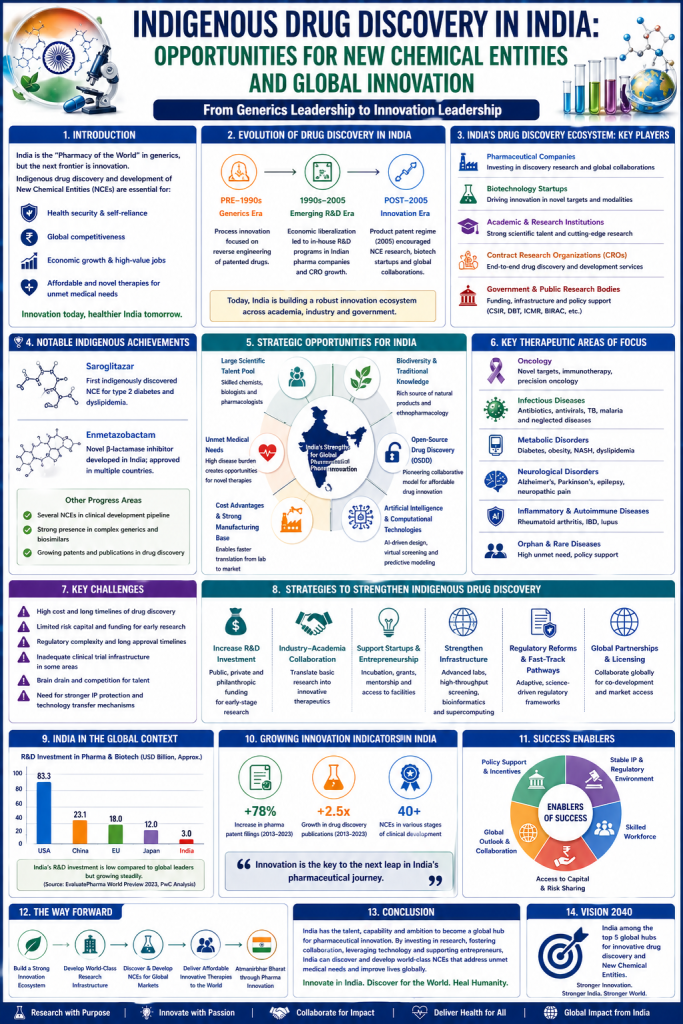
The evolution of drug discovery in India can be broadly divided into three phases.
2.1 Pre-1990 Era: Process Innovation and Generics
Before economic liberalization in the 1990s, Indian pharmaceutical companies focused primarily on reverse engineering of patented drugs. The absence of product patents enabled firms to produce generic medicines using alternative manufacturing processes.
This strategy allowed India to become a global leader in affordable generic medicines but did not encourage significant investment in novel drug discovery.
2.2 Post-Liberalization Era: Emergence of R&D Programs
Following economic reforms and globalization in the 1990s, several major Indian pharmaceutical companies began establishing in-house research programs dedicated to drug discovery.
Companies such as Ranbaxy, Dr. Reddy’s Laboratories, Glenmark, and Zydus initiated programs to discover new therapeutic molecules targeting diseases such as diabetes, cancer, and infectious diseases. (Pharma Focus Asia)
These programs marked the first major attempt by Indian firms to enter the global pharmaceutical innovation landscape.
2.3 Post-2005 Era: Innovation under the Product Patent Regime
The introduction of product patents in India in 2005 significantly strengthened incentives for pharmaceutical innovation.
Indian pharmaceutical firms began investing more heavily in NCE research programs, while biotechnology startups and contract research organizations expanded their role in drug discovery and development.
Today, India’s drug discovery ecosystem includes pharmaceutical companies, academic research institutes, biotechnology startups, and contract research organizations that collectively contribute to global pharmaceutical innovation.
3. Notable Achievements in Indigenous Drug Discovery
Although India’s contribution to global NCE discovery remains modest compared with leading pharmaceutical nations, several important milestones have been achieved.
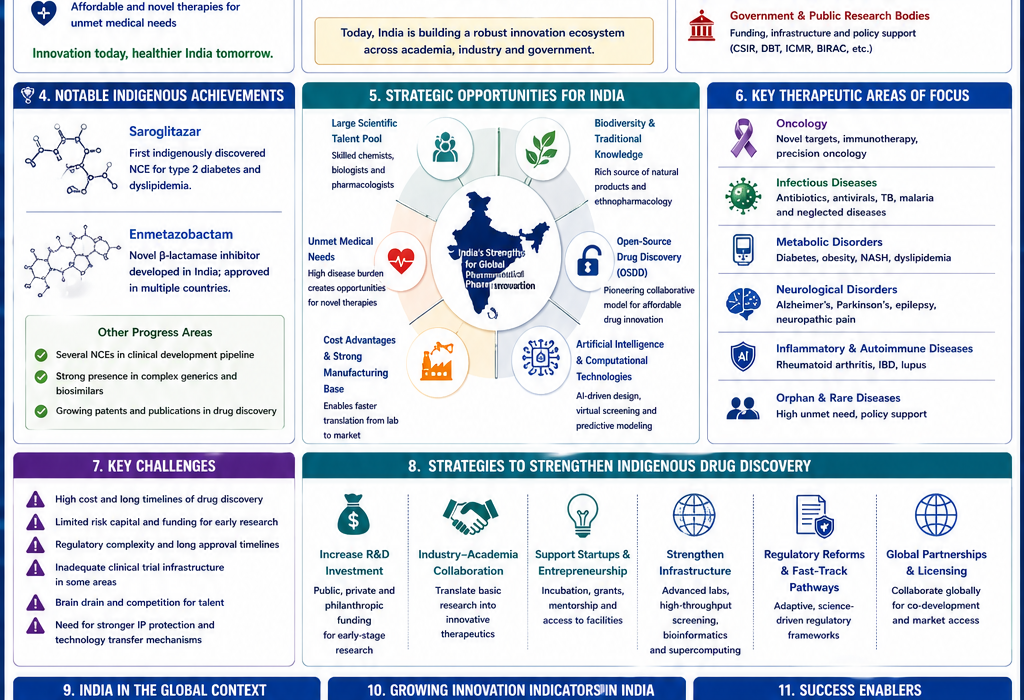
One of the most notable examples is Saroglitazar, an antidiabetic drug discovered and developed by an Indian pharmaceutical company. It represents one of the first indigenously developed NCEs to reach the market in India.
Another major achievement is Enmetazobactam, a novel β-lactamase inhibitor antibiotic developed by an Indian pharmaceutical research team and later approved by regulatory authorities in multiple countries. (Wikipedia)
These examples demonstrate that Indian pharmaceutical researchers possess the scientific capabilities required to contribute to global pharmaceutical innovation.
4. Role of Contract Research Organizations in Drug Discovery
Contract research organizations (CROs) have emerged as critical players in India’s drug discovery ecosystem. These organizations provide specialized research services to global pharmaceutical companies, including:
- target identification
- lead optimization
- preclinical testing
- clinical trial management
The growth of CROs in India has been driven by the availability of highly skilled scientists, advanced research infrastructure, and relatively lower operational costs.
Many CROs now provide end-to-end drug discovery services, supporting global pharmaceutical companies throughout the drug development process. (Syngene International Ltd)
5. Emerging Opportunities for Indigenous Drug Discovery
India possesses several strategic advantages that could support the growth of indigenous pharmaceutical innovation.
5.1 Large Scientific Workforce
India produces thousands of pharmaceutical scientists, chemists, and biomedical researchers each year, providing a strong human resource base for drug discovery.
5.2 Biodiversity and Natural Products
India’s rich biodiversity offers significant opportunities for natural product-based drug discovery. Traditional medicinal knowledge systems such as Ayurveda provide valuable insights into potential therapeutic compounds.
Traditional knowledge has historically contributed to the discovery of many modern medicines derived from plant-based compounds. (ashdin.com)
5.3 Open-Source Drug Discovery Initiatives
India has pioneered innovative collaborative research models such as the Open Source Drug Discovery (OSDD) program led by the Council of Scientific and Industrial Research (CSIR).
This initiative brings together global researchers to develop affordable drugs for neglected diseases using open-source collaboration models. (Wikipedia)
5.4 Advanced Computational Drug Design
The integration of artificial intelligence, machine learning, and high-performance computing is transforming modern drug discovery.
Recent investments in supercomputing infrastructure and computational biology research are enabling Indian scientists to accelerate molecular modeling and drug design processes. (The Times of India)
6. Challenges Facing Indigenous Drug Discovery in India
Despite promising opportunities, several structural challenges continue to limit India’s progress in innovative drug discovery.
6.1 High Cost of Drug Development
Drug discovery and development require substantial financial investment. The high risk associated with NCE development often discourages private investors and pharmaceutical companies.
6.2 Limited Venture Capital for Biomedical Research
India’s biotechnology startup ecosystem remains relatively underfunded compared with major innovation hubs such as the United States and Europe.
6.3 Long Development Timelines
Developing a new drug typically requires more than 10–15 years of research and clinical trials, creating financial and operational challenges for smaller pharmaceutical companies.
6.4 Regulatory and Infrastructure Constraints
Clinical trial infrastructure, regulatory efficiency, and intellectual property enforcement remain areas requiring further improvement.
7. Government Initiatives Supporting Indigenous Drug Discovery
The Government of India has launched several initiatives aimed at strengthening pharmaceutical innovation.
These initiatives include:
- funding programs for pharmaceutical research
- expansion of biotechnology research infrastructure
- industry-academia collaboration programs
- support for biotechnology startups
Recent initiatives also emphasize building a comprehensive ecosystem for pharmaceutical innovation through collaboration between academic institutions, research organizations, and industry partners. (www.pharmabiz.com)
8. Strategies for Strengthening India’s Drug Discovery Ecosystem
To achieve global leadership in pharmaceutical innovation, India must implement several strategic reforms.
8.1 Increasing R&D Investment
Greater public and private investment in pharmaceutical R&D is essential for sustaining indigenous drug discovery programs.
8.2 Strengthening Academic Research
Universities and national research institutions should play a more active role in early-stage drug discovery.
8.3 Encouraging Industry–Academia Collaboration
Collaborative research programs between academic scientists and pharmaceutical companies can accelerate translational research.
8.4 Promoting Biotechnology Startups
Government support for biotechnology startups can stimulate innovation in drug discovery technologies.
9. Future Outlook
The future of indigenous drug discovery in India is likely to be shaped by advances in biotechnology, artificial intelligence, and personalized medicine.
Emerging trends include:
- AI-driven drug discovery
- precision medicine and pharmacogenomics
- nanotechnology-based therapeutics
- gene and cell therapy development
These technologies may enable Indian scientists to accelerate the discovery of novel therapeutic molecules and compete with global pharmaceutical innovators.
10. Conclusion
India stands at a critical juncture in its pharmaceutical evolution. While the country has established itself as a global leader in generic drug manufacturing, the next phase of growth will depend on strengthening indigenous drug discovery capabilities.
Developing innovative NCEs requires sustained investment in research infrastructure, scientific talent, and collaborative innovation ecosystems. By leveraging its scientific workforce, biodiversity resources, and emerging digital technologies, India has the potential to become a major global hub for pharmaceutical innovation.
Strengthening indigenous drug discovery will not only enhance India’s global competitiveness but also contribute to the development of affordable therapies for diseases affecting millions worldwide.
References
- Balganesh T. Drug discovery research in India: Current state and future prospects. Journal of Biosciences. (PMC)
- Maiti S. Innovative drug discovery research by pharmaceutical companies in India. Journal of Medicinal Chemistry. (American Chemical Society Publications)
- Abrol D. Pharmaceutical innovation and in-house R&D in Indian firms. Institute for Studies in Industrial Development. (ISID)
- Drug discovery collaborations in India’s pharmaceutical industry. PharmaFocus Asia. (Pharma Focus Asia)
- Indigenous antibiotic development in India: Enmetazobactam discovery. (Wikipedia)
- Open Source Drug Discovery initiative. (Wikipedia)
- Role of traditional knowledge in drug development. (ashdin.com)
- Evolution of contract research organizations in Indian drug discovery. (Syngene International Ltd)
- Government initiatives supporting pharmaceutical innovation in India. (www.pharmabiz.com)