
Pharmaceutical Industry in India: The Rise of a Global Healthcare Powerhouse
By Author Devanssh Mehta Style
Introduction
The pharmaceutical industry in India represents one of the most remarkable success stories in modern industrial and healthcare development. From being dependent on imported medicines in the decades following independence to becoming one of the world’s leading pharmaceutical manufacturing and export hubs, India has undergone a profound transformation.
Today, the Indian pharmaceutical sector occupies a strategic position at the intersection of healthcare, science, manufacturing, innovation, economics, and public policy. The industry supports domestic healthcare needs while simultaneously serving global markets through affordable medicines, vaccines, active pharmaceutical ingredients (APIs), biotechnology products, and increasingly sophisticated research capabilities.
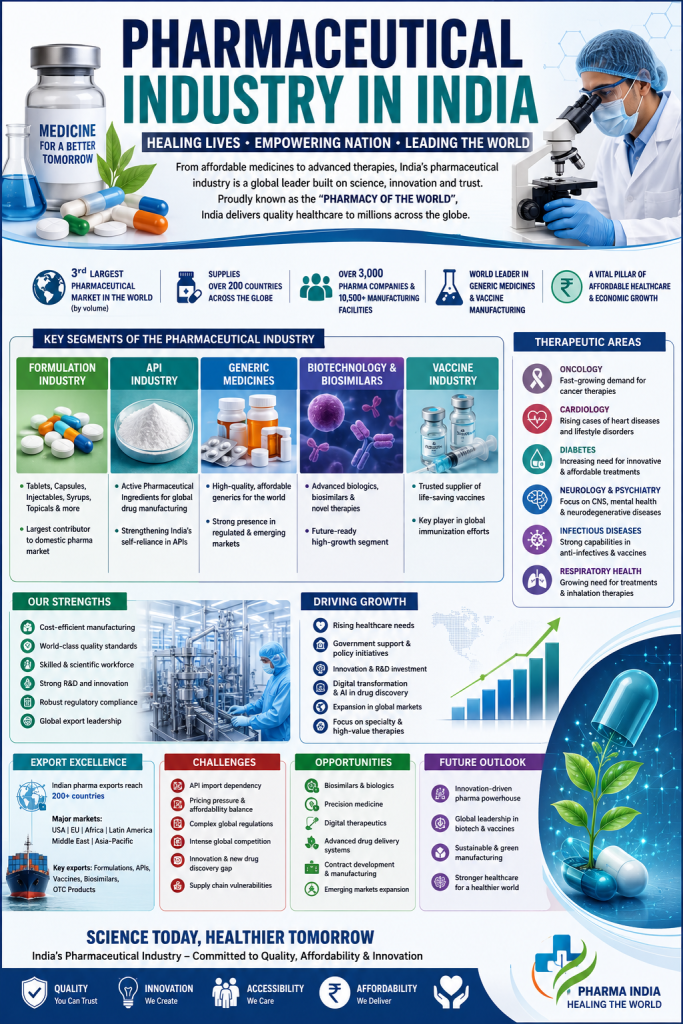
India is often referred to as the “Pharmacy of the World” because of its ability to produce high-quality, cost-effective medicines at scale and supply them across developed and developing economies.
This article presents a detailed analysis of the pharmaceutical industry in India, examining its evolution, market structure, growth drivers, opportunities, challenges, and future outlook.
Historical Evolution of the Indian Pharmaceutical Industry
The Early Foundation
After independence, India faced severe dependence on imported drugs and multinational corporations controlled a significant portion of the domestic market.
Major issues included:
- High medicine prices
- Limited domestic manufacturing
- Low accessibility
- Weak research capabilities
The Patent Reform Era
A major turning point came with the Indian patent reforms and policy support that enabled domestic companies to manufacture affordable formulations and build strong manufacturing capabilities.
This period led to:
- Expansion of generic medicines
- Development of indigenous manufacturing
- Emergence of domestic pharmaceutical companies
Liberalization and Global Expansion
Economic liberalization accelerated:
- Foreign investment
- Export competitiveness
- Contract manufacturing
- Global regulatory compliance
- Research outsourcing
Indian companies gradually entered regulated markets across North America, Europe, Asia, Africa, and Latin America.
Current Landscape of the Indian Pharmaceutical Industry
The pharmaceutical sector has evolved into a diversified ecosystem consisting of:
- Generic medicines
- Branded formulations
- Biotechnology
- Vaccines
- Biosimilars
- APIs
- Contract manufacturing
- Research services
- Digital therapeutics
India has emerged as a major pharmaceutical manufacturing center with thousands of manufacturing facilities and a large scientific workforce.
Structure of the Pharmaceutical Industry in India
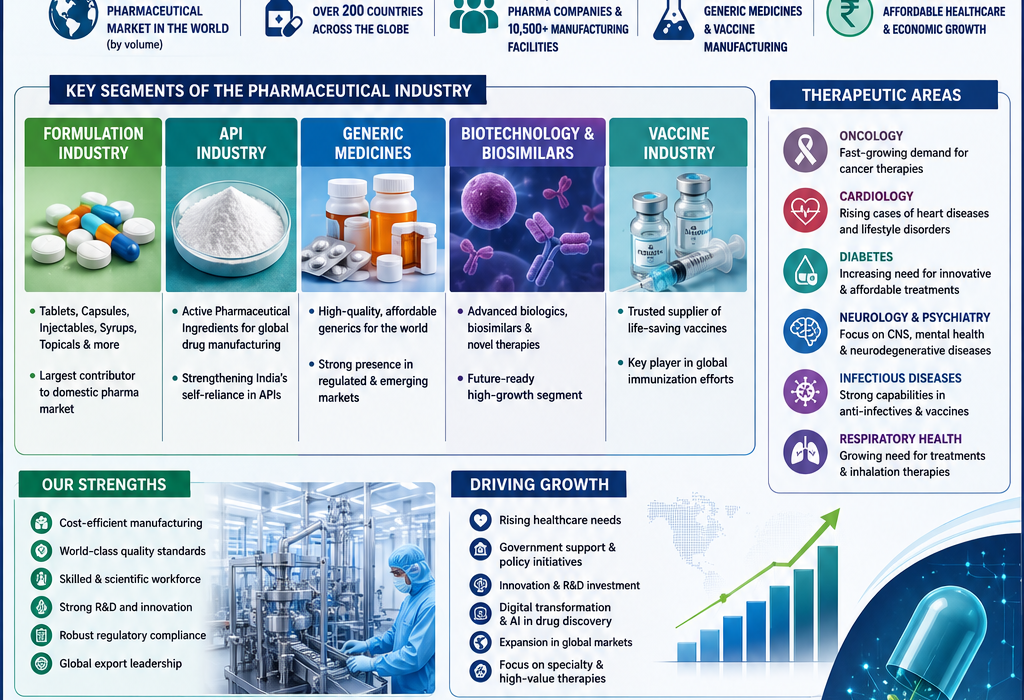
1. Formulation Industry
Formulations constitute the finished dosage forms delivered to patients.
Major dosage categories:
- Tablets
- Capsules
- Injectables
- Syrups
- Topical products
- Controlled-release systems
The formulation segment dominates domestic pharmaceutical revenues.
2. Active Pharmaceutical Ingredient (API) Industry
APIs are the biologically active components of medicines.
India manufactures APIs across:
- Antibiotics
- Cardiovascular agents
- Anti-diabetic agents
- Oncology products
- Central nervous system drugs
API self-reliance has become a strategic national priority.
3. Generic Medicines Industry
Generic medicines remain India’s strongest competitive advantage.
Advantages include:
- Cost efficiency
- Large-scale manufacturing
- Global regulatory acceptance
- Market accessibility
Indian generic manufacturers supply medicines worldwide.
4. Biotechnology and Biosimilars
Biopharmaceuticals are becoming increasingly important.
Major categories include:
- Monoclonal antibodies
- Recombinant proteins
- Cell-based therapies
- Biosimilars
This segment is expected to become a major growth engine.
5. Vaccine Industry
India has become a critical global vaccine manufacturing destination.
Capabilities include:
- Pediatric vaccines
- Adult vaccines
- Viral vaccines
- Combination vaccines
The vaccine ecosystem gained global recognition during recent public health emergencies.
Major Therapeutic Segments
Indian pharmaceutical growth is driven by multiple therapeutic categories.
Oncology
One of the fastest-growing segments.
Drivers:
- Rising cancer incidence
- Specialty medicine demand
- Targeted therapies
Cardiology
Growth supported by:
- Lifestyle disorders
- Aging population
- Preventive healthcare
Diabetes
India continues witnessing increasing demand for:
- Oral antidiabetics
- Insulin products
- Combination therapies
Neurology and Psychiatry
Emerging opportunities include:
- CNS therapeutics
- Mental health treatments
- Neurodegenerative disorders
Infectious Diseases
Traditional strength areas include:
- Anti-infectives
- Antivirals
- Vaccines
Pharmaceutical Manufacturing Excellence
India has developed extensive manufacturing infrastructure.
Key strengths include:
Scale
Large production capacities support global supply chains.
Cost Advantage
Competitive manufacturing economics remain a major differentiator.
Skilled Human Capital
Availability of:
- Pharmacologists
- Pharmacists
- Chemists
- Biotechnology professionals
- Regulatory experts
Quality Compliance
Indian facilities increasingly operate under international standards.
Pharmaceutical Research and Development
The future of Indian pharma depends on innovation.
Key R&D domains include:
Novel Drug Discovery
Focus on:
- New chemical entities
- New biological entities
Drug Delivery Technologies
Examples:
- Nanotechnology
- Sustained-release formulations
- Targeted delivery
Pharmacogenomics
Development of personalized treatment approaches.
Artificial Intelligence in Drug Development
Applications include:
- Molecule screening
- Clinical trial optimization
- Predictive analytics
Pharmaceutical Exports
India exports pharmaceutical products to numerous global markets.
Major export categories include:
- Generic formulations
- APIs
- Vaccines
- OTC products
Export competitiveness depends upon:
- Quality systems
- Regulatory approvals
- Manufacturing efficiency
Government Support and Policy Environment
Public policy plays a critical role in industry growth.
Major policy priorities include:
Domestic Manufacturing Expansion
Support for:
- API development
- Industrial clusters
- Infrastructure
Innovation Promotion
Encouragement for:
- Research institutions
- Startups
- Industry–academia collaboration
Healthcare Accessibility
Focus areas:
- Affordable medicines
- Public procurement
- Distribution systems
Emerging Trends Transforming Indian Pharma
Digital Transformation
Technology integration includes:
- Electronic medical systems
- Data-driven decision making
- Digital engagement
Precision Medicine
Patient-specific therapies are gaining importance.
Sustainable Manufacturing
Industry focus includes:
- Green chemistry
- Energy efficiency
- Waste reduction
Contract Development and Manufacturing
India is increasingly becoming a preferred outsourcing destination.
Major Challenges Facing the Industry
Despite rapid growth, structural challenges remain.
API Dependency
Supply chain concentration creates vulnerabilities.
Pricing Pressure
Balancing affordability and innovation remains difficult.
Regulatory Complexity
Global compliance standards continue evolving.
Competition
Growing competition from emerging manufacturing markets.
Innovation Gap
Transitioning from generics to discovery-driven innovation remains challenging.
SWOT Analysis
Strengths
- Global generic leadership
- Cost-efficient manufacturing
- Scientific workforce
- Strong export capabilities
Weaknesses
- Innovation limitations
- Supply chain dependency
- Regulatory complexity
Opportunities
- Biosimilars
- Precision medicine
- Digital healthcare
- Specialty pharmaceuticals
Threats
- Global competition
- Pricing regulations
- Geopolitical disruptions
Future Outlook: Indian Pharmaceutical Industry 2035
The future pharmaceutical ecosystem in India is expected to be defined by:
Innovation-led growth
Biotechnology leadership
Digital therapeutics
Advanced manufacturing
Pharmaceutical sovereignty
Export expansion
AI-assisted drug development
India’s pharmaceutical journey is likely to move beyond affordability toward becoming a global center for knowledge, innovation, and advanced healthcare solutions.
Strategic Recommendations
To sustain leadership, India should prioritize:
- Higher R&D investment
- Strong academia–industry collaboration
- Advanced manufacturing technologies
- Regulatory modernization
- Pharmaceutical education reform
- Export diversification
- Sustainable production systems
Conclusion
The pharmaceutical industry in India is no longer simply a manufacturing sector—it is becoming a strategic pillar of national development, healthcare security, scientific advancement, and global influence. Its evolution from reverse engineering to innovation-driven excellence demonstrates the capability of Indian science, entrepreneurship, and industrial policy.
The coming decade will determine whether India strengthens its position not only as the pharmacy of the world but also as one of the world’s foremost centers for pharmaceutical innovation, biotechnology leadership, and healthcare transformation.
For a pharmacologist, researcher, entrepreneur, or policy strategist, Indian pharmaceuticals remain one of the most dynamic and consequential sectors shaping the future of healthcare.